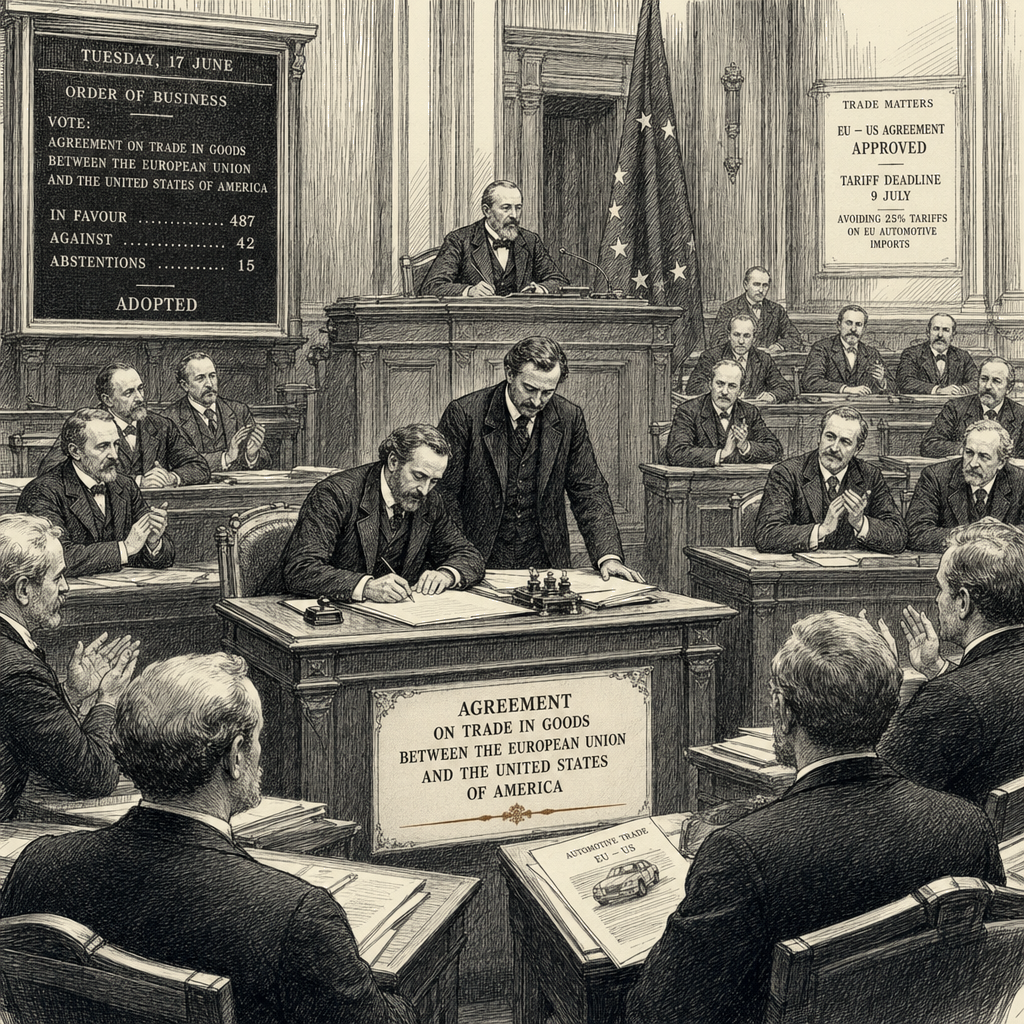
European lawmakers on Tuesday voted to approve their trade agreement with the United States, completing the parliament’s ratification step just weeks before a July 4 deadline that President Trump had set for threatening 25% tariffs on EU car imports. The European Parliament gave its assent with 440 votes in favor, 151 against, and 50 abstentions.
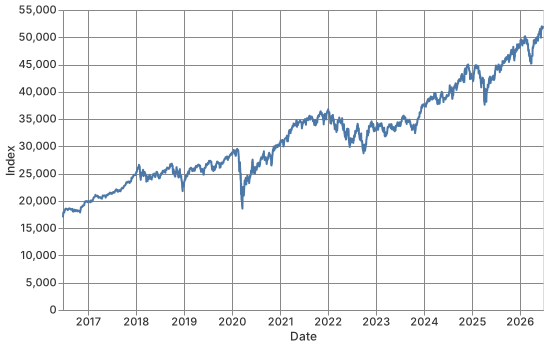
The deal is based on a framework agreement reached last July at Trump’s Turnberry golf course in Scotland following months of negotiations. That framework set 15% duties on most EU goods entering the U.S. and removed EU tariffs on most U.S. imports. The Dow Jones Industrial Average, a closely watched barometer of U.S. equity markets, closed at 51,671.03 on the day of the vote.
The ratification process was not straightforward. EU lawmakers temporarily set aside the deal twice this year — once after Trump threatened to take control of Greenland, and again when the U.S. Supreme Court struck down Trump’s broader tariff authority. Frustrated with the pace of progress, Trump later said he would impose 25% tariffs on EU car imports if Brussels did not implement the agreement by July 4.
During the debate, lawmakers included a sunset clause that would keep the deal in force only through the end of 2029 unless extended further by both parties. The European Commission also said it could suspend tariff concessions if the U.S. continues to apply rates above 15% on EU steel and aluminum derivatives beyond the end of this year. The Trump administration set out a tariff regime for steel, aluminum and copper in April that imposes duties of up to 50% on some metal products.
Bernd Lange, chair of the European Parliament’s trade committee, said the agreement “not only strengthens and stabilizes EU-U.S. trade relations, but it also gives the EU the ability to respond if the U.S. fails to uphold its side of the bargain.” He added: “If the U.S. side breaches either the letter or the spirit of the Turnberry agreement, Parliament will insist that the Commission makes full and timely use of every instrument provided by this regulation and the wider EU toolkit.”
Wolfgang Niedermark, a member of the board at the BDI German industry federation, welcomed the vote. “This approval is a necessary step toward stabilizing trade relations and restoring mutual trust between the two economies, even if tariffs remain a significant burden on the European economy,” he said. “Planning certainty with the U.S. is important for German industry. The tariff deal contributes significantly to this. The aim must be to build new momentum in trans-Atlantic trade.”
The agreement now goes to EU member states for their final approval, a step the parliament’s vote is widely expected to accelerate. The deal opens a new chapter in relations between the two economies after a turbulent period that included the so-called Liberation Day tariffs last year, which significantly raised duties on goods imported from the European Union.