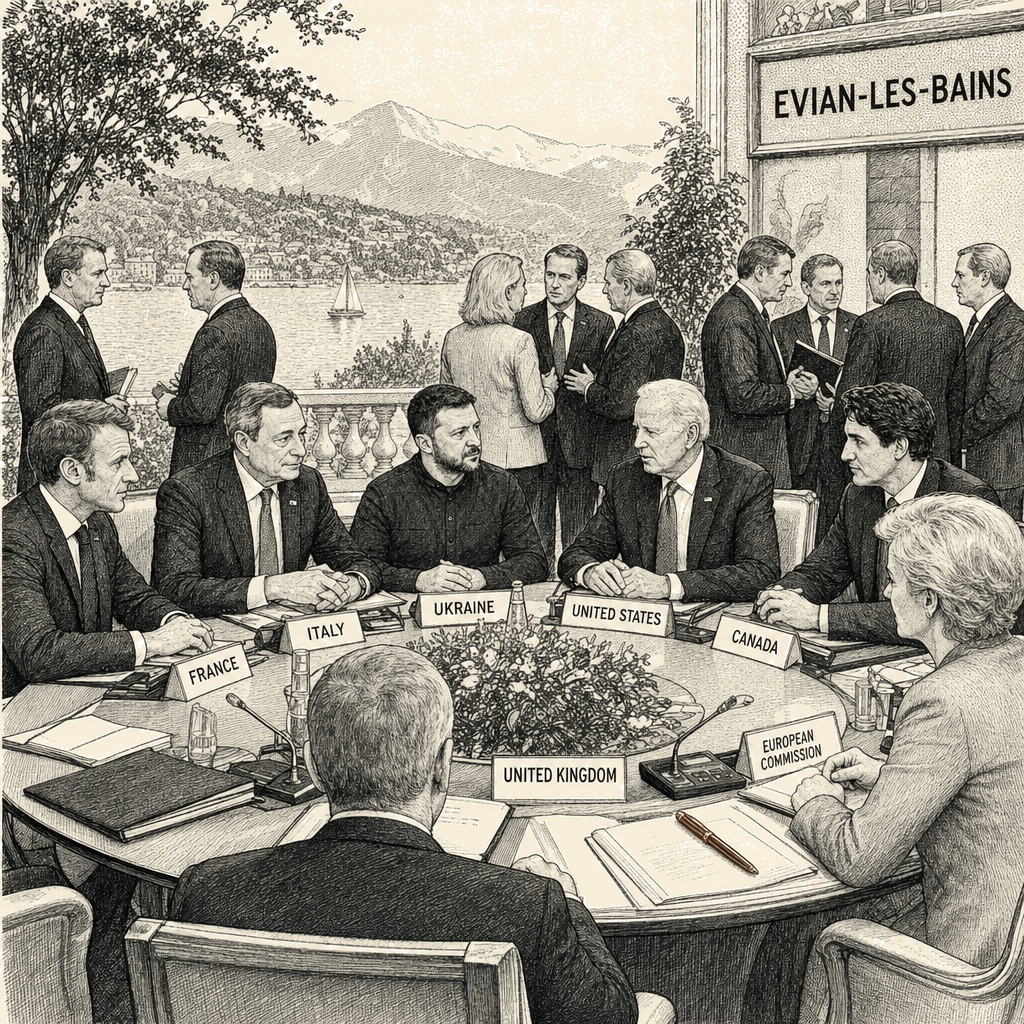
EVIAN-LES-BAINS, France — Tuesday’s discussions in the French spa town marked the first full day of the summit, with Ukraine talks coming on the heels of Trump’s announcement of an agreement to end the 3½-month-old U.S. war against Iran. In recent weeks, the Iran conflict has overshadowed the war in Ukraine that Putin launched more than four years ago.
Trump said he had good conversations on Sunday with both Zelenskyy and Putin. “Now that this (Iran) is finished, we’re going to be focusing on that,” he said, speaking during a bilateral meeting Monday with Macron.
Macron said he’ll seek to persuade Trump to continue supporting Ukraine and increase pressure on Russia to help reach a peace agreement. “The right negotiation is one in which Ukraine and Russia are at the table, but with Europeans and Americans present as well,” Macron said on French television.
Hours before the start of the summit, Russia fired hundreds of drones and dozens of missiles at Ukraine’s biggest cities in a barrage that killed 11 people and set fire to a religious landmark, according to Ukrainian officials.
The attacks came after Zelenskyy and Putin spoke separately by phone with Trump on Sunday, the U.S. leader’s 80th birthday, suggesting Washington has not given up on its diplomatic efforts to stop the fighting that followed Moscow’s all-out invasion in 2022.
Tuesday’s agenda also included a work session focused on “ending crises and ensuring stability in the Middle East,” with leaders of Egypt, Qatar and the United Arab Emirates joining those talks.
Ahead of their meeting at the G7, the leaders of France, Germany, Italy and the United Kingdom — along with Canada — issued a joint statement congratulating the United States, the Iranian government and the mediators on what they called a “diplomatic breakthrough.” Macron later said France and other Western partners are “ready to take action very quickly” to help reopen the Strait of Hormuz peacefully. France and Britain have championed a mission to restore maritime security in the strait as soon as conditions allow.
Trump, however, appeared to downplay the need for a large international naval deployment. “I don’t think we’re gonna need much help,” he said during his meeting with Macron. “But I don’t think it’s a bad idea to have a ship or two up here from a few countries.”
Ukraine on Monday officially started European Union membership negotiations, launching a process that will require its government to commit to years of political reforms even as it fights the Russian invasion. Ukraine sees EU membership as a security guarantee for a stable future once the war ends, though its best guarantee — membership in the NATO military alliance — remains out of reach. The Trump administration has insisted Ukraine cannot join NATO, and other allies are wary of it joining while the war continues.
While campaigning for a return to the White House, Trump claimed he could end the Russia-Ukraine war within 24 hours of taking office; he has since acknowledged it has proved much harder than he initially thought it would be.
In recent months, Trump has had sharp disagreements with Macron, British Prime Minister Keir Starmer, German Chancellor Friedrich Merz and Italian Prime Minister Giorgia Meloni over his failure to consult them before the decision to go to war in Iran. Trump has threatened reprisals, including drawing down U.S. troops in all four countries, all members of the NATO military alliance, for their lack of support. Despite those disagreements, the tone in Evian was measured, as U.S. allies sought rapid progress that could ease the economic impact of rising oil prices caused by the blockade of the Strait of Hormuz.
“I think a lot of great things are going to happen in the Middle East right now, and very importantly the oil is plummeting down and the stock market is shooting up like a rocket today,” Trump said.
On Tuesday, in addition to a working session that includes Zelenskyy, Trump participated in meetings with the emir of Qatar and the president of the UAE before attending a cultural performance and a dinner with the other G7 leaders.
The G7 includes France, the United States, Canada, Germany, Italy, Japan and the United Kingdom. Guest nations at this summit — Brazil, India, Kenya and South Korea — were invited to participate in some discussions as partner countries alongside G7 members.