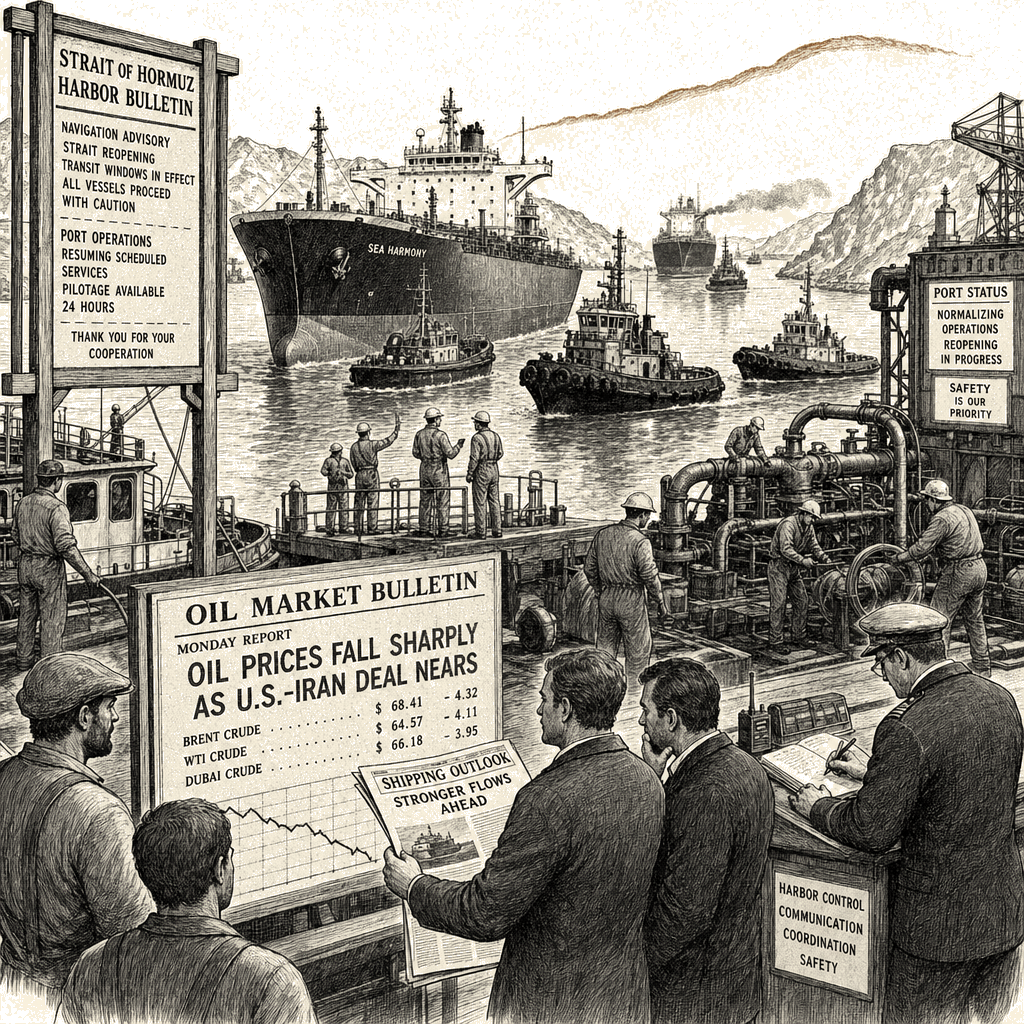
Oil prices extended their weekly decline Monday as the prospect of a U.S.-Iran peace deal scheduled for Friday fueled expectations that the Strait of Hormuz would reopen, unwinding the geopolitical risk premium that had driven crude above $120 a barrel earlier this year.
Brent crude fell 2.6% to $81.03 a barrel in afternoon trading, while West Texas Intermediate settled 3% lower at $78.29 a barrel, according to market data cited by analysts at MUFG. Both benchmarks are down roughly 9% for the week. The decline accelerated after Goldman Sachs lowered its oil-price forecast, with analysts saying they now expect Brent to average $85 a barrel in the fourth quarter, down from a previous estimate of $90 a barrel.
“While full details on the agreement are unclear, we now assume that Persian Gulf exports normalize to pre-war levels by the end of July,” Goldman Sachs analysts said.
The U.S. and Iran are scheduled to sign a preliminary deal Friday to end the war, which began in April and effectively closed the Strait of Hormuz, a narrow waterway through which about a fifth of global oil supply transits. Details of the agreement have yet to be disclosed, and analysts cautioned that even after a deal is signed, the resumption of oil flows will be gradual.
“Physical crude markets weakened, with the Dubai and Murban forward curves shifting into contango for the first time since the war began, signaling easing concerns over immediate supply shortages,” analysts at MUFG said. Contango occurs when future prices trade above prompt prices, suggesting reduced anxiety about near-term supply availability.
Analysts at HSBC said oil traffic through the Strait of Hormuz isn’t expected to normalize before late July and projected a return to prewar levels only by end-September. “Hurdles include mine clearance, insurance reinstatement, emptying excess Gulf oil storage, repositioning ships, and restarting idled production fields and downstream infrastructure across several Gulf producers,” HSBC analysts said in a research note. They expect Saudi Arabia and the UAE to ramp up relatively quickly, while other producers could take “months not weeks.”
Kpler analysts said the reopening could see an early surge in tanker activity as around 118 laden vessels trapped inside the Gulf could be the first to exit, generating a sharp but temporary spike in transits over the first 10 to 15 days. The key uncertainty is how quickly new vessels will re-enter the region.
Airlines, which had been squeezed by soaring jet fuel costs, have continued passing higher expenses to passengers. U.S. airline ticket prices for May were 26.7% higher than a year earlier, Morgan Stanley analysts said in a research note, citing federal data. That marks an acceleration from a nearly 15% year-over-year increase in March and a more than 20% surge in April. Pricier flights have been the norm this spring, the analysts said.
“This isn’t a surprise given what airline executives have been saying since the war in Iran sent fuel prices soaring,” the Morgan Stanley analysts said. They predicted another double-digit percentage price hike in June and through the summer months.
Other commodities also moved on the easing geopolitical tensions. Aluminum prices fell 0.8% on the London Metal Exchange to $3,356.50 a metric ton, according to Sucden Financial analysts, who said the metal was the most exposed to the conflict narrative given the concentration of smelting capacity in the region and key seaborne trade routes. Three-month futures are down 5% on the week.
Gold held near Monday’s gains as expectations of improved energy flows and lower oil prices eased concerns about inflation and further interest-rate increases, though investors remained cautious amid limited details on the agreement. New York futures slipped 0.3% to $4,339 a troy ounce in early trading but remained up more than 1% on the week. Attention is shifting to a series of central-bank meetings, with investors particularly focused on the Federal Reserve for fresh signals on the outlook for monetary policy.
In Europe, the European Parliament approved the U.S. tariff agreement, a move welcomed by the German auto industry. Hildegard Mueller, president of the German Association of the Automotive Industry, said the agreement must be formally adopted without delay.
“One thing is clear: all parties must abide by the agreement reached last summer,” Mueller said. She added that this includes the U.S. president withdrawing current tariff threats as soon as the EU has fulfilled its commitments. A reliable regulatory framework is of paramount importance to Germany’s companies, she said.
Analysts at AmInvestment Bank said they see a two-stage earnings recovery in Malaysia’s oil and gas sector. Near-term gains will be driven by higher Brent crude prices and stronger energy shipping and storage demand, followed by a broader recovery among service providers as industry activity rebuilds through 2027 to 2028, analyst Aimi Nasuha Md Nazri said. The bank raised the sector’s rating to overweight from neutral.
Other analysts adjusted their outlooks on transport and logistics companies. Nomura analysts said Adani Ports and Special Economic Zone is well placed to capitalize on tailwinds from rising trade and e-commerce growth. Barclays upgraded German luxury sports-car maker Porsche to equal-weight from underweight, saying it can no longer justify a below-consensus rating on its estimates despite the stock’s valuation looking rich versus peers.
Oil prices remain well above pre-conflict levels. The full timeline for a return to normal shipping and production, analysts said, depends on how security concerns evolve in the Gulf region and whether Iran retains influence over the strait via the proposed Persian Gulf Strait Authority.