- Federal Reserve Governor Lisa Cook faced more than $1.3 million in legal and security fees after the Trump administration attempted to fire her from the Federal Open Market Committee.
- Bill Pulte, then director of the Federal Housing Finance Agency, accused Cook on social media of mortgage fraud; Cook denied the charge and said the administration was “cherrypicking” discrepancies for political reasons.
- Two nonprofit organizations, State Democracy Defenders Fund and Contina Impact, reimbursed Cook for more than $1 million in legal and security costs.
- The Supreme Court is expected to rule before the end of June on whether Trump’s firing of Cook was legal, a decision that will affect the Federal Reserve’s independence from political influence.
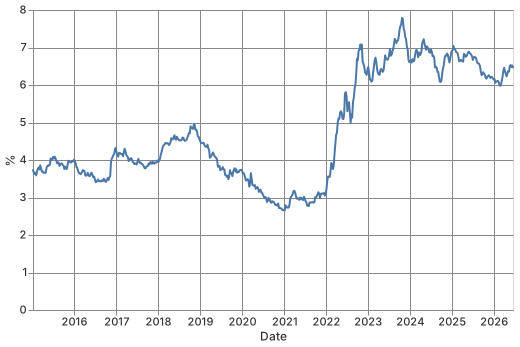
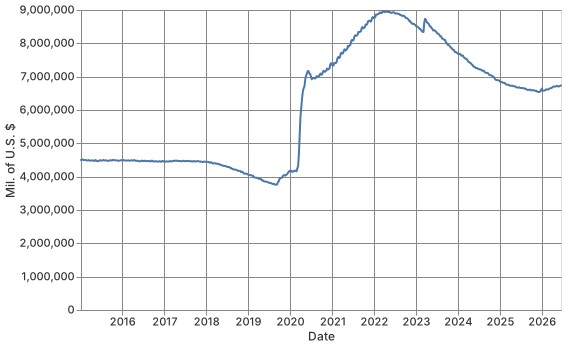
- The 30-year fixed mortgage rate stood at 6.47% as of June 18, according to FRED data; the Federal Reserve’s total assets were about $6.73 trillion.
Federal Reserve Governor Lisa Cook incurred more than $1.3 million in legal and security fees after the Trump administration targeted her with a firing attempt and a public accusation of mortgage fraud, according to ethics disclosures filed Wednesday.
Cook was appointed by President Joe Biden in 2022, becoming the first Black woman to serve on the Federal Open Market Committee (FOMC), the 12-member panel that sets U.S. interest rates eight times a year. Her term on the Fed board runs through 2038.
The White House moved to remove Cook last summer as President Donald Trump intensified an unprecedented campaign to pressure the Fed into cutting interest rates. On social media, Bill Pulte — then director of the Federal Housing Finance Agency and now set to become acting U.S. intelligence chief Friday — accused Cook of mortgage fraud, alleging she misled lenders by listing a second home as her primary residence to obtain a better rate.
Trump fired Cook from the FOMC. She denied the accusation and said the administration was “cherrypicking” discrepancies to remove her for political reasons.
A federal court temporarily reinstated Cook, and her firing is now before the U.S. Supreme Court, which has not yet ruled on its legality. During a hearing in January, justices expressed skepticism over the brusque manner of Cook’s removal.
The ethics filings show that two nonprofit groups — State Democracy Defenders Fund and Contina Impact — reimbursed Cook for more than $1 million in legal and security services.
The Supreme Court case will ultimately determine how much independence the Federal Reserve retains from White House pressure. Congress established the central bank in 1913 with structural protections — including long board terms and independence from congressional funding — meant to insulate it from political influence.
Economists widely agree that an independent central bank is essential for maintaining a stable economy. While past presidents generally refrained from publicly criticizing the Fed, Trump in his second term has been vocal in demanding lower rates.
Trump’s nominee for Fed chair, Kevin Warsh, has aligned himself with the president but holds only one of 12 FOMC votes. After the committee’s most recent meeting Wednesday, members signaled a possible rate hike before year-end, citing rising inflation since the start of the Iran war.
As of June 18, the 30-year fixed mortgage rate stood at 6.47%, according to FRED data, and the Federal Reserve’s total balance sheet was about $6.73 trillion.