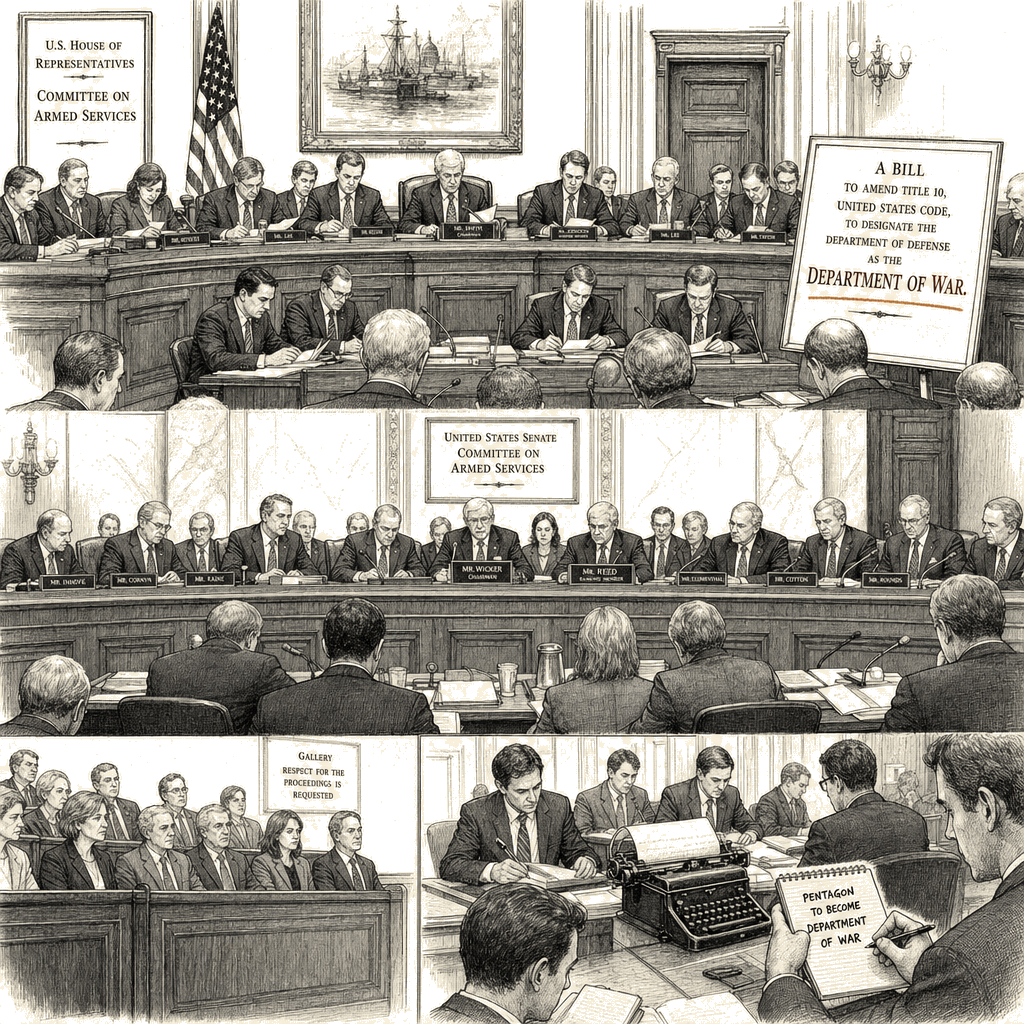
Key committees in the House and Senate have approved legislation to officially rename the Department of Defense the “Department of War,” a change that President Donald Trump is expected to sign into law, according to a report in the Guardian. The rebranding, which would replace a name that has been in place since 1949, is the most significant institutional name change in the U.S. defense establishment in over seven decades.
The Department of Defense was christened in 1947 and formally established in 1949, unifying the military branches under the Pentagon. The name was intended to signal a defensive posture, but critics say it has functioned as a euphemism for what is in reality the “ultimate blunt instrument of a warfare state,” as journalist Norman Solomon wrote. The new name “would undermine some of the deceptive marketing that has been central to the Department of Defense brand,” he argued.
Representative Adam Smith, the ranking Democrat on the House Armed Services Committee, last week called the proposed name change “one of the dumbest things that has been done by this administration,” according to the Guardian. Smith was among 81 House Democrats who in October 2002 voted in favor of a resolution authorizing the U.S. invasion of Iraq.
The name change has drawn support from the Trump White House, which has proposed a 50% increase in the already enlarged military budget. Defense Secretary Pete Hegseth has touted what the Guardian described as “the warrior ethos,” using rhetoric that the publication said “dispenses with the usual window-dressing for warmaking.” President Trump, the Guardian reported, “is often quite open about his enthusiasm for the tremendous violence of war.”
MSI previously reported that a House panel voted to codify the name change on June 5, and that the Congressional Budget Office estimated the rebranding could cost up to $125 million. The articles are part of an ongoing series on the administration’s military posture.
Norman Solomon, writing in the Guardian, traced the history of “boilerplate claims of peaceful intent” from past presidents: Lyndon Johnson signed the Tonkin Gulf Resolution in 1964 “so that the people of south-east Asia be left in peace,” before the Vietnam War that took an estimated 3.8 million lives. George W. Bush, weeks before the 2003 invasion of Iraq, declared in a State of the Union address: “We seek peace. We strive for peace. And sometimes peace must be defended.”
The name change, Solomon wrote, is “a symptom of what Martin Luther King Jr called ‘the madness of militarism.’” He noted that “every president in the last 80 years has mouthed platitudes about defense and peace, while gunning the most destructive war machinery on the planet.”