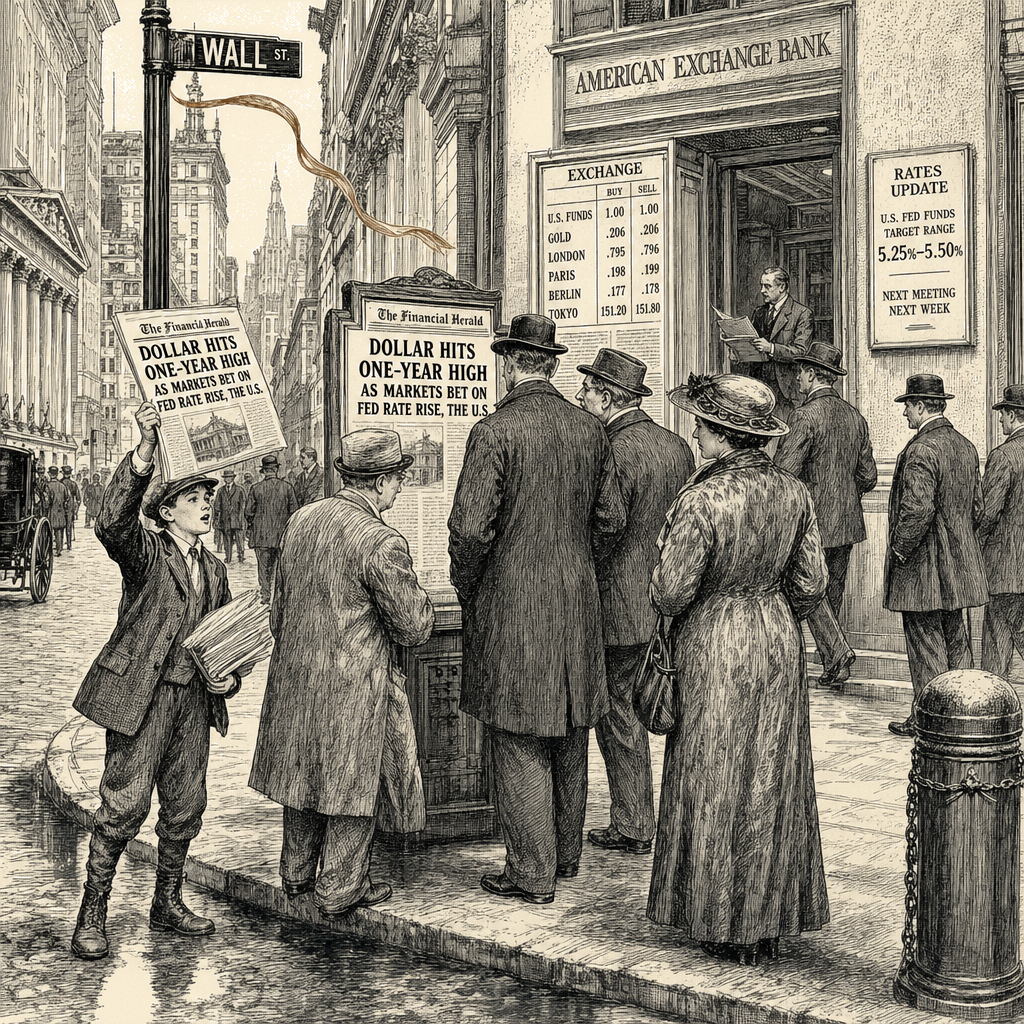
The U.S. dollar rose to a one-year high against a basket of currencies on Friday, lifted by growing expectations that the Federal Reserve will raise interest rates in the coming months after its latest policy meeting signaled a shift by key officials.
The Federal Reserve held its benchmark rate at a range of 3.5% to 3.75% following its two-day meeting that ended Wednesday. However, the quarterly projections released alongside the decision showed that nine of the 19 policymakers penciled in at least one quarter-point rate increase by the end of the year, a sharp rise from none in the March projection round. The Fed’s new Chair, Kevin Warsh, in his first meeting leading the central bank, emphasized a commitment to restoring inflation to the 2% target, according to the Fed’s official statement.
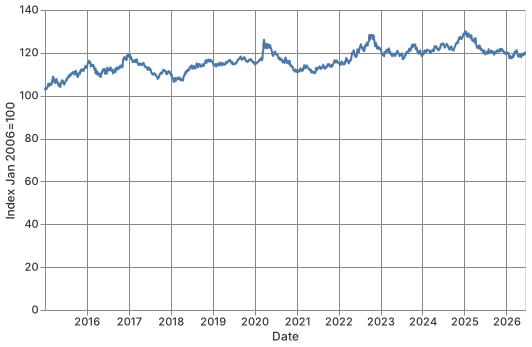
The hawkish turn quickly rewired rate expectations. LSEG data early Friday implied a 90% probability of a 25-basis-point rate increase in September, with a move fully priced by October. Markets had previously not anticipated a tightening move until later in the year. The broad trade-weighted U.S. dollar index, a measure of the greenback against a wide basket of trading partners’ currencies, stood at 119.51, according to Federal Reserve data. The narrower DXY index, which tracks the dollar against six major currencies, reached 101.127, its highest level since May 2025.
Commerzbank foreign exchange and commodity analyst Volkmar Baur attributed the dollar’s strength partly to the artificial-intelligence investment boom. “This is due in no small part to the ongoing euphoria surrounding artificial intelligence,” Baur wrote in a note. He said AI investments continue to drive U.S. economic growth, prompting markets to abandon expectations for rate cuts. Competition for U.S. Treasury bonds as companies raise funds for AI investments is also pushing U.S. rates higher, Baur added. ING foreign exchange strategist Francesco Pesole offered a more cautious view, arguing that the U.S.-Iran deal “removes a positive argument for the dollar” and that markets may be overestimating the chances of a rate rise.
U.S. stock and bond markets were closed Friday for the Juneteenth holiday, and trade is set to resume Monday. The Dow Jones Industrial Average stood at 51,492.55, according to FRED data from the prior session.
Oil markets reacted to a mix of cross-currents. Brent crude rose 0.5% to $80.23 a barrel after Vice President JD Vance scrapped plans to travel to Switzerland for a ceremonial signing with Tehran, even as oil tanker traffic through the Strait of Hormuz began to restart. The U.S. and Iran signed an interim peace deal on Wednesday, though questions remain about the long-term conditions for shipping through the vital waterway. “Market euphoria that a deal had been reached has shifted to some skepticism, as the deal is only interim and is not a peace treaty,” XTB analyst Kathleen Brooks said. West Texas Intermediate crude, the U.S. benchmark, rose to $77.56 a barrel. Both benchmarks remain on track for sharp weekly declines.
In Europe, index performance was mixed. The Europe-wide Stoxx 600 was flat. London’s FTSE 100 edged 0.1% lower as metals miners slipped. The Paris CAC 40 rose 0.2% as auto stocks rallied and luxury giant LVMH gained 1.7%. Germany’s DAX was up 0.15%, supported by a 1.6% jump in defense contractor Rheinmetall. Italy’s FTSE MIB gained 0.55%, with defense company Leonardo rising 3.1%. The semiconductor-heavy AEX in Amsterdam slipped 0.4%, dragged down by ASML, Europe’s most valuable company, which fell 1.7%.
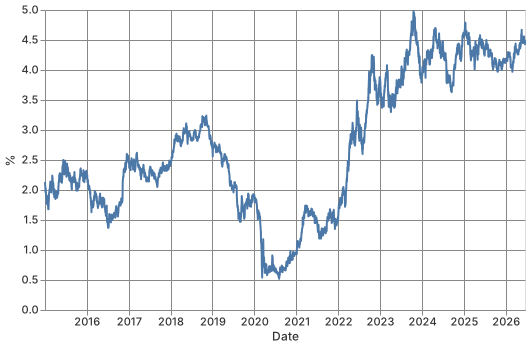
U.K. government bond yields climbed and the pound weakened against the dollar after higher-than-expected borrowing data and a special-election victory by Labour politician Andy Burnham added to fiscal uncertainty. U.K. public borrowing for May reached 23.3 billion pounds — 5.4 billion pounds higher than in the same month a year earlier. “Borrowing has got off to a terrible start to the fiscal year 2027,” Pantheon Macroeconomics analyst Rob Wood wrote in a note. The 10-year gilt yield rose 6.5 basis points to 4.809%. Analysts said Burnham’s victory increases political uncertainty because markets expect he would favor higher government spending.
Gold continued to fall as the prospect of higher interest rates weighed on the non-yielding asset. New York gold futures were down 1.8% to $4,170.30 a troy ounce. Bitcoin dropped 0.5% to $62,732.
In Asia, Japan’s Nikkei Stock Average rose 0.3% to close at a fresh record high of 71,250.06. Markets in Hong Kong and China were closed for holidays. Korean stocks reversed earlier gains, with the Kospi closing down 0.1%.