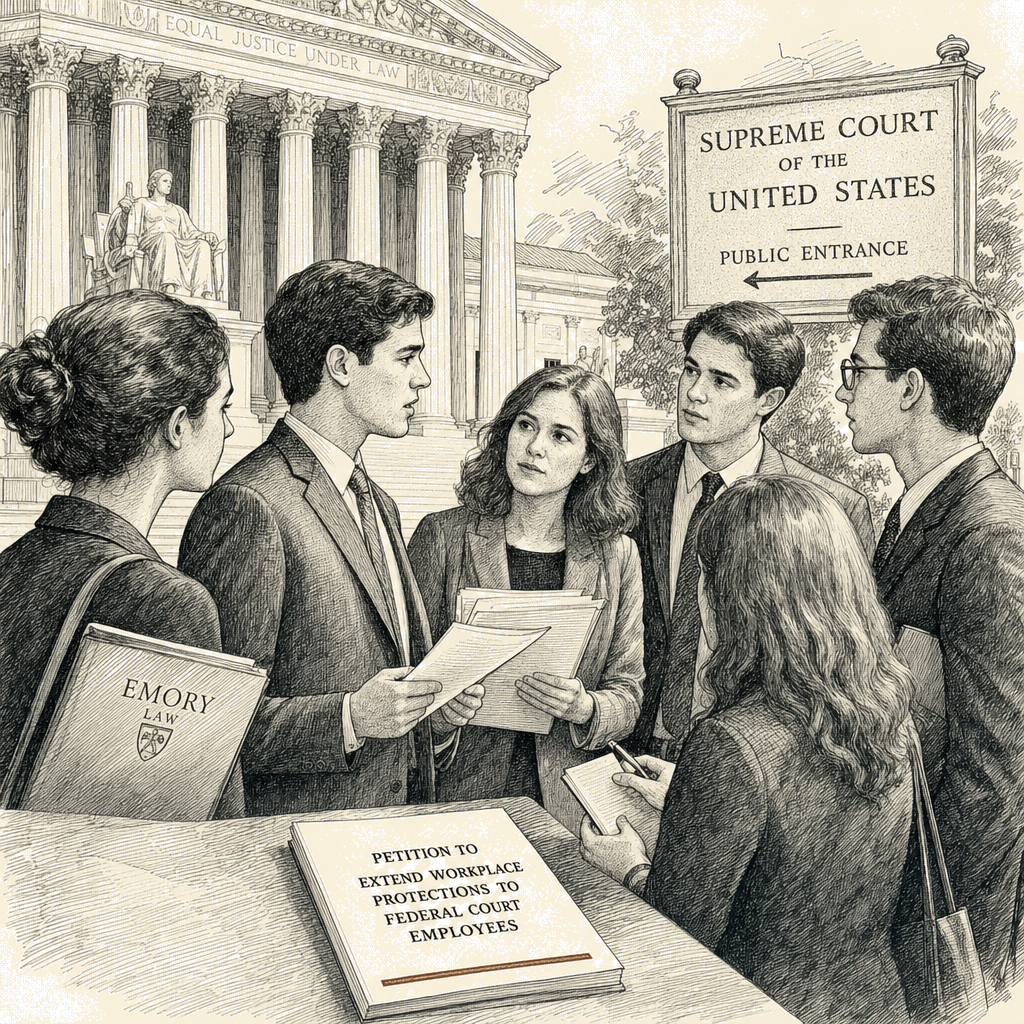
Nut graf. The case at the center of the petition — which the students drafted as part of the Emory University Supreme Court Advocacy Program, the only student-led Supreme Court litigation program in the country — challenges the system the judiciary uses to police itself. The students are working to support a former federal public defender, Caryn Strickland, who says she faced sexual harassment on the job. The Supreme Court has asked the Justice Department for a response to the petition, due next month.
Body. Sofia Bettini, a recent Emory graduate who worked on the petition, said it was a “no brainer” for the students to pick this issue out of several other requests for help that came their way at the program. “You may not know as a student entering a clerkship that you’re going to forgo certain workplace protections that you otherwise would never have to even consider forgoing because they just seem that fundamental,” Bettini told NPR.
Many of her friends and colleagues expect to take jobs in the courts someday, Bettini said, making the plight of clerks, probation officers, and public defenders who work for the judicial branch feel personal. “They have nowhere to turn, no independent enforcer, no neutral decision maker and there exists a very real threat that speaking up will cost them everything,” Bettini said.
Professor Paul Koster, who directs the program, said the students are not getting credits or grades for the work. “These students aren’t getting credits for this, they’re not getting graded on this, they’re doing the work because they want to do the work,” Koster told NPR.
Student Andrew Taramykim, who will enter his third and final year of law school in the fall, spent hours researching Title VII for the petition. “Title VII goes back to the Civil Rights Act of 1964 and it prohibits certain unlawful workplace conduct that includes what we generally understand as workplace harassment, workplace discrimination,” Taramykim said. By 1995, lawmakers had extended those protections to workers in Congress. Taramykim said by his read, Congress intended federal court employees to get those same protections but wanted to give the judiciary wide berth to execute on them.
Every federal circuit court has since developed its own human resources program for workers to resolve disputes. Those rules typically leave judges to oversee complaints against people they know and might work with every day. The Emory law students said that system does not provide the kind of neutral, independent decision-making promised in the civil rights law. “Autonomy for the institution cannot come at the cost of basic workplace rights and safety for people within it,” Bettini said.
In a written statement to NPR, Strickland said she is proud of the students for taking up her cause. “The shortcomings in civil rights protections for the judiciary’s 30,000 employees will only be addressed if the legal community is willing to stand up publicly against this serious injustice,” she said.
A spokesman for the Administrative Office of the U.S. Courts declined comment on the case. The office has been defending the judiciary’s internal system as robust and has said changes are underway to make it easier to report wrongdoing.