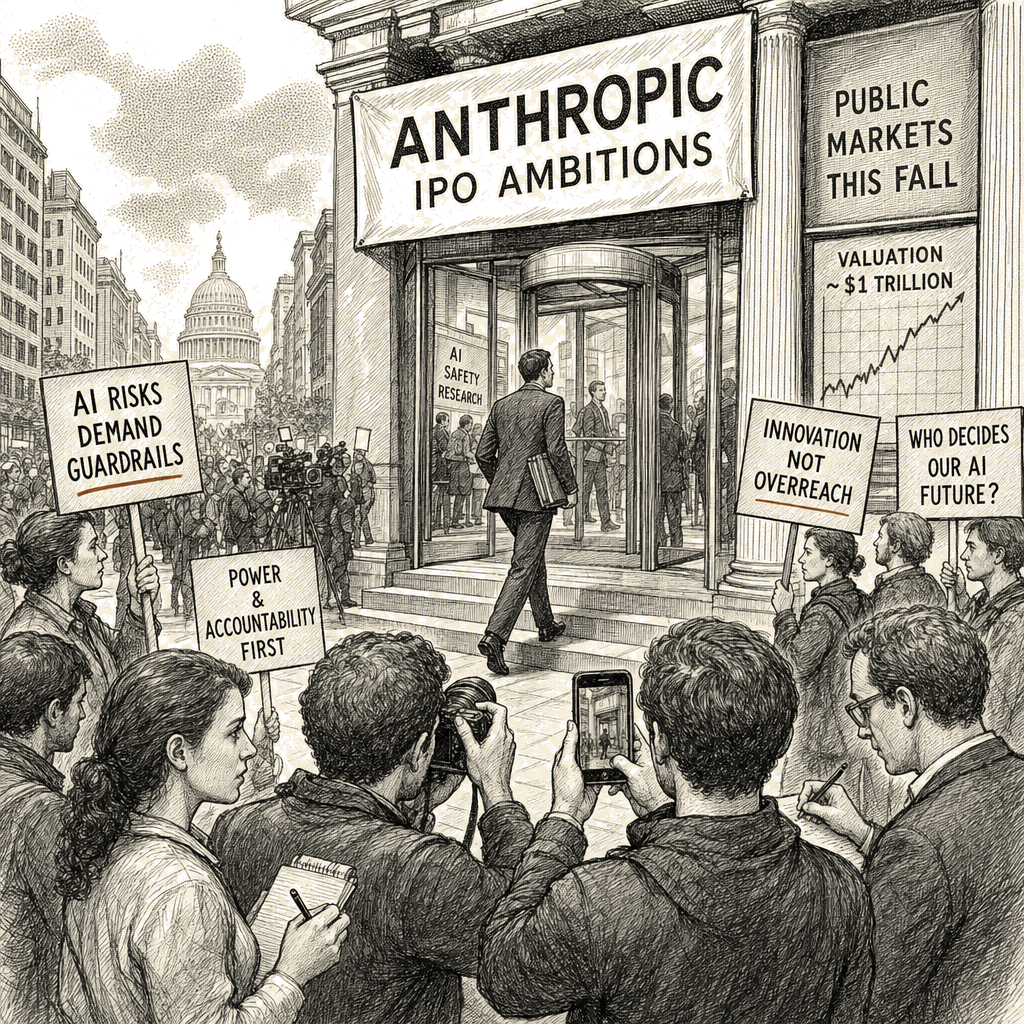
Anthropic, a five-year-old artificial-intelligence company valued at nearly $1 trillion in its latest private fundraising round, is heading toward a potential public offering this fall as political opposition to the technology escalates from both parties, threatening to complicate what could be one of the largest market debuts in history.
The company finds itself wrapped up in another bruising dispute with the Trump administration over concerns that its AI could wreak havoc on global cybersecurity, according to a report by The Wall Street Journal. Anthropic has pushed back on those claims with statements that appear to suggest it sees political motives behind moves to restrict access to its models. The new skirmish follows a separate blowup with the Pentagon earlier this year over disagreements about the company’s efforts to apply guardrails to how its AI could be used in military applications.
Anthropic Chief Executive Dario Amodei has compounded the company’s political problems with what colleagues and critics alike describe as almost Dickensian predictions of how AI could result in Great Depression-like job losses and create nuclear weapon–like dangers. The company recently called for top AI labs to slow or pause development because of the threat the technology poses by soon being able to improve itself without human involvement. Some see his comments as sincere; others told the Journal they view them as grandstanding meant to stoke investor excitement.
Longtime critic David Sacks, who served as White House AI czar, appeared to respond to Amodei in a post on X without naming the company. “Signs you might be trying to get your frontier AI lab nationalized: You compare it to nukes…threaten half of white-collar jobs…warn recursive self-improvement could end humanity…then race ahead anyway,” Sacks wrote. “In other words, you want the government to save us from…you.”
Amodei joined other AI leaders at the Group of Seven summit in France on Wednesday to press global leaders on their AI positions, pushing for the U.S. to lead the countries in shaping AI safety standards. President Donald Trump, whose administration has advocated a largely hands-off approach, told reporters at the G-7: “We have to be very careful with it. It’s both great and could be bad.”
The political crossfire intensified on Capitol Hill this week. Sen. Bernie Sanders, an independent who caucuses with Democrats, introduced legislation Thursday that would take 50% ownership stakes in the largest AI companies and create a sovereign-wealth fund to generate dividends for Americans and eventually fund social programs such as healthcare. Sanders acknowledged the challenge of going against AI companies, telling reporters: “They have the ability to spend huge amounts of money in campaigns to defeat any candidate who is talking about sensible regulation or actions that will benefit the public.”
Sen. Josh Hawley, a Missouri Republican, penned a blistering op-ed in the Free Press with a headline that warned: “AI Will Control Us If We Do Not Control It.” Hawley wrote, “We are not raw material in the hands of Silicon Valley,” and pledged to side with humans worried about job losses, increased energy costs and safety.
Some technology industry leaders themselves are advising caution. In a lengthy essay last weekend, Microsoft CEO Satya Nadella, a major backer of OpenAI, detailed how he thinks companies can fight against AI labs capturing the economic returns of entire industries. “There is no societal permission for an AI future that hollows out entire industries,” Nadella wrote.
Dev Ittycheria, who retired last fall as CEO of software giant MongoDB, posted on X that AI company CEOs sound increasingly detached. “The more I listen to AI company CEOs, the stranger they sound,” Ittycheria wrote. “They’re full of ideas that no normal person can relate to, talking past the people they’re supposed to reach.”
Beyond Washington and Wall Street, the technology’s rapid expansion is encountering grassroots opposition. The giant data centers needed to train and power AI models are facing dramatic pushback in local cities and counties across the nation from residents worried about increased electricity and water costs. The growth projected by Anthropic, OpenAI and others is built in large part on the assumption that the billions of dollars IPOs will unlock will fund ever-larger data centers.
Survey data reinforces the shift in public sentiment. A Pew Research Center survey released Wednesday found that more Americans predict AI will be bad rather than good for society. Those under age 30 were especially likely to say AI will have a negative effect on society and themselves, and few respondents expressed confidence that the government could effectively regulate AI.
“All politics is local,” as former House Speaker Tip O’Neill said, and while the benefits of AI remain uncertain for many, the politics around the technology are becoming increasingly concrete, the Journal’s report said. Everything is moving fast, and not in favor of the AI giants.