A gentle breeze blew through the cemetery at the Little Sisters of St. Francis convent in Nkokonjeru, central Uganda, as Sister Jane Frances Nakafeero walked between rows of white crosses marked with pink and yellow flowers. She pointed to one grave after another — a nurse, a teacher, a social worker, a doctor. The sisters who trained at the motherhouse and went out to serve the community eventually return here to be buried. “The motherhouse is where we begin and where we end,” Nakafeero said.
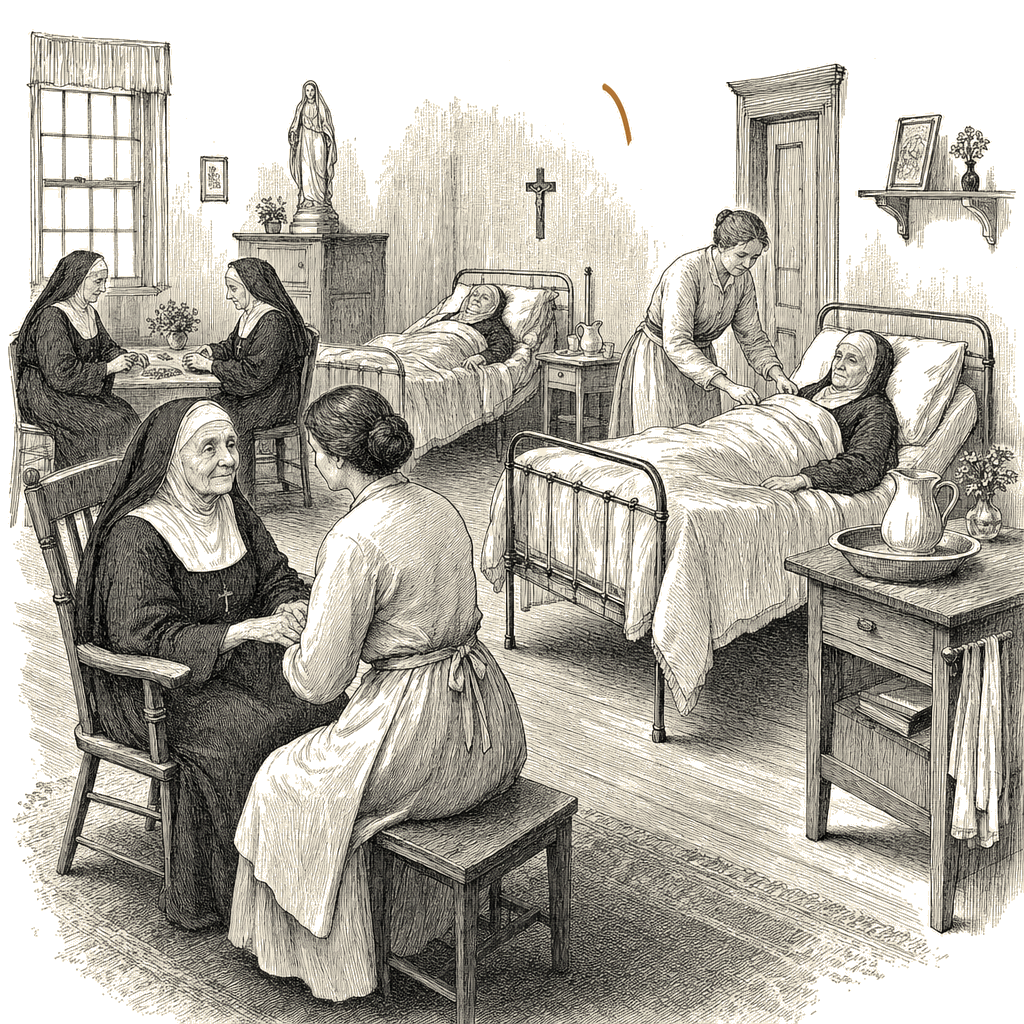
But Nakafeero is increasingly worried about the sisters still living. The convent houses 14 retired nuns, many in their 80s and 90s, who are cared for by a small team of younger sisters and a handful of cooks and caregivers. Material resources are scarce. The convent owns only seven wheelchairs, some with sticky wheels and faulty hand brakes, and the sisters lack adult diapers, hearing aids, and warm blankets.
Palliative care — medical and emotional support for patients at the end of their lives — emerged as a formal field only in the 1960s and remains poorly funded and poorly understood, particularly within the Catholic Church, Nakafeero said. African religious orders, she explained, are especially under-resourced compared with their American and European counterparts.
In 2023, Nakafeero presented these concerns at a meeting of the African Palliative Care Association. Her account moved Jean Callahan, then chair of the Irish Hospice Foundation, who was in Uganda learning about two Irish-funded projects. Callahan said she thought of her grandmother Sybil, who left Ireland for Tanzania in the 1950s to work as a nun. “These women, who could have been my grandmother’s colleagues, are being left at the end of their lives without the basic human supports they should have,” Callahan said.
Callahan and Nakafeero decided to collaborate with the African Palliative Care Association on a pilot program to provide hospice support to aging nuns. Launched in September 2025, the program aims to address medical care, material needs, and psychological interventions, while training younger nuns in caregiving.
Eve Namisango, director of the African Palliative Care Association, said researchers are now assessing the needs of about 50 retired sisters at the Little Sisters of St. Francis convent. Most are Ugandan, but the order also includes nuns from Kenya and Tanzania. After the assessment, her team will train caregivers, with plans to introduce palliative care in Ugandan convents by 2027 and then across the continent. “They have served humanity for all their useful years,” Namisango said. Now, she added, “they deserve decent, person-centered care.”
The broader scale of need is significant. According to the Vatican, there are about 82,000 nuns in Africa. The African Palliative Care Association estimates that between 8,000 and 10,000 of them could require end-of-life care.
Inside the Nkokonjeru convent, mornings begin with prayer. On a May day — the same day 81-year-old Ugandan President Yoweri Museveni was inaugurated for a seventh term — several retired sisters watched the ceremony on a television mounted in the dining room. Those who could speak chatted quietly. Others stared into the distance.
Sister Mary Hedwig Agoya, 89, entered the convent in 1951 at age 14, given khaki robes and a veil by the order’s founder, Mother Kevin Kearney, an Irish woman who arrived in Uganda in 1903 and is now a candidate for sainthood. “She embraced me,” Agoya recalled. After 40 years as a teacher, Agoya said life in retirement feels different. “It becomes a bit dull,” she said. Most of the sisters who entered with her have died.
Sister Rosemary Luyiga, 95, came to the convent in 1944 when she was 12 and ran a school teaching girls to cook and clean. She lived through World War II and Uganda’s independence but said she remembers little of world events. “I don’t think we were very much interested,” she said. Now mostly immobile, she spends most of her time in a room with a single bed and a chair. “I don’t know what can take away loneliness,” she said. “You would like to sit and talk, but you find that you cannot do that.”
Sister Mary Consolata Nakawoojwa, a social worker who studied geriatric care in the United States, is part of a team of three sisters responsible for the retired nuns. The sisters in her charge often suffer from depression and anxiety, she said. “They are not sure really how life will be,” she said. “We define ourselves by what we do. But now they’ve got to be instead of doing. They have to be, and then they have to redefine identity.”
Dr. Kristina Newport, chief medical officer at the American Academy of Hospice and Palliative Medicine, said the concerns facing aging nuns are universal. “Whether you’re a nun in Africa or you’re a construction worker in the Bronx, you face those same kinds of concerns as you face the end of your life,” she said. “And it means a lot to have people to walk with you in that place.”
Callahan and Nakafeero both said the neglect of aging nuns stems in part from their status as women. “I feel very aggrieved that nuns are second-class citizens,” Callahan said. Nakafeero offered a comparison: “We have the bishops, who are in charge of the dioceses and in charge of the priests. They would do something for the priests, but they will not do something for the nuns,” she said. As a result, she said, nuns “have to do it ourselves.”
The Vatican did not respond to repeated requests for comment, including questions about who is responsible for female religious orders upon retirement.
The pilot program’s research is funded by an Irish donor who has asked to remain anonymous. Campaigners are now seeking about $135,000 to carry out the rest of the program, including providing material support and training caregivers. “I’m an optimist and I’m also bloody determined on this,” Callahan said.
For Nakafeero, who is 57, the effort is personal. She cared for her own father as he died, an experience that later motivated her to establish a palliative care program at Naggalama Hospital, where she is chief operating officer. Standing at the cemetery in Nkokonjeru, she looked across the rows of graves toward the mausoleum where Mother Kevin Kearney is buried. “In a few years time, I myself will be there,” she said. “When that time comes, I would want someone to gently, gently journey with me.”