Richard Parias entered the United States illegally from Mexico in 2002 and spent more than two decades living in the Los Angeles area, including with his two U.S. citizen children, according to NPR. He built a following of more than 250,000 on TikTok by documenting community events and, after the Trump administration increased immigration enforcement in Los Angeles last year, began recording immigration arrests and federal officer presence.
On Oct. 15, 2025, Parias was leaving his house when federal officers in multiple vehicles blocked his path. Body camera footage reviewed by the Los Angeles Times shows agents surrounding his vehicle. One officer yelled “I’m going to break the window” and began smashing the passenger-side window while holding a gun. Yelling in Spanish from officers included “I am going to shoot you” and “turn off the car.” Parias can be heard yelling “I don’t have anything” and “kill me.” Seconds later, an officer fired.
Parias was struck near his left elbow. The bullet also hit a U.S. marshal who was part of the operation. The federal government charged Parias with assault on a federal officer. Parias had no criminal history before the incident, according to his attorney, Margaret Hellerstein.
Parias spent nearly a week in the hospital after the shooting. He was then placed in federal criminal custody and, in November 2025, transferred to ICE custody under the Laken Riley Act, a law signed by President Trump that expanded mandatory detention for people without legal status charged with certain offenses including assault on a law enforcement officer.
In December 2025, U.S. District Judge Fernando Olgin dismissed the criminal charges, citing inadequate access to legal representation. The government is appealing that ruling.
While Parias remained in ICE custody, immigration attorneys filed a habeas petition in District Court also before Judge Olgin. A federal judge later ordered an immigration judge to hold a bond hearing. At that hearing, ICE argued the immigration judge lacked jurisdiction under the Laken Riley Act; the immigration judge agreed and denied bond, adding that even without the act she would have denied bond because Parias could be considered a flight risk due to his lack of legal status.
Hellerstein said she believes Parias did not receive a constitutionally adequate bond hearing. “It’s the way the law is at the moment,” she said. “You have to file a habeas. Which means, unfortunately, that for people like Richard who are languishing in detention and have serious medical concerns, you could be waiting for your decision for months and months and months.”
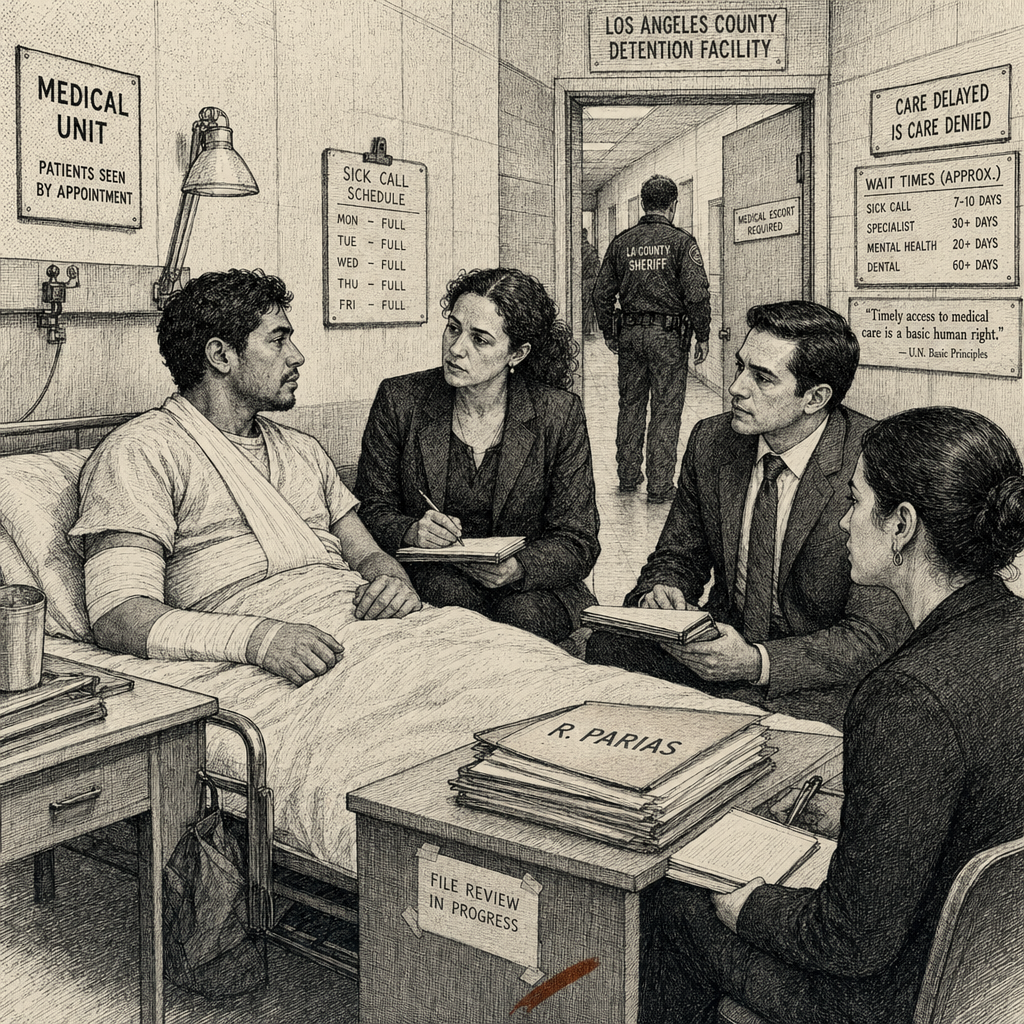
Medical records reviewed by NPR from November to May show Parias reporting consistent pain, decreased mobility, and radiating pain from his neck down to his left hand. The records note no therapy had been completed and that Parias had been in a sling for six months. He was primarily prescribed Motrin, gabapentin, and muscle rub cream, among other medications.
DHS told NPR that from November to June, Parias was seen by a nurse who provided a brace and sling, educated him on exercises, and prescribed various medications. In March, a nurse referred Parias for an orthopedic evaluation after noting decreased mobility; an orthopedic surgeon also provided a physical therapy referral. As of May, his pain had not improved.
Hellerstein said the case illustrates the administration using detention to encourage people to leave the country. A DHS spokesperson said in a statement, “ICE detention is still not punitive.”
Rep. Sydney Kamlager-Dove visited Parias at Adelanto and said she is seeking treatment for him. “What I need to hear is that he is going to physical therapy, he is getting the kind of antibiotics and medical and prescription medication that he needs to help him with his vision, to help him with his headaches, to help him with his pain,” Kamlager-Dove said.
Caseworkers in the congresswoman’s office have been in touch with DHS, but Kamlager-Dove said the agency has not provided what she is asking for. “We don’t have that many oversight tools,” she said, adding that Democrats in the minority in Congress have limited options.
Parias’ son, Ulises Parias, 20, has been helping the family navigate the legal system and caring for his 16-year-old sister. He has been working to repair the car in which his father was shot, cleaning blood and broken glass from it.
“This is the first World Cup where I’m experiencing it alone. And it feels wrong,” Ulises Parias said. “I’m hoping the next step is to get a call from the lawyer saying soon he will be with us again.”