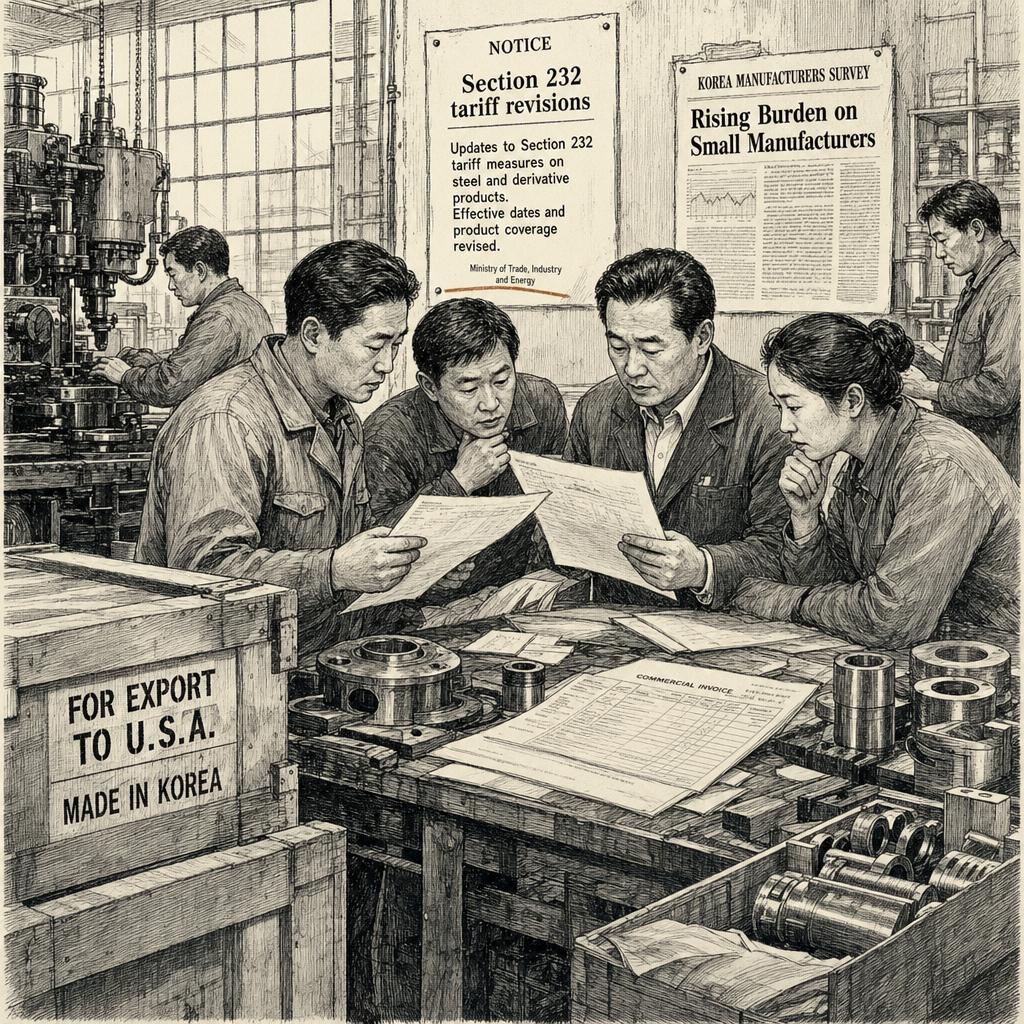
The Korea Federation of Small and Medium Business released the survey findings Sunday after polling 600 companies from April 29 through May 29. The survey covered firms affected by revisions to U.S. tariffs imposed under Section 232 of the Trade Expansion Act of 1962, which authorizes the president to restrict imports that threaten U.S. national security.
The United States currently applies a 50% tariff on most steel and aluminum imports and on covered derivative products. U.S. authorities have also expanded the list of derivative products subject to the duties.
Among companies whose products were classified under Annex I-A and faced a 50% tariff, 40% expected their export conditions to deteriorate, the survey found.
Several manufacturers said that tariffs calculated using the customs value assigned to finished products, rather than only the value of their steel content, had rendered exports commercially unviable.
A representative of a South Korean fastener manufacturer said the company’s effective tariff burden had risen from about 25% before the revision to 50%.
“Imposing a high tariff on manufacturing costs, which account for most of the product’s cost, is unreasonable,” the representative said.
Another component manufacturer said the company was losing its ability to compete for U.S. orders, as buyers demanded lower prices while tariff costs continued to increase.
Companies concerned about declining exports said they were attempting to renegotiate prices and reduce production costs, but those measures were insufficient to offset the higher duties.
Respondents identified stronger negotiations with Washington over the reclassification of products under the tariff annexes and government assistance with cost reductions as their highest priorities.
Kim Hee-jung, head of economic policy at the Korea Federation of Small and Medium Business, said small manufacturers whose products contain substantial processing and manufacturing value were bearing a structurally excessive tariff burden.
“The government should strengthen negotiations for reasonable reclassification under the annexes instead of allowing products to be classified uniformly based only on their metal content,” Kim said.
Kim also called for measures to protect exporters’ profitability, including assistance with logistics costs and long-term tariff consulting to help smaller companies respond to rapidly changing trade rules.