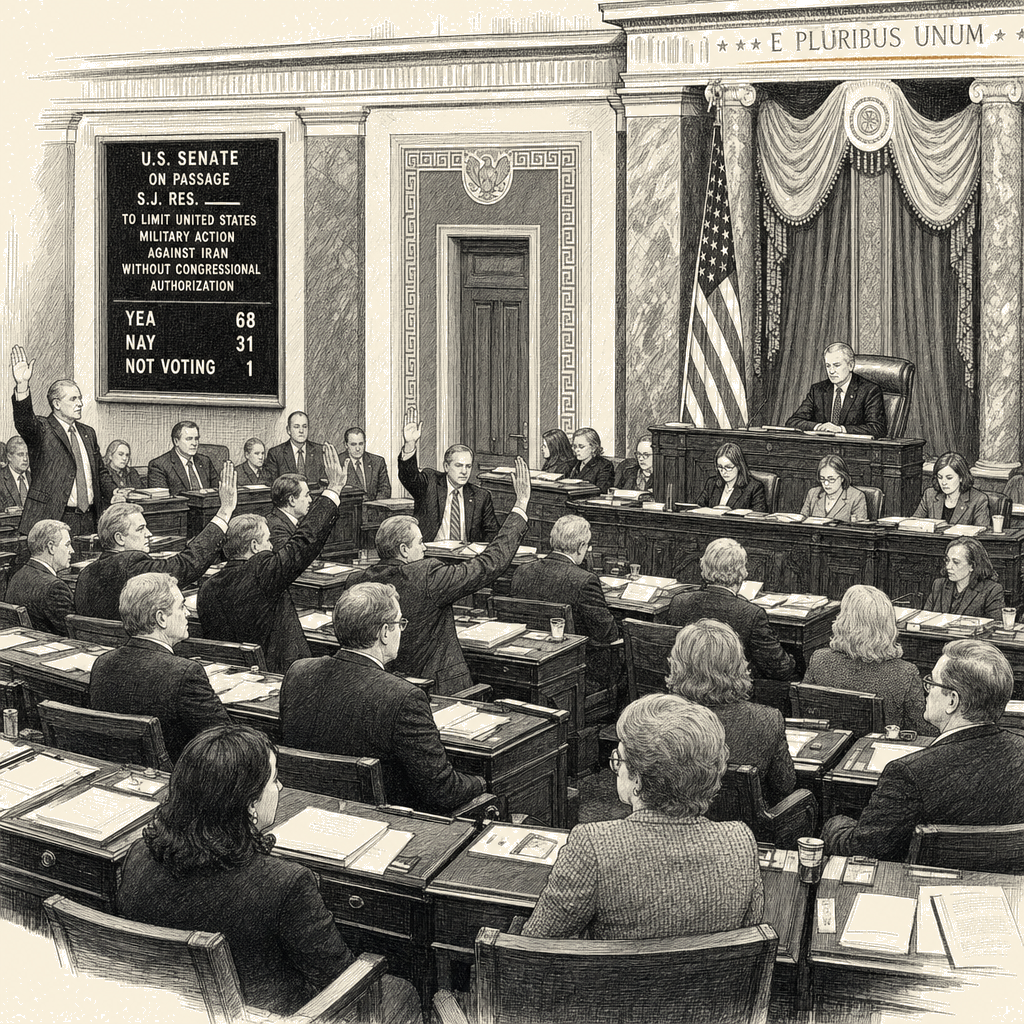
The Senate voted Tuesday to direct President Trump to withdraw U.S. armed forces from hostilities with Iran, the first time both chambers of Congress have passed the same measure seeking to rein in the president’s war powers related to Tehran.
Four Republicans joined with Democrats in the vote, according to The Wall Street Journal, a bipartisan rebuke that came one week after Trump signed a memorandum of understanding with Iran. The Journal described the vote as a “stinging rebuke” of the president’s approach.
The nonbinding resolution directs the president to remove U.S. forces unless Congress explicitly authorizes military action, with exceptions for defending the United States, an ally, or a partner from what the measure describes as “imminent attack.” The House previously passed the same version, and the Senate’s approval sends the measure to the president’s desk.
Congressional action on Iran war powers has been building for months. The House passed its first version of a war-powers resolution in early March, narrowly rejecting a similar measure before later approving one that gained rare Republican defections. The Senate had previously advanced but not finalized companion legislation as GOP lawmakers publicly wrestled with the scope of presidential war-making authority.
The resolution’s passage Tuesday reflects growing unease among some Republican lawmakers with the administration’s military posture toward Iran, particularly after the president signed a diplomatic agreement with Tehran that critics in both parties said lacked clear congressional oversight. The memorandum of understanding, which Trump signed June 16, established a framework for de-escalation but left key details about troop levels and the scope of U.S. military commitments unresolved, according to the Journal.
The measure now goes to the White House. As a nonbinding resolution — formally known as a concurrent resolution — it does not carry the force of law and would not require the president’s signature or override a veto. Supporters have said the vote nevertheless serves as a statement of congressional intent and a signal to the administration that continued military action without explicit authorization lacks legislative backing.
The four Republican senators who voted with Democrats were not identified in initial reporting on the vote. The final tally was not immediately available.
The White House did not immediately comment on the resolution. Trump has previously described congressional efforts to limit his military authority as an infringement on the president’s constitutional role as commander in chief.