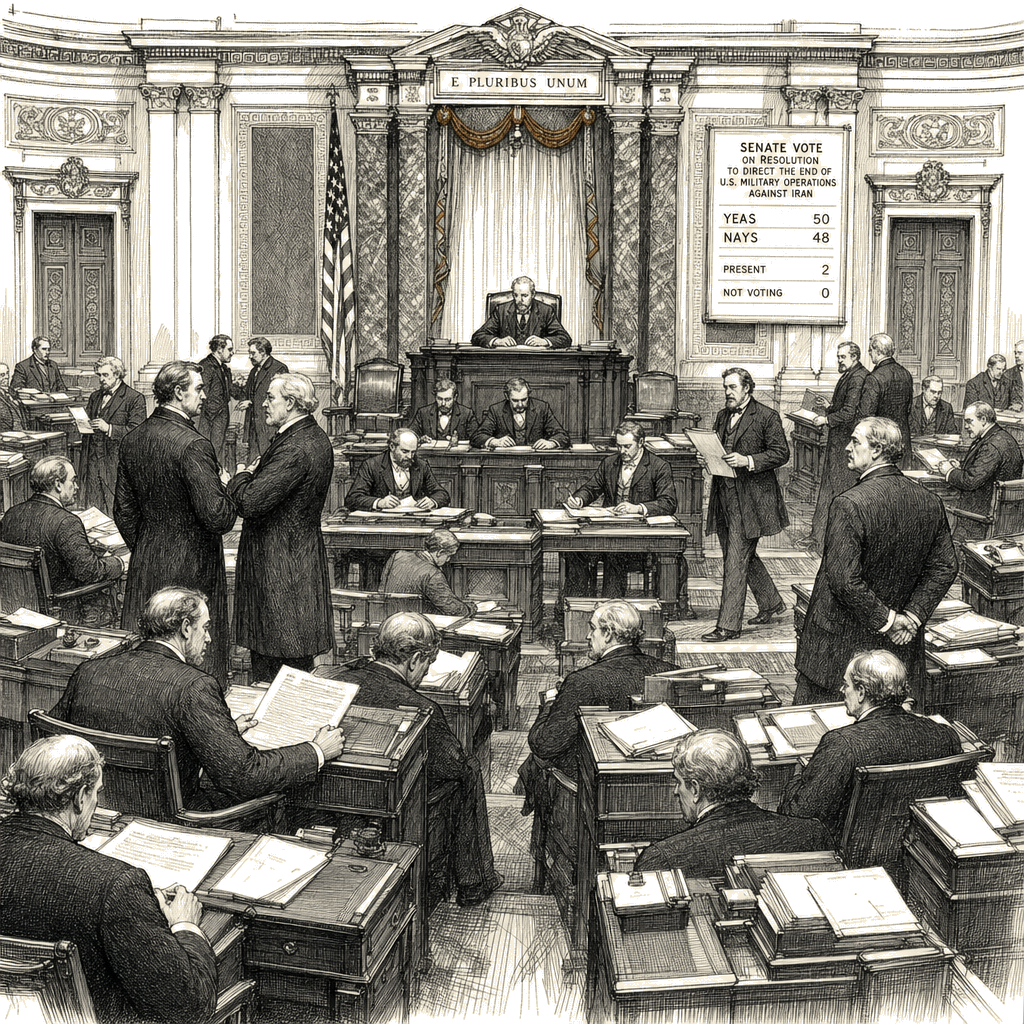
The Senate voted 50-48 on Tuesday afternoon to pass a concurrent resolution directing President Donald Trump to remove U.S. armed forces from hostilities with Iran, with four Republicans joining Democrats in a bipartisan but symbolic rebuke that is the first of its kind since the War Powers Resolution of 1973 was enacted.
Republican Sens. Bill Cassidy of Louisiana, Susan Collins of Maine, Lisa Murkowski of Alaska and Rand Paul of Kentucky voted with Democrats in support. Democratic Sen. John Fetterman of Pennsylvania was the only member of his party to vote against it. Republican Sens. Mitch McConnell of Kentucky and Dave McCormick of Pennsylvania were absent for the vote.
The measure, which the House passed June 3 in a 215-208 vote with four Republicans also breaking with their party, directs the president to remove U.S. armed forces from hostilities against Iran unless Congress explicitly authorizes military action, with exceptions for defending the U.S., an ally or a partner from “imminent attack.” Because it is a concurrent resolution, it is not sent to the White House for a signature or veto and does not carry the force of law.
Brian Finucane, a senior adviser with the U.S. Program at the International Crisis Group, said the resolution’s passage is significant despite its nonbinding status. “Even if it’s not binding as such, it still has legal effect in as much as it represents Congress’s view of the allocation of war powers and that the president doesn’t have authority to conduct this war,” Finucane said.
Senate Minority Leader Chuck Schumer, D-N.Y., said ahead of the vote that Trump’s “historic blunder in Iran will go down in the history books as one of the worst foreign policy forays America has ever made, or any country has ever made.” He cited the loss of 13 U.S. service members, hundreds more wounded, and rising gasoline prices.
Sen. Jim Risch, R-Idaho, who chairs the Senate Foreign Relations Committee, urged a no vote, warning that passage would undermine ongoing negotiations. “If this passes, the Iranians are going to simply stand up and walk away from negotiations,” Risch said. “They’re going to say this thing’s over.”
Trump criticized the House version earlier this month, writing on Truth Social that the House voted “to limit my War Powers, right in the middle of my final negotiations to end the War with the Islamic Republic of Iran.”
Republicans had blocked similar Iran war powers resolutions eight times since the conflict began in February, but defections have grown in recent months as public opposition increased and gasoline prices spiked. A Reuters/Ipsos poll released Tuesday found that 23% of Americans believed the U.S. was stronger because of the war and nearly two-thirds thought any truce with Iran was unlikely to last.
Sen. Tim Kaine, D-Va., who has led the push for weekly war powers votes, said the passage of the same resolution through both chambers was historic. “I don’t think both houses have ever passed a resolution, the same resolution, telling the president that it’s an illegal war,” Kaine told reporters after the vote. “And so it’s a powerful vote.”
A spokeswoman for Sen. John Barrasso of Wyoming, the No. 2 Senate Republican, dismissed the resolution as pure political messaging and noted that the number of Republican yes votes did not grow from the prior vote. “It doesn’t go to the president’s desk, cannot become law, and does nothing to impact policy,” the spokeswoman said.
The resolution comes a week after Trump signed a memorandum of understanding with Iran — an interim deal that both sides continue to clash over. The U.S. and Israel launched strikes against Iran on Feb. 28. Iran responded by attacking Israel and U.S.-allied Gulf states and effectively closed the Strait of Hormuz, through which about 20% of the world’s oil and LNG travels. An initial April ceasefire did not hold.
Earlier this month, the House passed the same resolution as MSI previously reported, with four Republicans joining Democrats in support.