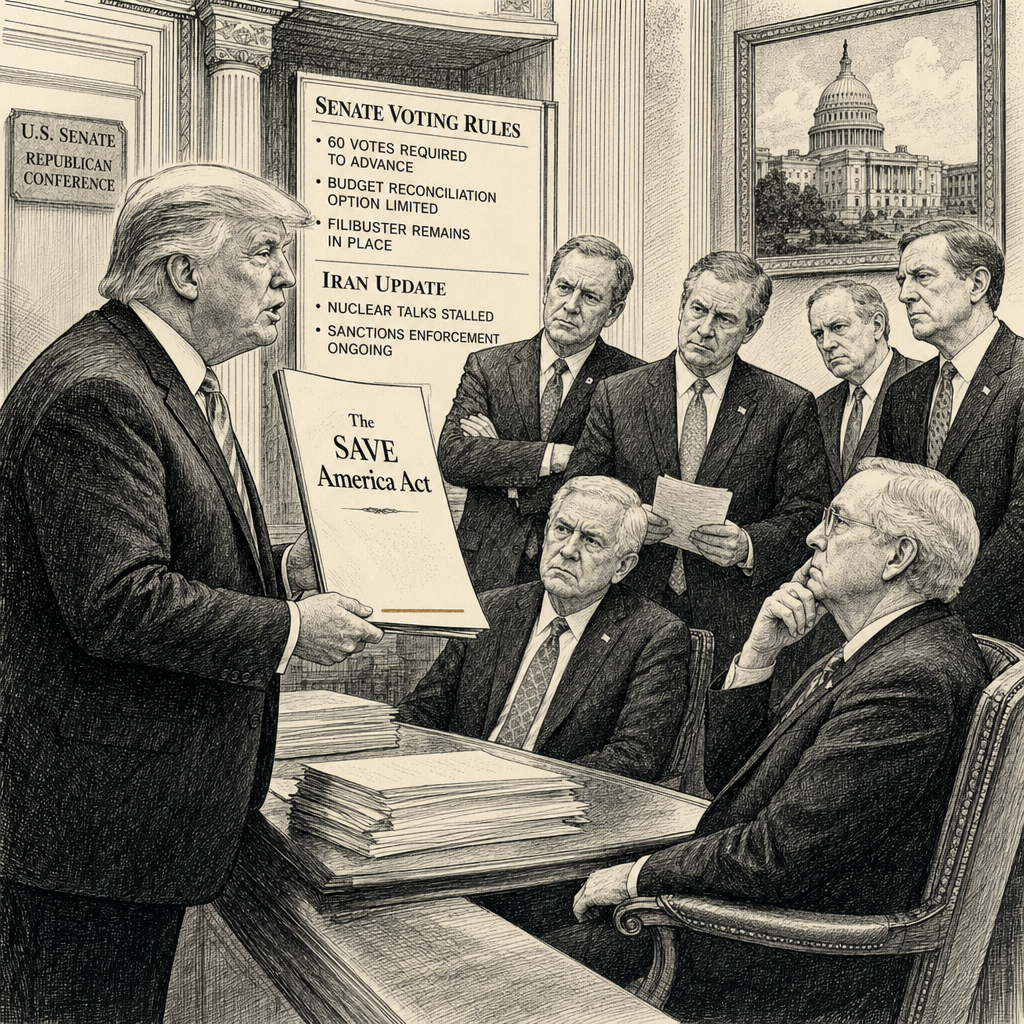
President Trump’s push for the SAVE America Act, which would tighten voting rules nationwide, faces resistance from a Republican Senate that has shown increasing willingness to break with him on both domestic and foreign policy. Senate Majority Leader John Thune and other GOP lawmakers have said the votes are not there for the president’s top priority.
“It’s true that Republicans have been deferential to the president to a point. That doesn’t seem to have done any good,” Sen. John Cornyn of Texas said. “That is, if you support the president, that doesn’t mean he’s going to support you.”
Trump is scheduled to visit Capitol Hill on Wednesday to press GOP lawmakers on the SAVE America Act, which he has called critical to the GOP keeping its majorities in Congress. Republicans hold a 53-47 majority but have not come close to the 60-vote filibuster threshold required under Senate rules. The lack of progress has prompted Trump to call for eliminating the filibuster or firing the current parliamentarian, moves Thune has rejected.
Sen. Mike Lee of Utah has pushed for months to spend more floor time on the SAVE America Act, pleasing Trump and irritating colleagues. The tensions boiled over in last week’s closed-door Senate lunch, in which Cornyn and Sen. John Kennedy of Louisiana confronted Lee, according to people familiar with the meeting.
Thune said he appreciates that Lee feels strongly about the issue. “But at the end of the day, I have to deal with reality,” Thune said. “And sometimes the alternative universe that is X doesn’t reflect the facts on the ground.”
While Trump pressures Republicans on the voting bill, many Senate Republicans are alarmed by what they have heard about the possible terms of a fragile peace deal with Iran, including easing sanctions and freeing up frozen cash. Sen. Ted Cruz of Texas said, “History demonstrates giving billions of dollars to theocratic lunatics who want to murder us is an exceptionally bad idea.”
Sen. Bill Cassidy of Louisiana, who was defeated by a Trump-backed primary challenger last month, said, “Right now Iran is ending up stronger than they started, and we’ve achieved none of the objectives originally laid out, so you might say that’s disappointing.”
Late Tuesday, Cassidy and three other GOP senators — Rand Paul of Kentucky, Susan Collins of Maine, and Lisa Murkowski of Alaska — crossed party lines to pass a nonbinding resolution to rein in Trump’s war powers. Senate Armed Services Committee Chairman Roger Wicker said he expected “a very productive family conversation” at Wednesday’s lunch.
Defense Secretary Pete Hegseth is scheduled to offer a classified briefing to House Republicans on Wednesday about a record-setting $1.5 trillion defense budget proposal, according to a senior Defense Department official. The proposal includes $1.1 trillion for the Defense Department for the next fiscal year plus $350 billion for munitions and industrial base expansion. It does not include an additional $80 billion that the Pentagon expects to request to cover Iran war costs.
Sen. John Hoeven of North Dakota said he expected the request for additional Iran war funding to come up at lunch, and he would advocate to include farm aid and disaster aid. If all three elements are included, Hoeven said, “I think it has a better chance to pass.”