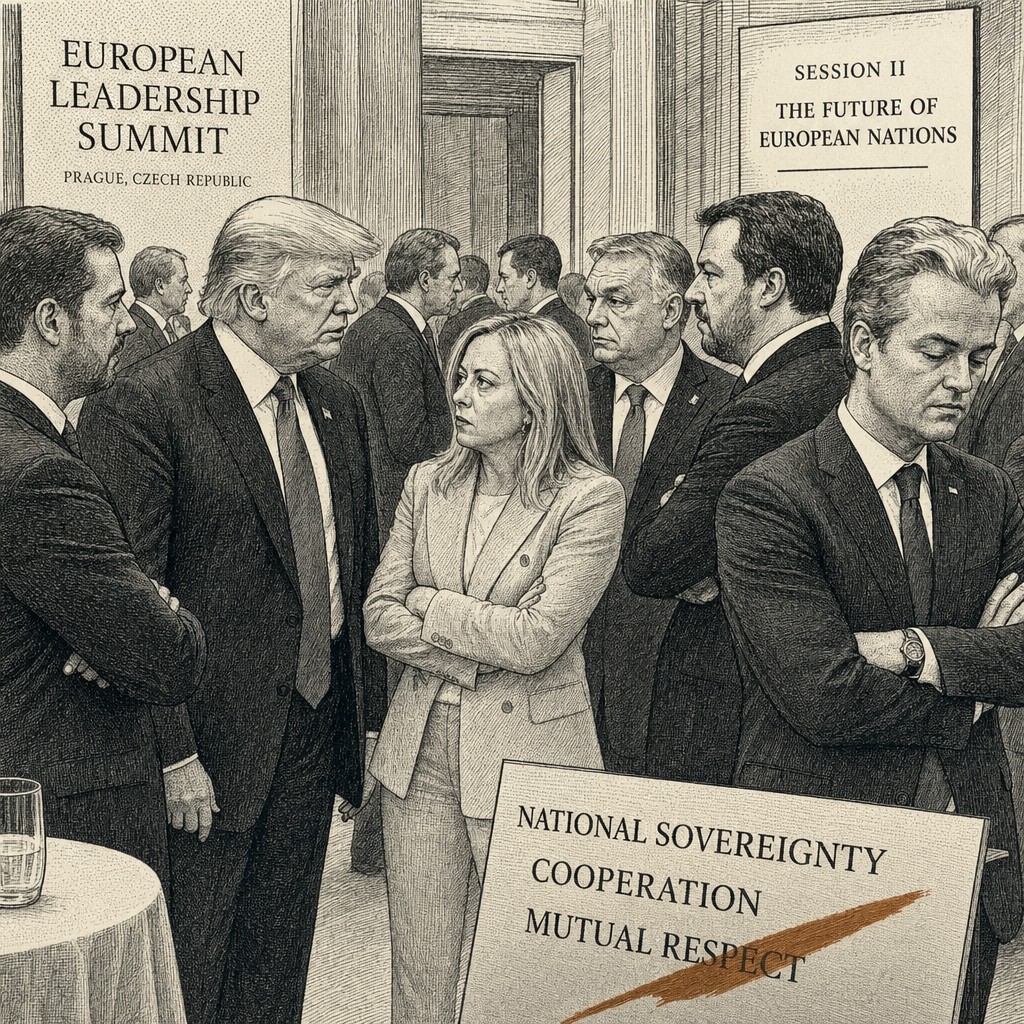
ROME — European nationalist right politicians who once gathered under the slogan “Make Europe Great Again” are now distancing themselves from President Donald Trump, with a public feud between Trump and Italian Prime Minister Giorgia Meloni highlighting the depth of the rupture. The break reflects Trump’s unpopularity among European voters and the tensions caused by the Iran war.
In early 2025, politicians including France’s Marine Le Pen, Italy’s Matteo Salvini and Hungary’s Viktor Orban attended a Madrid rally where Le Pen said, “We, the nationals of Europe, are the only ones who can talk to the new Trump administration.” Many of those same figures have since distanced themselves from a U.S. president they now see as a political liability.
The shift became starkly visible in recent days when Trump told an Italian morning TV show that Meloni had “begged” him for a photo opportunity at the Group of Seven summit in France. Meloni, who had attended Trump’s 2025 inauguration and worked to preserve ties despite Trump’s tariff threats and his push to seize Greenland, responded with a video message that showed the combative style for which she is known at home. “I and Italy never beg,” she said.
The dispute escalated when Trump posted on social media that Meloni “asked me over and over for a picture” during the summit. “She wants to be friends again in order to get her ‘numbers up.’ No thanks!!!” Trump wrote. Meloni answered: “These constant, unprovoked attacks are senseless. As for my popularity, being your friend certainly has not helped.”
Trump’s approval ratings are now underwater even among the nationalist right electorate, according to polling cited by supporters of Meloni’s Brothers of Italy party and Farage’s Reform UK. A survey of British voters found 37% listed Farage’s support for Trump as their top reason not to back Reform.
Le Pen and her allies have distanced themselves as French public opinion turned against Trump. Orban lost his re-election bid by a wide margin despite a campaign visit from Vice President JD Vance. The Alternative for Germany party, which once styled itself as Trump’s closest German partner, has said the war in Iran is not in Germany’s interest. AfD official Tino Chrupalla said in March: “Donald Trump started as a president of peace. In the end, Donald Trump will end as a president of war.”
Italy’s refusal to allow the U.S. military to use an air base in Sicily for airstrikes in Iran drew Trump’s anger; he said Saturday it caused “great logistical inconvenience.” Italy’s government responded that such operations require advance parliamentary approval.
Meloni, who opposed the Iran war from the start, also came to the defense of Pope Leo XIV after Trump attacked the pontiff’s condemnation of the war, calling Trump’s insults “unacceptable.” Political analyst Lorenzo Castellani of LUISS Guido Carli University in Rome said: “For these parties, it was always going to be difficult to defend the interests of the U.S. over the interests of their own nation states. Everyone is fleeing from Trump—both because of what he says and because of the Iran war, which has neither strengthened his status at home nor abroad.”
Despite the tensions, Meloni was caught on camera at the G-7 summit saying she and Trump “never stopped being friends.” The public spat that followed suggested otherwise, as Trump questioned her motives and she pointedly advised him to focus on his own approval ratings.