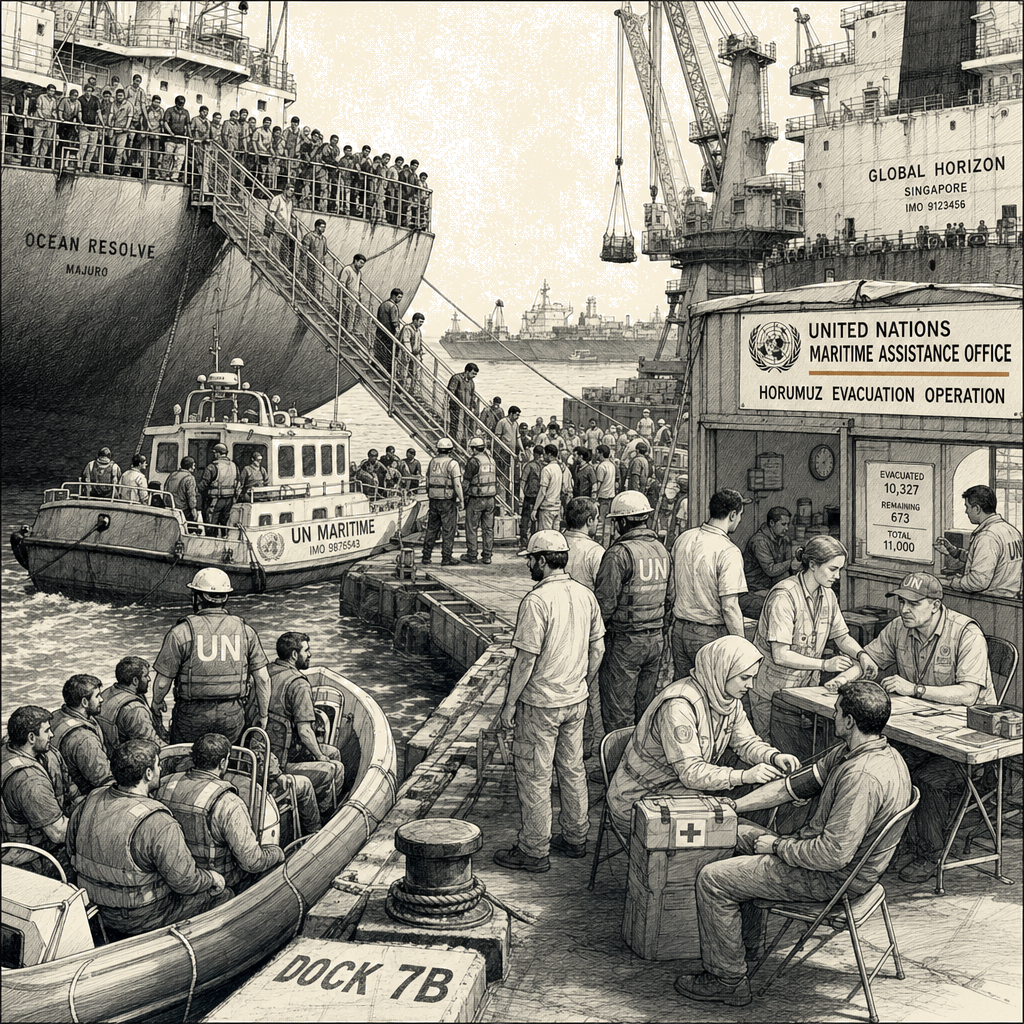
The International Maritime Organization said Tuesday it will begin evacuating thousands of sailors who have been stranded aboard their vessels near the Strait of Hormuz since the United States launched military operations against Iran on Feb. 28.
The U.N. maritime agency said approximately 11,000 seafarers have been stuck on ships in and around the strategic waterway as the conflict brought maritime traffic through the strait to a near standstill. Iran effectively closed the strait to shipping after the initial U.S. and Israeli attacks, causing global gas prices to climb and deepening an energy crisis. The United States responded by imposing a naval blockade on Iranian ports, cutting Iran off from sea-based trade.
IMO Secretary-General Arsenio Dominguez said Tuesday that the agency would implement a large-scale evacuation plan.
“We have secured the necessary safety guarantees and have thoroughly verified the conditions for safe navigation to support these operations,” Dominguez said in a statement. “We remain fully committed to ensuring the safety of seafarers and the continuity of global trade.”
Dominguez said the plan involves coordination with Iran, Oman, the United States and other coastal nations, but did not provide specific details on the evacuation’s timeline or logistics.
The announcement comes one week after the United States and Iran signed a Memorandum of Understanding on June 17 committing both countries to working toward ending the war. Dominguez said he welcomed the agreement “with deep satisfaction,” calling it “a decisive step toward restoring maritime security and bringing to an end the unacceptable attacks against civilian shipping.”
MSI previously reported on the growing strain on ship crews as the Strait of Hormuz remained shut in late April, when vessels and their crews were stuck in place with no clear timeline for reopening the waterway.
The Strait of Hormuz is a vital maritime energy shipping route through which about a fifth of the world’s oil passes. Its closure during the conflict disrupted global energy markets and heightened economic pressure on countries dependent on Gulf oil.