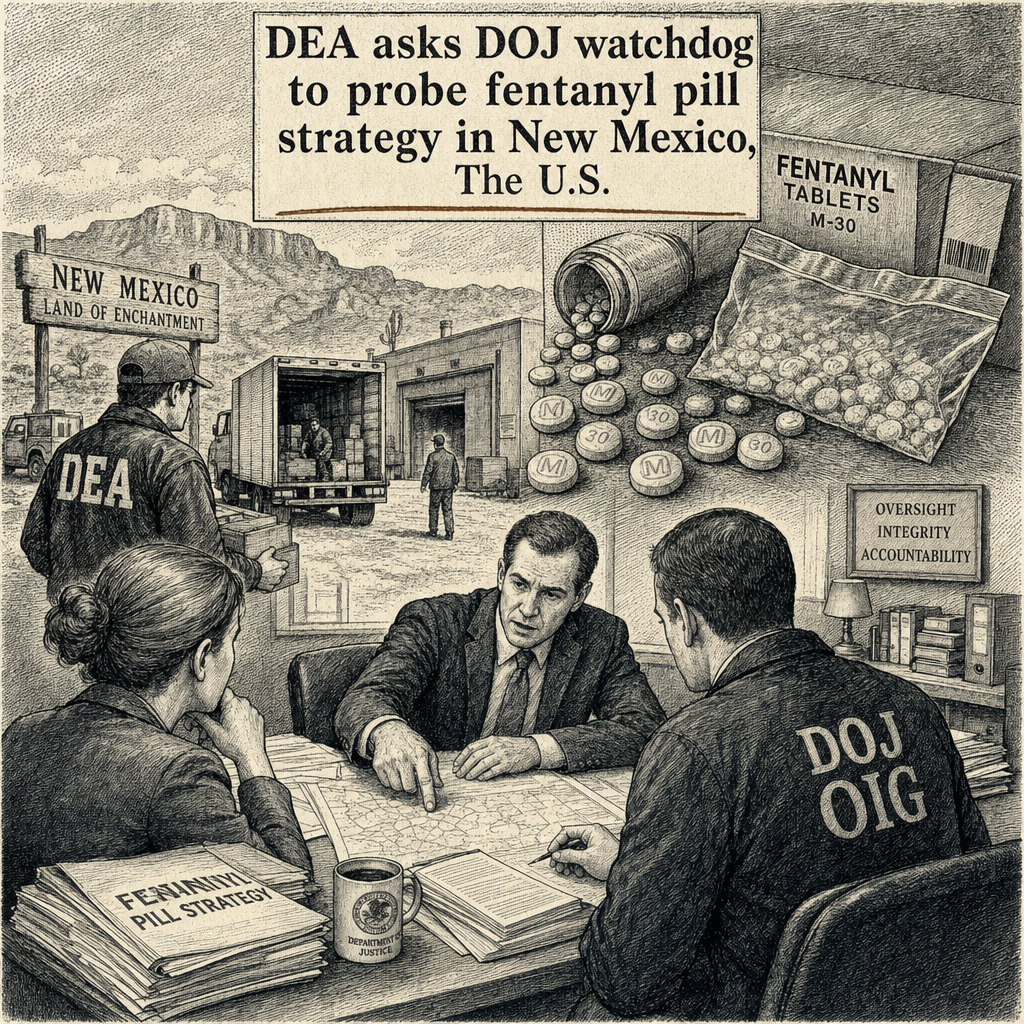
The Drug Enforcement Administration on Thursday asked the U.S. Justice Department’s internal watchdog to investigate whistleblower claims that DEA agents permitted hundreds of thousands of fentanyl pills to reach the streets of New Mexico, escalating a controversy over the agency’s drug enforcement tactics.
DEA Administrator Terry Cole sent a letter Thursday to the Justice Department’s Office of Inspector General requesting the probe, writing that “the allegations have generated significant public attention and have raised questions regarding DEA’s operational decisions, supervisory oversight, and response to concerns,” according to a copy of the letter provided by the DEA.
The request came days after an Associated Press investigation found that DEA agents repeatedly monitored — but declined to seize — large shipments of fentanyl between 2023 and 2025 in a strategy aimed at building larger criminal cases against higher-ranking traffickers.
In a public statement accompanying the request, Cole wrote that his decision “should not be interpreted as reflecting any lack of confidence in the professionalism or integrity of DEA personnel or in the investigative decisions made during this matter.”
The federal inquiry runs parallel to a separate state-level call for action. New Mexico Gov. Michelle Lujan Grisham on Wednesday asked the state’s attorney general to investigate whether the DEA’s actions violated New Mexico law, describing the AP’s findings as an extraordinary challenge to federal law enforcement authority at a time when fentanyl remains one of the nation’s deadliest public health threats.
MSI previously reported that the DEA permitted hundreds of thousands of fentanyl pills to be distributed in New Mexico between 2023 and 2025 as agents monitored shipments without seizing them, according to three current and former DEA agents and internal government records reviewed by the Associated Press in a previous article.
The governor’s call for a criminal review shifts the debate from enforcement tactics to the question of whether federal agents themselves crossed legal lines. Fentanyl has been designated by the White House as a weapon of mass destruction, and the drug remains a driver of overdose deaths across the country.