- A new bipartisan consortium, RAISE US, launched Thursday to prepare the U.S. workforce for AI-driven disruption, led by former Commerce Secretary Gina Raimondo and former Indiana Gov. Eric Holcomb.
- The group includes state governments, employers including Amazon, Microsoft, Bank of America and Eli Lilly, and philanthropic organizations.
- RAISE US plans to develop policy changes such as modifying unemployment insurance to allow displaced workers to keep benefits while starting AI-related businesses, and to test corporate incentives for employers that retrain rather than lay off workers.
- Former Indiana Gov. Eric Holcomb said the scale of job reshaping from AI “is different — and more so than it has ever been, I think, in human history.”
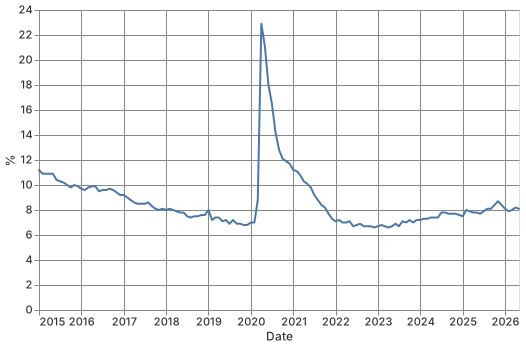
- The broader U-6 underemployment rate — which counts discouraged workers and involuntary part-time workers — stood at 8.1% as of the latest data, providing a measure of slack in the labor market as AI disruption begins.
A new bipartisan consortium called RAISE US launched Thursday with a mission to prepare the U.S. workforce for potential disruption from artificial intelligence, bringing together state governments, major employers, and philanthropic groups to develop what its leaders described as a comprehensive “people strategy” for the AI era.
The effort, led by former Commerce Secretary Gina Raimondo and former Indiana Gov. Eric Holcomb, a Republican, aims to move beyond traditional retraining programs and reconsider policies such as unemployment insurance as a way to help workers whose jobs may be reshaped or eliminated by AI. The group’s formation reflects growing concern among business leaders and policymakers that the scale of AI-driven labor market change could exceed anything the country has previously experienced.
“With AI, there’s an enormous amount of money and focus right now on winning the technology: the chips, the models,” Raimondo, the group’s chief executive, told The Wall Street Journal. “There’s not enough attention on securing the future for the American worker.”
The consortium’s mandate is to “pull all the levers at once,” Raimondo said. That includes collaborating with employers to help workers gain new skills or transition to new roles, working with educators on training programs, and proposing policy changes. One idea under discussion is modifying unemployment benefits so that displaced workers can continue receiving them while, for example, starting new businesses that use AI.
RAISE US will also explore corporate incentives designed to encourage employers to retain workers whose jobs are disrupted by AI and prepare them for new positions, rather than laying them off, according to the Journal.
The group includes state governments and employers across industries, including Amazon.com, Microsoft, Bank of America, and Eli Lilly. Brad Smith, vice chair and president at Microsoft, said a more comprehensive approach is needed. “We’re going to need to scale, and scaling can never be done by single institutions,” Smith said.
U.S. workforce development efforts are currently highly fragmented across state governments and federal agencies, which can be confusing for job seekers, the Journal reported. Some business leaders said a more coordinated approach is necessary, particularly for white-collar roles that are most vulnerable to AI.
The Leadership Now Project, a group of more than 400 current and retired business executives, devoted several sessions at its annual spring meeting to AI’s potential threat to jobs, comparing it to the effects of globalization and offshoring in recent decades. Holcomb said the current moment is different in scale. “The scale of change and reshaping of jobs and careers is different — and more so than it has ever been, I think, in human history,” Holcomb said.
The RAISE US work will vary by state. In Maryland, the group plans to expand a service-year option to help people gain exposure to growing fields such as healthcare. An effort in Arkansas will focus on supporting an AI-powered career navigation platform.
Raimondo said she believes AI will bring significant benefits but said she remains worried about workers who could be left behind. “I personally don’t believe there’ll be nothing for humans to do, so we’re just going to sit around and take up leisure time,” Raimondo said. “But I am worried — obviously, I wouldn’t be doing this if I weren’t worried.”
The broader U-6 underemployment rate — a measure that includes discouraged workers who have stopped looking and people working part-time who want full-time work — stood at 8.1% as of the most recent data, providing a baseline measure of labor market slack as the group begins its work. The Dow Jones Industrial Average closed at 51,848.9.
The launch of RAISE US comes as a series of efforts to address AI’s labor market impact have emerged in recent months. MSI previously reported that economists surveyed by The Wall Street Journal broadly agreed that AI will boost productivity but were divided on whether it will eliminate more jobs than it creates over the next five years, and that the banking industry is grappling with how AI tools are reshaping entry-level and mid-career roles.