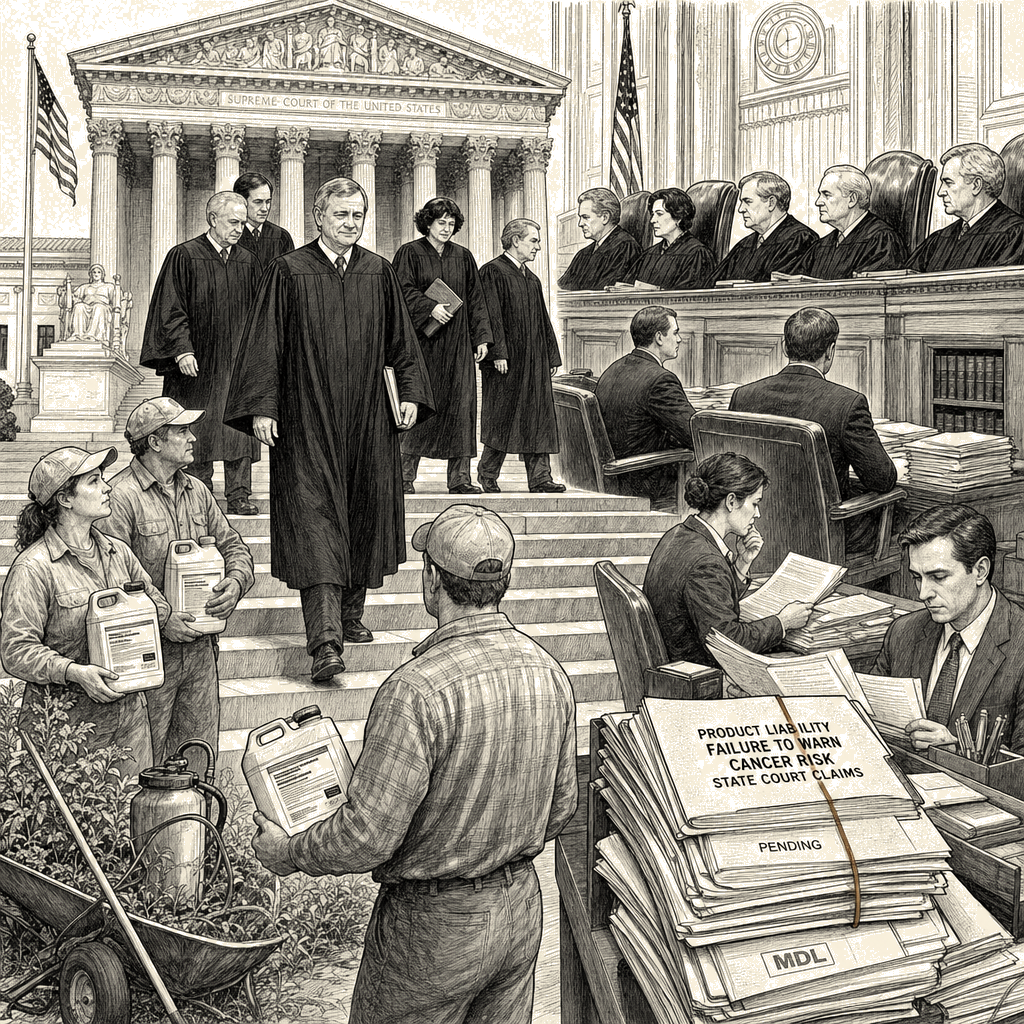
The Supreme Court ruled Thursday that Monsanto cannot be held liable under state law for failing to warn consumers about the alleged cancer risks of its weedkiller Roundup, handing a major victory to the company’s owner Bayer as it seeks to resolve thousands of pending lawsuits.
The 7-2 decision, written by Justice Brett Kavanaugh, held that the Federal Insecticide, Fungicide, and Rodenticide Act — known as FIFRA — expressly preempts state failure-to-warn claims against the company because the Environmental Protection Agency has not required a cancer warning on Roundup’s label. The ruling could result in the dismissal of thousands of pending cases and bar future claims based on failure-to-warn theories.
The case was brought by John Durnell, a Missouri gardener who sued Monsanto in 2019 under state law, alleging that glyphosate, the active ingredient in Roundup, caused him to develop non-Hodgkin lymphoma. A jury awarded him $1.25 million in damages.
Monsanto, now owned by Bayer, argued that FIFRA gives the EPA sole authority to set pesticide labels and that allowing state juries to impose additional warnings would undermine the federal regulatory scheme. The company’s lawyer, former Solicitor General Paul Clement, told the justices during oral argument in April that “you shouldn’t let a single Missouri jury second-guess that judgment.”
The current U.S. Solicitor General, John Sauer, sided with Monsanto in the case.
“Because Durnell’s state tort claim would impose a pesticide labeling requirement ‘in addition to or different from’ the label required by EPA, FIFRA expressly preempts Durnell’s claim,” Kavanaugh wrote in the majority opinion.
Justice Ketanji Brown Jackson filed a dissenting opinion, joined by Justice Neil Gorsuch. Jackson wrote that the majority “misunderstands FIFRA’s requirements, misinterprets the scope of FIFRA’s preemption, and ultimately leaves Durnell without a remedy for the significant harms he has suffered.” She argued that adding a cancer warning does not conflict with the federal law.
Ashley Keller, an attorney for Durnell, had argued during oral arguments that Congress has been debating a “golden shield” for the company as part of the farm bill, but until Congress acts, state juries should still be able to evaluate such cases.
Bayer has faced more than 100,000 lawsuits over Roundup since acquiring Monsanto in a $63 billion deal in 2018. The company has set aside billions to settle existing cases and is working to secure court approval for a proposed $7.25 billion settlement to resolve most current and future claims. As MSI previously reported, that settlement has faced delays as parties dispute which court should oversee it. The venue fight continues, with a state-court opt-out deadline of June 4 and a scheduled July 9 hearing.
In a statement, a Bayer spokesperson said Thursday’s decision was “good for science, farmers, and industries that depend on regulatory clarity for innovation” and said it “should help significantly contain the Roundup litigation after nearly a decade of legal battles.”
Bayer’s stock, which trades in Germany, spiked about 17% on Thursday. Investor optimism that Bayer will get the litigation under control had already sent the company’s stock up about 50% over the past 12 months prior to Thursday.
Bayer has long maintained that Roundup is safe to use. The EPA has repeatedly determined that glyphosate is not likely to be carcinogenic in humans and does not require a cancer warning label. The World Health Organization’s International Agency for Research on Cancer, however, classified glyphosate as “probably carcinogenic to humans” in 2015.
Scores of protesters appeared in front of the Supreme Court in late April to support people who say they were harmed by the weedkiller, in allegiance with the Make America Healthy Again movement. President Trump has signed an executive order to boost domestic production of glyphosate, which has contributed to a rupture between the White House and some MAHA supporters.
The ruling is a significant victory for Bayer Chief Executive Bill Anderson, who took over the German conglomerate in 2023 with a mandate to steer it through the litigation. Bayer, which produces about half the world’s glyphosate, has said it could stop producing the chemical if it cannot get the litigation under control.