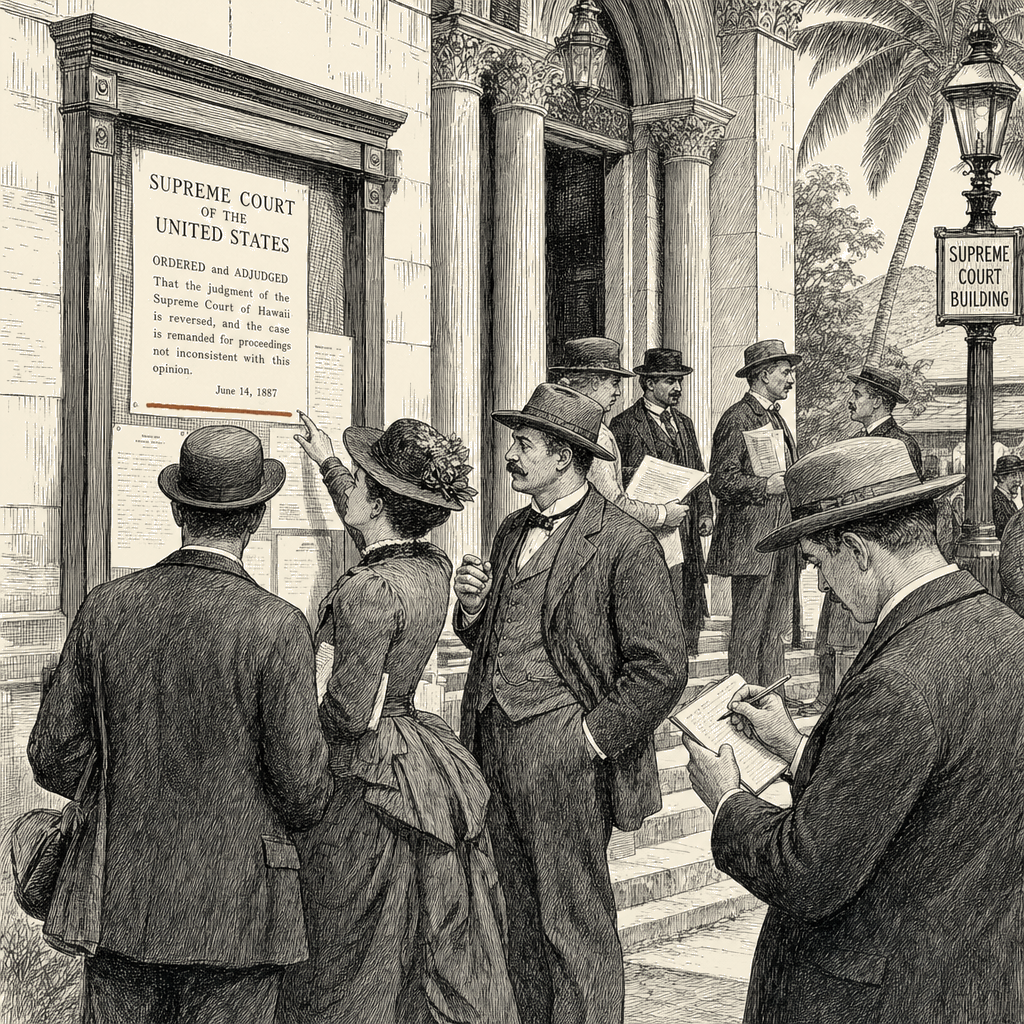
The U.S. Supreme Court on Thursday struck down a 2023 Hawaii law that barred concealed-carry permit holders from bringing firearms onto private property open to the public, ruling the restriction violated the Second Amendment.
The 6-3 decision, the latest major gun rights ruling since the court’s landmark 2022 decision in New York State Rifle & Pistol Association v. Bruen, held that the law’s default prohibition on carrying firearms in private businesses, restaurants, parking lots, and other privately owned spaces that are accessible to the public was inconsistent with the nation’s historical tradition of firearm regulation.
The challenged law, enacted in 2023, created a list of more than a dozen “sensitive places” where guns could not be carried, including beaches and restaurants that serve alcohol. It also barred carrying a firearm on any private property without the explicit permission of the property’s owner, effectively making the default rule a prohibition on carrying in most commercial and public-facing spaces.
Three Maui residents who held permits to carry concealed firearms, together with the Hawaii Firearms Coalition, sued the state. The plaintiffs argued that the definition of “sensitive places” was so broad that it encompassed “all places of public congregation,” according to the complaint they filed against Hawaii’s attorney general. They contended that the law violated the Second Amendment under the standard set by the Bruen decision, which requires gun regulations to be “consistent with the nation’s historical tradition of firearm regulation.”
The case was the latest in a series brought before the court based on the Bruen precedent, which still has the potential to void many state restrictions, such as limits on carrying firearms in public or lifetime bans for people convicted of violent and non-violent crimes.
In the first major case to follow Bruen, the 2024 decision in United States v. Rahimi, the conservative majority chose to uphold a 30-year-old federal law that prohibits people subject to domestic violence restraining orders from possessing guns. In the same term, the court took up Garland v. Cargill, which led to the repeal of a ban on the sale of bump stocks, a device that allows semi-automatic rifles to fire at speeds comparable to machine guns. The bump-stock ban had been imposed during the first Trump administration after the devices were used in the 2017 mass shooting at a music festival in Las Vegas that killed 60 people. Unlike Rahimi, the Cargill case centered not on whether bump-stock bans violate the Second Amendment under Bruen, but on whether the Bureau of Alcohol, Tobacco, Firearms and Explosives had overstepped its statutory authority.