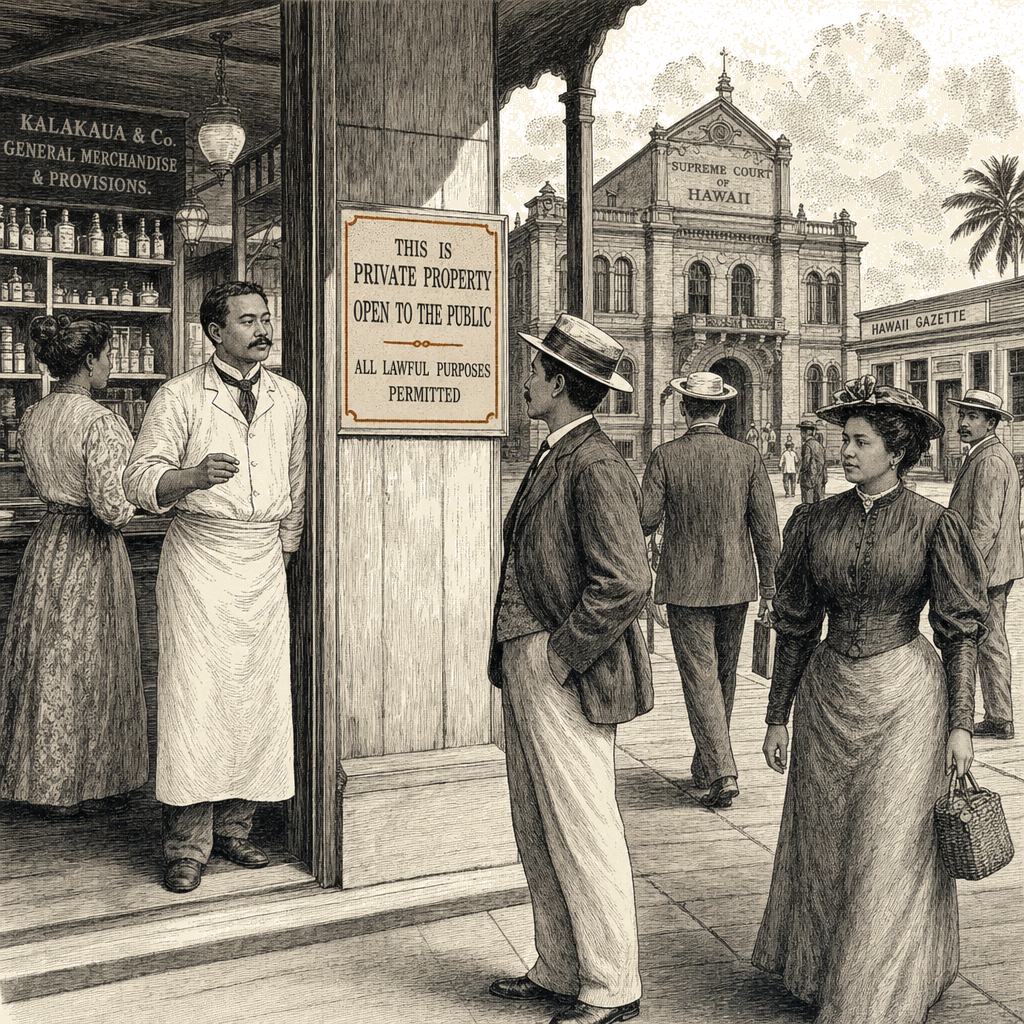
The Supreme Court on Thursday struck down Hawaii’s law that prohibited people from carrying firearms onto privately owned, publicly accessible property — such as stores, gas stations, and hotels — without the explicit permission of the property owner. The 6-3 decision, written by Justice Samuel Alito, held that the state’s default rule requiring advance authorization imposed an unconstitutional burden on the Second Amendment right to carry a gun for self-defense.
Under the new Hawaii law, Alito wrote, no one carrying a firearm could enter without the property owner’s express authorization, and the effect was to impose severe restrictions on the daily activities of residents who had satisfied the state’s rigorous requirements for a carry permit.
The law, sometimes called a “vampire rule,” drew its name from Bram Stoker’s 1897 novel Dracula, in which the vampire Count cannot enter a home unless invited. Critics of the rule argued that requiring gun owners to seek permission before entering stores, restaurants, and other public-facing private spaces effectively made the default on most private property a ban on carrying firearms.
The decision divided the court along ideological lines, with the six Republican-appointed justices voting to strike down the law and the three Democratic-appointed justices voting to uphold it. The ruling is the latest in a wave of cases testing the boundaries of the Second Amendment since the court’s landmark 2022 decision in New York State Rifle & Pistol Association v. Bruen. That case established a new test requiring modern gun restrictions to be consistent with the nation’s historical tradition of firearm regulation.
Supporters of Hawaii’s law argued that at the time of the founding, numerous state laws prohibited entry onto private property without the owner’s express consent, providing a historical basis for the rule. Opponents countered that requiring permission for each entry would turn the vast majority of public-facing private property into gun-free zones by default, since most property owners do not post signs authorizing firearm possession.
The Supreme Court sided with those challenging the law, Alito wrote, because requiring permission in advance is an undue burden on the right to possess and carry a firearm for self-defense as people go about their daily lives.
In addition to Hawaii, similar laws were in effect in California, Maryland, New York, and New Jersey. The Thursday ruling invalidates those statutes as well, unless states can craft narrower versions that pass the historical test established in Bruen.
The decision comes shortly after the court ruled unanimously on June 18 that the federal government cannot automatically bar all users of illegal drugs from owning guns, striking down a separate firearms restriction. That case also relied on the historical-tradition framework from the 2022 decision.
Since the Bruen ruling, lower courts have issued widely varying judgments on challenges to gun laws, creating confusion about the scope of the Second Amendment. According to an analysis by scholars at Southern Methodist University, the Brennan Center for Justice, and the RAND Corporation, nearly 100 gun laws were successfully challenged in the year after the 2022 decision.
Thursday’s ruling marks the Supreme Court’s latest intervention in the post-Bruen landscape. In 2024, the court upheld a federal law preventing domestic abusers from owning guns in United States v. Rahimi, a case that had been struck down by a lower court before the high court reversed.