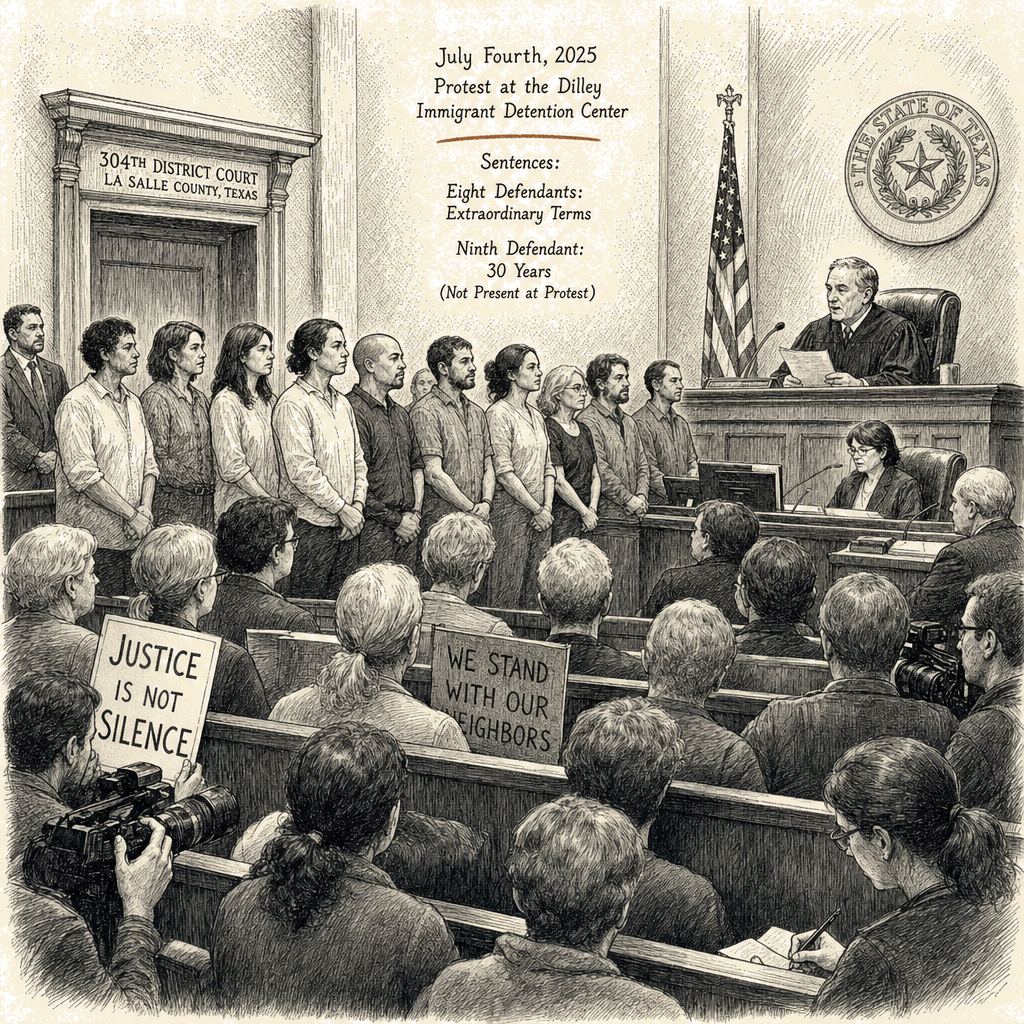
A federal judge on Tuesday sentenced eight people to prison terms ranging from 50 to 100 years and a ninth defendant to 30 years in connection with a July Fourth 2025 protest at the Prairieland ICE detention facility in Alvarado, Texas, in a case that civil liberties advocates described as an extraordinary escalation in the criminalization of political dissent under the Trump administration.
The sentences have drawn condemnation from First Amendment groups and sparked concern among sentencing experts, who said the combined lengths are exceptionally harsh compared with typical federal sentences, even for violent offenses. All nine defendants were convicted in March on charges including riot, providing material support to terrorists, and firearms or explosives charges.
“This is a travesty and totally unjustified, but that’s the point,” Rep. Rashida Tlaib, D-Mich., posted on X. “Americans hate the fascist Trump regime, so the only way they can try to cling to power is brute force. More bullshit ‘terrorism’ charges like these are coming.”
The case has been closely watched as the first to go to trial after the Trump administration vowed to crack down on “antifa” — a loosely defined constellation of leftwing ideologies, not a formal organization. Prosecutors described the defendants as part of “antifa” and brought terrorism charges that the administration has cited in public statements as evidence it is prosecuting antifa terrorists. The actual terrorism charge on which the jury returned a conviction, however, is not connected to ideology, according to court records.
Of the eight people who participated in the protest, five received 50-year prison sentences, including two individuals who arrived late to the protest, left when guards asked them to, and were not involved in planning. Maricela Rueda was sentenced to 70 years. Benjamin Song, who fired a single shot that struck a police officer, received 100 years.
MSI previously reported that eight defendants received a combined 450 years in sentencing earlier this week here.
The 30-year sentence for Daniel Sanchez-Estrada, who did not take part in the protest, has drawn particular alarm. Sanchez-Estrada, the husband of defendant Maricela Rueda, was convicted of moving boxes containing leftwing zines and other materials after a prison phone call from his wife. In a statement, the Freedom of the Press Foundation’s chief of advocacy, Seth Stern, said the zines are “no different from the pro-Revolution pamphlets this country’s founders had in mind when they drafted the first amendment’s press clause.”
“Sanchez’s case is the latest example of the Trump administration grasping at any legal straws it can to criminalize disfavored ideologies and writings,” Stern said. “Americans should not make the mistake of believing Sanchez’s sentence only threatens immigrants, leftists or so-called antifa members — they’re just the low-hanging fruit, not the endgame.”
The two judges overseeing the sentencing — Trump appointee Mark Pittman and George W. Bush appointee Reed O’Connor — stacked sentences for multiple convictions, a practice that sentencing experts said produced the unusually lengthy terms.
“It’s relatively unusual to see that kind of stacking,” said Mark Osler, a law professor and sentencing expert at the University of St. Thomas in Minneapolis. “Usually the sentence for the core offense is pretty harsh in the federal system, frankly, and there’s no need to pile things on.”
O’Connor explained his harsh sentences as necessary to send a message, calling the attack an “assault on democracy” and saying “the need to deter this type of conduct is high,” according to the Associated Press.
The government’s sentencing recommendations remain sealed, but experts said a terrorism enhancement under federal sentencing guidelines likely inflated the recommended ranges. The enhancement increases both the offense level and the criminal history calculation, producing what Douglas Berman, a law professor and sentencing expert at Ohio State University, called a “double whammy.”
“I still can say these are extreme sentences,” Berman said.
Even with guideline recommendations, judges have wide discretion to impose shorter terms. Osler noted that judges “very often go below the guidelines, much more often than they go above.” He pointed to a recent case in Maryland where a federal judge sentenced a woman who pleaded guilty to attempting to assassinate Supreme Court Justice Brett Kavanaugh to eight years, despite guidelines recommending 30 years to life. The Justice Department is appealing that sentence as too lenient.
“The 30-year sentence for Estrada is probably the one that for most people will come closest to shocking the conscience,” Osler said, noting that Sanchez-Estrada’s conduct occurred after the harm was already done and involved moving materials within a family context. “Frankly, which many people can imagine themselves doing in a similar situation.”
Frank Gatto, a federal prosecutor, said during sentencing that “people with that kind of extremist beliefs need extra time in prison. They believe violence is justified.”
Phillip Hayes, an attorney for Song, described the defendants as “a bunch of kids and young adults who really have a really big heart and really wanted their voice to be heard. It was never intended that anybody get hurt. It was never intended that any shots would be fired.”
Lydia Koza, whose wife, Autumn Hill, was sentenced to 50 years, told the Associated Press: “The government wants to take her entire life away because she attended a protest. Nobody died.”
All nine defendants are expected to appeal both their convictions and sentences.