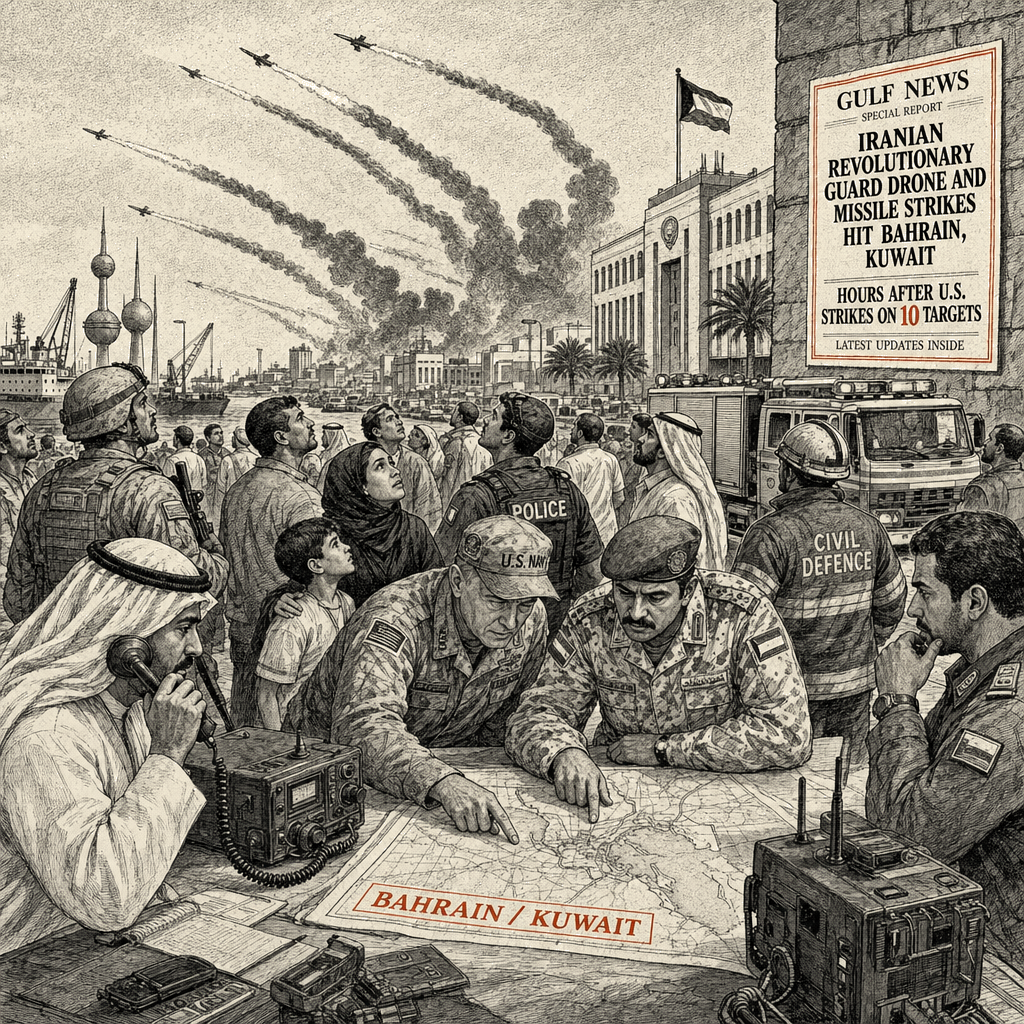
Iran’s Revolutionary Guard claimed responsibility for launching drone and missile attacks on Bahrain and Kuwait on Sunday, according to a statement carried by Iranian state media. The strikes came after U.S. Central Command said it had hit 10 Iranian military targets late Saturday, including surveillance infrastructure, communication systems, air defense sites, drone storage facilities and minelayer capabilities.
The U.S. military said the operation was in response to an Iranian attack Saturday on a Panamanian-flagged tanker, the Kiku, near the Strait of Hormuz. The vessel was carrying crude oil for Qatar’s state-run energy company, and Qatar has served as a key mediator between Iran and the U.S.
Kuwait said on Sunday that its air defenses intercepted two Iranian ballistic missiles, reporting no injuries or damage. Bahrain’s Interior Ministry said Iranian munitions hit a residential building near the international airport, destroying its top floor and blowing out windows. The ministry reported no fatalities. Bahrain’s Foreign Ministry condemned what it called “a dangerous escalation” and described the attacks as “a deliberate approach and a systematic pattern of repeated aggression.”
Sunday’s exchange was the most significant since Iran and the U.S. signed a memorandum of understanding earlier in June, giving both sides 60 days to resolve key disputes including shipping arrangements in the Strait of Hormuz, the removal of a U.S. blockade on Iranian ports, sanctions relief and the future of Iran’s stockpile of highly enriched uranium.
Iranian Foreign Minister Abbas Araghchi restated Tehran’s position on Sunday, saying that any attempt to establish new arrangements for the Strait of Hormuz would “only lead to further complications, delay the reopening of the Strait of Hormuz and increase the level of tension.” Iran insists it alone must govern the waterway. The Revolutionary Guard warned that Iran could halt negotiations entirely if U.S. military action continued, according to a social media post by Iranian state-run media.
In a social media post, President Trump accused Iran of violating the ceasefire. “There may come a point when we are no longer able to be reasonable, and will be forced to militarily complete the job that we very successfully started,” he said, adding, “If that happens, the Islamic Republic of Iran will no longer exist!”
Separately, violence between Israel and Hezbollah in southern Lebanon continued to stoke regional tensions. On Sunday, the Iranian-backed militant group killed an Israeli soldier in Deir Siryan village in southern Lebanon, according to Israel’s military, which said it responded by killing the man responsible. Hezbollah’s leader said a day earlier that the group would fight on until Israel withdraws from southern Lebanon, according to a statement carried in a pro-Hezbollah local media outlet. Israel’s military chief of staff, Lt. Gen. Eyal Zamir, warned that Israeli forces were “prepared to rapidly resume offensive operations in both Lebanon and Iran if required,” according to Israeli media. The ceasefire signed earlier this month did not include Iran or Hezbollah.