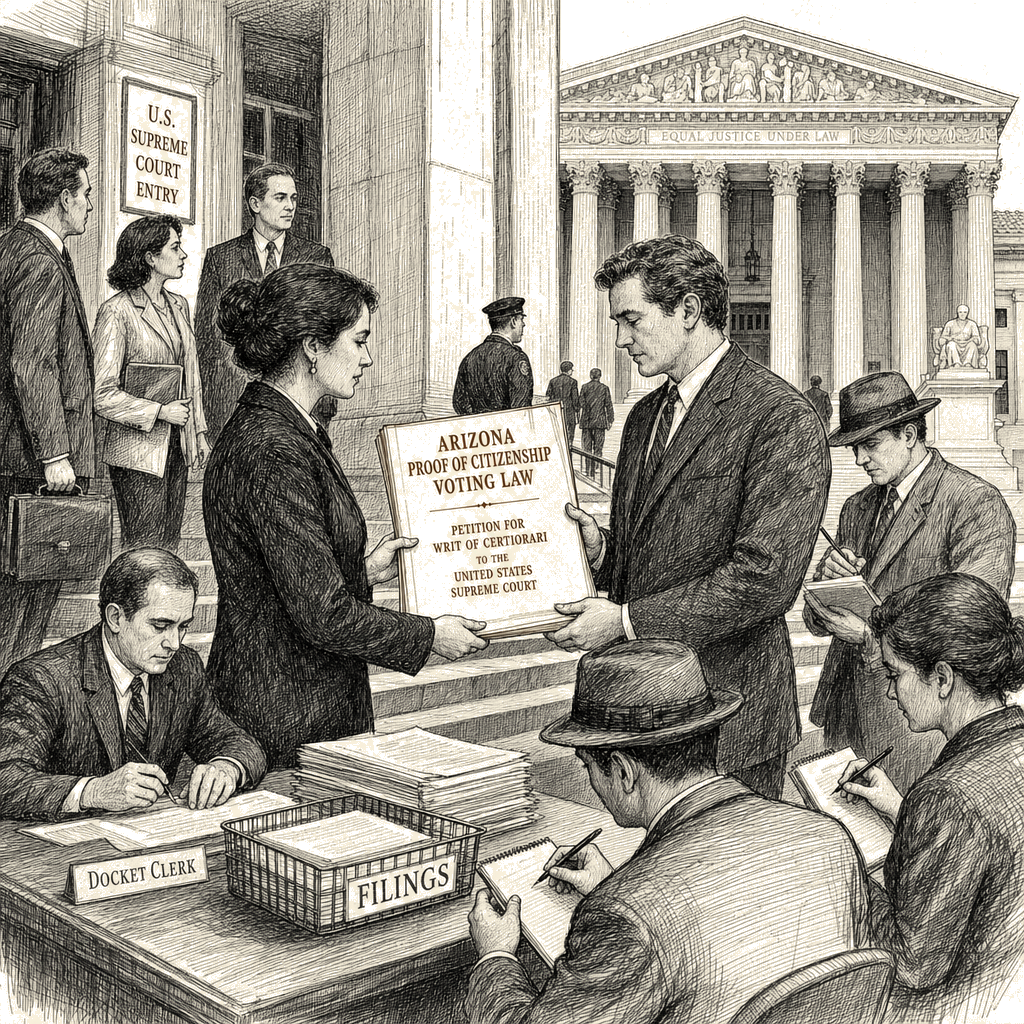
The U.S. Supreme Court on Monday agreed to hear a case over Arizona’s election law requiring voters to provide documentary proof of citizenship when registering to vote, setting up an election-law dispute for the term that begins in October.
The high court will consider whether federal law prohibits states from demanding such documentation for state elections. Noncitizen voting is already illegal in federal and state elections, though some municipalities allow noncitizen voting in local contests.
The Arizona legislature in 2022 adopted a law requiring voters to provide proof of citizenship when registering using a state form. Acceptable documentation under Arizona’s law includes a birth certificate and a U.S. passport.
The legislature also passed a separate law outlining how state election officials review voter rolls and establishing a procedure to cancel the registrations of noncitizens.
The legal challenge was brought by Mi Familia Vota and Voto Latino, two nonprofit advocacy organizations. The Republican National Committee appealed after a lower court struck down the proof-of-citizenship requirement.
President Donald Trump, who has advocated for a national proof-of-citizenship requirement, has repeated what UPI described as “unfounded claims” of election fraud. The SAVE Act, a bill under consideration in Congress that Trump supports, would impose a proof-of-citizenship requirement for federal elections.