Analysts issued a series of health care sector assessments Tuesday, with labor disputes and weak consumer spending creating headwinds for some companies while regulatory approvals and new product developments fueled optimism for others.
Labor and production risks. Daiwa Capital’s Yoonki Bae said labor unrest at Samsung Biologics could weigh on earnings at the South Korean contract drug manufacturer. The union is demanding an average 14% increase in base salary and a performance-based bonus equal to 20% of operating profit, according to the analyst. Bae said this could undermine the rationale for the company’s valuation premium, which has been supported by historically higher profitability and revenue growth than its global peers. He expects the impact of a partial strike and production disruptions in May to be recognized in the third quarter. Daiwa trimmed its target price for the company by 3% to 1,600,000 won and kept a buy rating. Shares were 0.5% lower at 1,441,000 won.
Meanwhile, Macquarie analysts said CSL faces a significant near-term headwind from the almost certain withdrawal of the CSL-marketed Tavneos therapy in Europe. A European Commission ruling on the treatment appears to be a formality, one analyst said. Macquarie trimmed earnings-per-share forecasts by 3% for fiscal 2027 and by 4% for fiscal 2028, reiterating a neutral rating and noting significant near-term earnings uncertainty across CSL’s core business segments plus ongoing medium-term competitive risks. The target price rose 2.7% to A$114.00, reflecting currency moves.
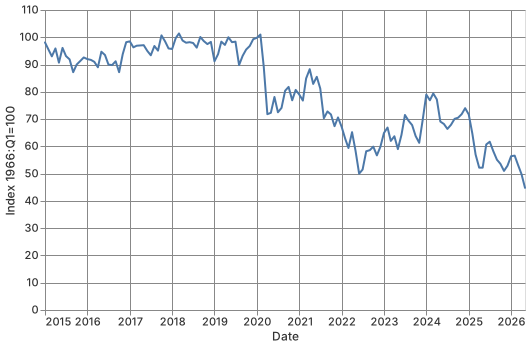
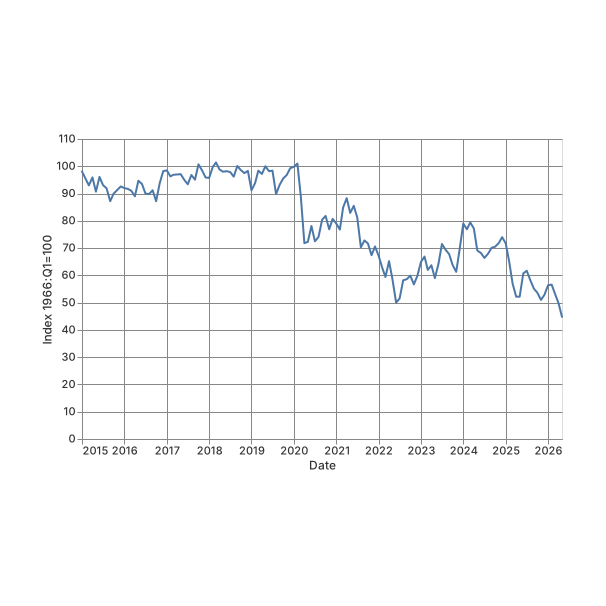
Consumer sentiment headwinds. Macquarie analysts also cited weak U.S. consumer sentiment as a drag on medical device demand. For Cochlear, an analyst said the hearing-implant maker’s earnings outlook continues to moderate due to an ongoing decline in U.S. consumer sentiment, which has worsened since the company downgraded its fiscal 2026 guidance in April. Consumer pressures remain centered on cost-of-living and inflation pressures that erode confidence in implant demand, the analyst said. Macquarie reduced its fiscal 2026 underlying net profit forecast by about 3% to A$306 million, with similar cuts over the next two fiscal years. The University of Michigan consumer sentiment index stood at 44.8 in June, reflecting continued consumer pessimism. Macquarie kept a neutral rating on Cochlear but raised its target price 3.5% to A$119.00 on an updated weighted risk-free rate. Shares were down 0.9% at A$120.04.
Product and regulatory catalysts. In contrast, several companies received upgrades tied to product launches and regulatory milestones. Macquarie upgraded its earnings view for Neuren Pharmaceuticals after a key European regulator changed its mind on the registration of trofinetide for Rett Syndrome. Earnings-per-share forecasts rose by 5% in each of fiscal 2027 and 2028, driven by an expected $35 million milestone payment in the second half of 2026 for the product, to be known in the EU as DAYBU, along with favorable currency movements. “We expect an initial launch in Germany, where DAYBU will be able to be sold in a free pricing environment for six months, and other key EU countries, such as France and Italy, to follow,” Macquarie said. The U.K. typically has weaker pricing and involves a separate regulatory process, it added. Macquarie expects the Germany launch by the fourth quarter of 2026.
Sartorius Stedim Biotech might narrow its full-year sales guidance when it reports second-quarter results, Bernstein analysts Delphine Le Louet and Susannah Ludwig said. “We think the company will probably narrow its sales guidance up to the high end from 6-10% to 8-10%,” the analysts said. They said the French lab-tools supplier is doing well across regions, with a U.S. slowdown in the first quarter likely temporary, demand for disposable supplies from large pharma customers in Europe and Asia, and equipment demand showing signs of catching up after recent product launches. Shares rose 1.8%.
Bernstein analysts also said Roche Holding’s new gene-sequencing platform gives it a chance to take Illumina’s crown in the market. The market for next-generation sequencing is expected to grow at an annual rate of 11% over the next decade to reach about $15.5 billion in 2035, and Roche can grab a 40% share, according to Bernstein. The diagnostics division of the Swiss pharma group is launching Axelios 1, which Bernstein said has a cost and speed advantage over Illumina’s NovaSeq X Plus. Illumina held a quasi-monopoly of the market but has faced competition from new entrants including U.S. rivals Element Biosciences and Ultima Genomics and China’s MGI Tech in recent years, they added. Shares rose 0.2%.
Bernstein also said the gene-sequencing platform, alongside new mass-spectrometry and glucose-monitoring products, means Roche’s diagnostics business is at its most important inflection point in 25 years. The three new technologies should significantly increase Roche’s presence in the profitable U.S. market and help it deliver annual sales growth of 9% over the 2025-2035 period, according to Bernstein.