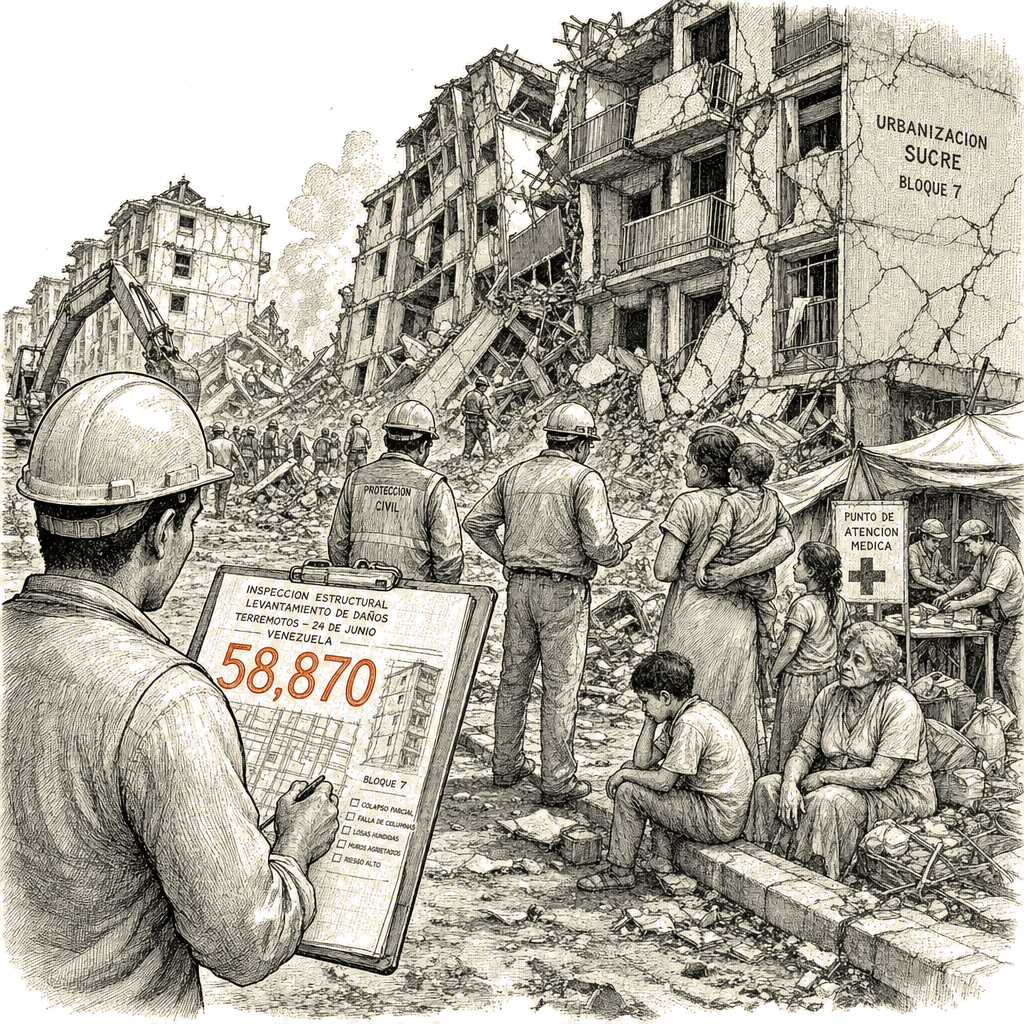
The Venezuelan government confirmed Monday that 1,719 people had died and 5,034 had been injured from the pair of quakes — a magnitude-7.2 temblor followed 39 seconds later by a magnitude-7.5 quake — that struck near Caracas on June 24. The United Nations estimated that as many as 50,000 people remain missing and about 6.76 million have been affected. The U.S. Geological Survey estimated a 42 percent probability that the final death toll will range between 10,000 and 100,000.
The NASA assessment, the agency said, is a preliminary damage probability map that requires field verification. It classifies a structure as damaged when at least 50 percent of its footprint shows a loss of stability as detected by radar comparisons of before-and-after satellite imagery. The strongest indicators of widespread destruction are concentrated along Venezuela’s central Caribbean coast, including La Guaira state and the Caracas metropolitan area.
Geologist Eduardo Malagnino told Infobae that the magnitude-7.5 earthquake released energy equivalent to about 260 atomic bombs of the size dropped on Hiroshima. Malagnino said the earthquakes resulted from strike-slip movement between tectonic plates, with the Caribbean Plate shifting eastward along the South American Plate.
The disaster has drawn attention to the performance of buildings constructed under the Great Venezuela Housing Mission, a flagship public housing program launched by former President Hugo Chávez in 2011 and continued under his successor, Nicolás Maduro. Social media posts and rescue crew images circulated showing housing developments in La Guaira and Caracas in which load-bearing walls and interior partitions allegedly contained expanded polystyrene blocks and aluminum sheets instead of reinforced concrete.
Independent professional organizations, including the Venezuelan College of Engineers, said the collapse of projects built under the housing mission reflects years of financial opacity and contracts awarded without adequate oversight to state-owned construction companies from China, Turkey and Belarus, under military supervision. The organizations said political pressure to rapidly inaugurate thousands of apartments for electoral purposes eliminated meaningful technical inspections and independent audits.
Chilean civil engineer Rubén Boroschek, a specialist in earthquake engineering at the University of Chile, told Spain’s El País newspaper that it is “difficult to justify” catastrophic collapses in buildings constructed after 1980. Boroschek said modern engineering provides the technical tools needed to prevent structural collapse, provided buildings are not constructed directly on active faults and building codes are properly enforced. He added that the absence of independent oversight and failure to comply with construction standards can have deadly consequences.
Acting President Delcy Rodriguez announced Monday that the government will begin a housing reconstruction program “as quickly as possible” and said authorities will guarantee the safety of workers involved in rebuilding efforts, according to local newspaper Ultimas Noticias. Rodriguez said a team of specialists is evaluating whether damaged homes remain habitable and planning new housing construction before the end of the year. She added that authorities have identified families who lost their homes and said they will receive immediate assistance in temporary shelters established by the government.
The United Nations Development Programme estimated direct losses at $6.7 billion, equivalent to about 6 percent of Venezuela’s gross domestic product, with total economic losses potentially reaching between $10.05 billion and $20.1 billion. The disaster comes as Venezuela has been grappling with years of economic devastation that drove nearly nine million people to flee abroad.