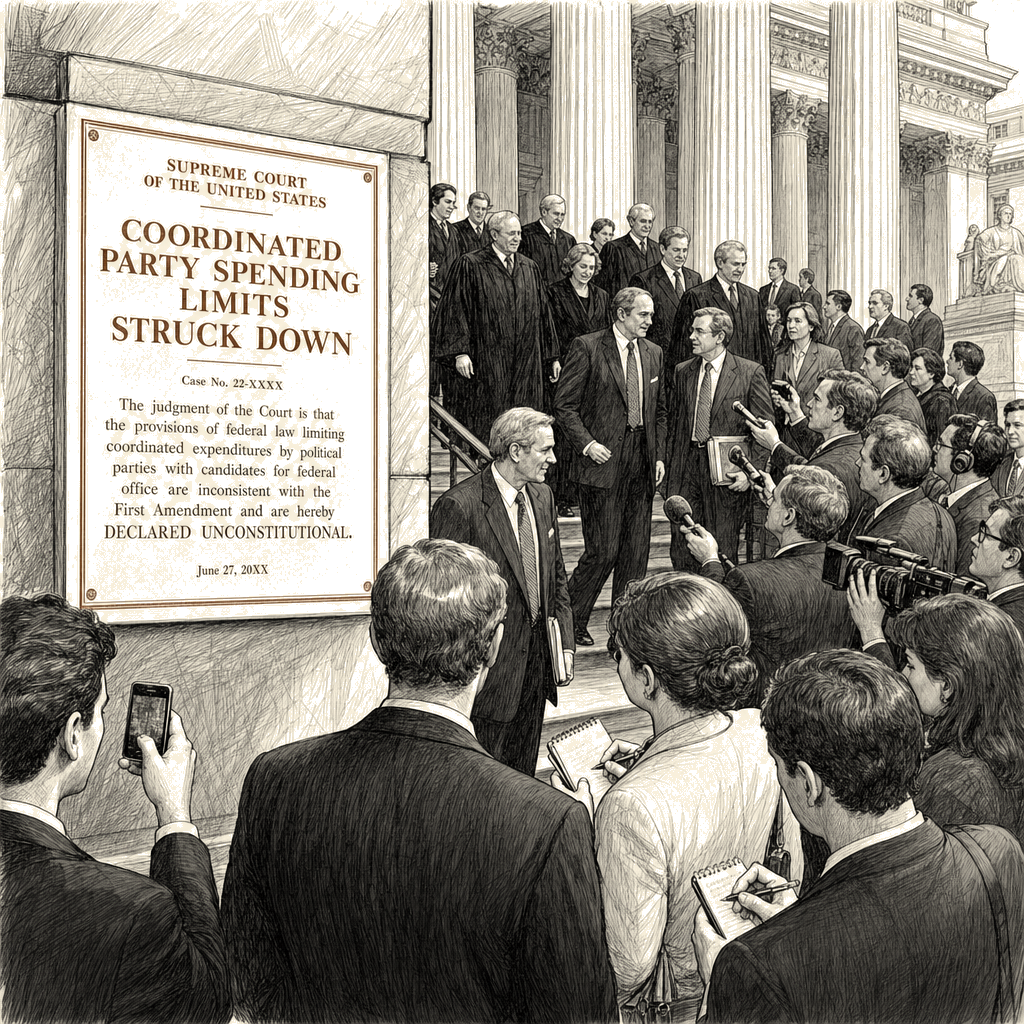
The Supreme Court on Tuesday struck down federal limits on how much political parties can spend in coordination with candidates for Congress and president, ruling 6-3 that a post-Watergate campaign finance law violates political parties’ First Amendment rights.
Justice Brett Kavanaugh wrote the majority opinion, which was joined by the court’s five other Republican-appointed justices. The three Democratic-appointed justices dissented.
“Congress’s original justification for the limits on political-party coordinated expenditures is entirely inadequate under the First Amendment,” Kavanaugh wrote, according to text of the opinion cited by The Wall Street Journal.
The case, National Republican Senatorial Committee v. Federal Election Commission, stems from a 2022 lawsuit by Vice President JD Vance — then a Senate candidate in Ohio — former Republican Rep. Steve Chabot of Ohio, the National Republican Senatorial Committee, and the National Republican Congressional Committee. The plaintiffs challenged the Federal Election Commission’s enforcement of limits on what are called coordinated party expenditures, according to the court filings.
The decision overturns a 2001 Supreme Court ruling that had declared the party spending limits constitutional. The laws at issue date to 1974, when Congress passed the Federal Election Campaign Act in the wake of the Watergate scandal to limit how much money individuals could give to political parties and how much parties could spend on their candidates.
Under the ruling, political parties now have the ability that Super PACs and other independent groups do not: they can both coordinate directly with candidates and raise unlimited funds. Super PACs may raise and spend unlimited sums but cannot coordinate with candidates. Parties previously were limited in how much they could spend on behalf of their candidates.
The Trump administration supported Vance and the Republican committees in the case. The FEC, which has not had a quorum since April 2025 and cannot initiate enforcement actions, had outside counsel appointed by the court to defend the law, the Guardian reported.
Lawyers for the Democratic Party, who intervened in the case in support of the limits, argued in court filings that the restrictions were necessary to prevent quid pro quo corruption. They wrote that authorizing unlimited coordinated expenditures would “fundamentally reshape the campaign finance regime” and that the “potential for actual or apparent corruption is obvious,” according to NPR.
The Republicans argued that the risks of corruption are low. “It doesn’t make any sense to think of a party as ‘corrupting’ its candidates,” lawyers for Vance and the committees wrote in a court brief cited by NPR, “because the very aim of a political party is to influence its candidate’s stance.”
The ruling will likely allow candidates to shift broadcast advertising costs to political parties, according to The Wall Street Journal.
The decision is the latest in a series of Supreme Court rulings since 2010 that have loosened campaign finance regulations, each decided by ideologically split votes. In 2010, the court ruled in Citizens United v. FEC that corporations have a First Amendment right to unlimited independent spending on elections. In 2014, the court struck down aggregate limits on how much an individual may contribute to all candidates and committees combined in an election cycle in McCutcheon v. FEC.