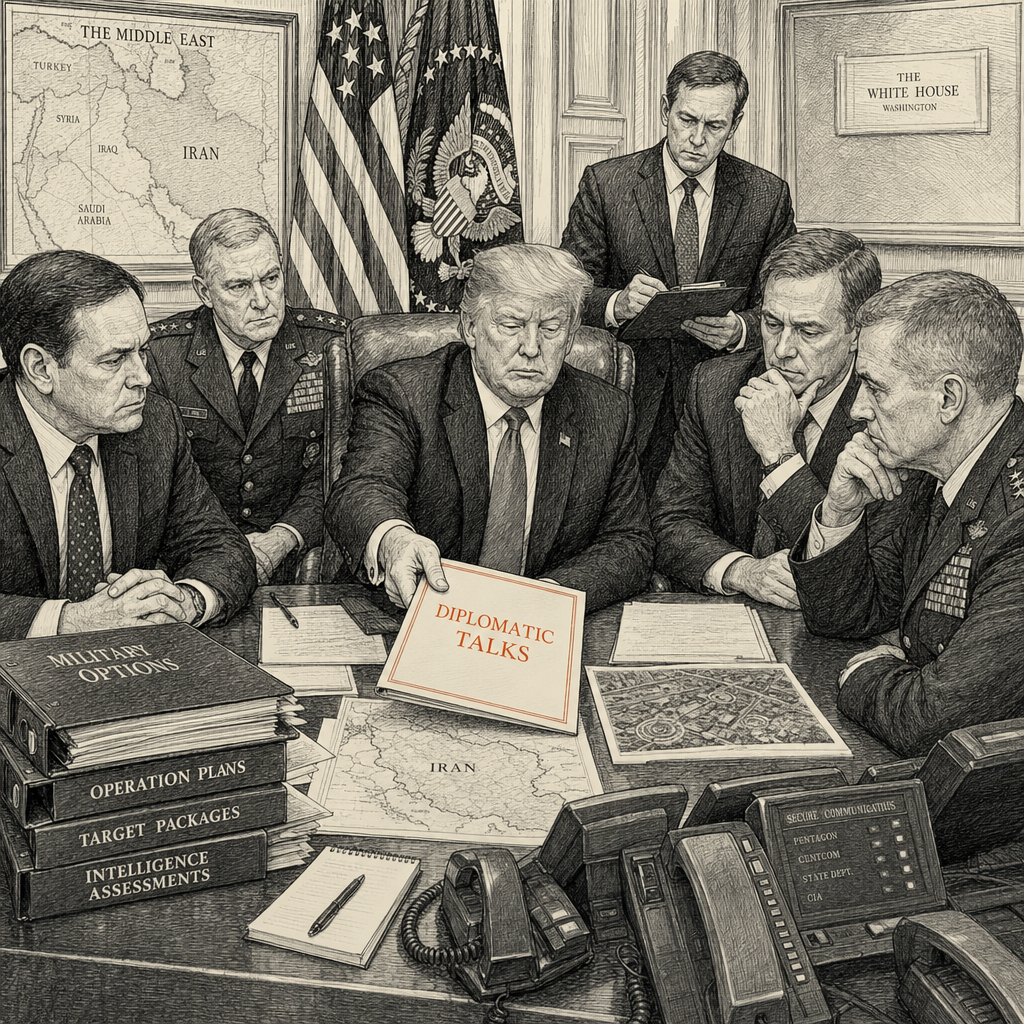
President Donald Trump weighed a return to full-scale war with Iran in recent days, holding multiple conversations with top military advisers about resuming large-scale airstrikes, but has decided to continue diplomatic talks for now, according to U.S. officials familiar with the discussions.
Trump met with Defense Secretary Pete Hegseth and Chairman of the Joint Chiefs of Staff Gen. Dan Caine to discuss abandoning negotiations and resuming full-scale attacks on Iran, the officials said, with some describing the potential move as “finishing the job.” The president has not made a final decision, but told aides he believes another round of large-scale attacks could derail diplomacy and hurt Washington’s chances of ultimately dismantling Iran’s nuclear program.
Trump also told aides he is fine if negotiations with Tehran extend past an Aug. 18 deadline for a nuclear deal, the officials said, a decision that gives the talks more time to work. The president said he is currently satisfied with ordering one-off strikes on Iran when it violates the “memorandum of understanding,” which sparked back-and-forth fighting over the weekend that undermined a fragile ceasefire clinched two weeks ago.
MSI previously reported that Trump said he would not resume all-out war unless U.S. troops were killed, a position that has guided his approach since early June.
Pentagon briefings on military options in an active conflict are not unusual, with Trump routinely holding formal and impromptu meetings on Iran. But the latest discussions suggest he is looking for ways to break the deadlock and hasn’t ruled out a return to fighting. Resuming the conflict, some officials acknowledged, would be a tacit admission that the much-touted Iran deal failed.
Publicly, Trump has said the talks are succeeding and that he retains military options should they fall apart. “They’re agreeing to everything that I want, and they have to,” he told reporters last week. “Otherwise, we just go back and do what we have to do.”
A White House official said Trump’s preference is always diplomacy and that Iranians would be wise to make a good deal with the U.S. Spokesmen for Hegseth and Caine declined to comment.
Trump’s Iran envoys Steve Witkoff and Jared Kushner arrived in Doha on Tuesday for a new round of negotiations, though they spoke through mediators and not their Iranian counterparts, Qatari officials said. Technical experts from both countries were similarly set for indirect talks this week.
The U.S. and Iran are more than a week into negotiations since agreeing to 60 days of talks two weeks ago. A key point of contention is Iran’s insistence upon charging billions of dollars in service fees for ships transiting the Strait of Hormuz. The U.S. says the waterway should be free to transit, as it was before the war began. Tehran also says it won’t accept severe restrictions on its nuclear work despite Trump insisting that Iran already has made that commitment.
“Iran has not been cooperative at all yet,” Energy Secretary Chris Wright said Tuesday on Fox News. The U.S. military effort to escort ships is the sole reason why global oil supplies are rebounding, Wright continued. “With or without Iran, we will ensure energy flows through the Strait of Hormuz. Of course, better with their cooperation. We want to put an end to their nuclear program.”
In a bid to de-escalate tensions, the U.S. has moved to set up a crisis communication line between the Islamic Revolutionary Guard Corps and U.S. Central Command. Some U.S. officials have pointed to the effort as evidence of improved relations, while others cautioned it is in early stages. The White House official said the deconfliction channel is open and already used by both sides.
The diplomatic stalemate has led Trump to probe aides for new ideas. Hegseth and Caine have provided options on resuming large-scale airstrikes on Iranian military sites, the officials said.
Over the course of Operation Epic Fury, which began Feb. 28, U.S. military forces struck more than 13,000 targets across Iran, destroying much of Tehran’s arsenal of conventional missiles and drones as well as its ability to build new weapons. By late March, top military leaders briefed the president that they would need several more weeks to completely eliminate Iran’s military threat. Trump agreed to an initial ceasefire on April 7.
Some U.S. officials note that Trump has repeatedly declined to authorize large-scale operations since then. He threatened to wipe out Iranian civilization and seize Iran’s oil-export hub of Kharg Island, only to pull back in both instances and revert to diplomatic talks. Trump previously told aides he’d restart the war only if Iran killed U.S. troops.
“If we go and bomb, which we can do very easily if we want, and we spend another two or three weeks bombing, they’ll have nothing left whatsoever, but you won’t have the strait opened for months. If we do the bombing, a lot of people are going to be killed. Who wants to do that? I don’t,” he said in June, adding that a deal would be “stronger than doing the bombing.”
Suzanne Maloney, an Iran expert and vice president for foreign policy studies at the Brookings Institution, said the president has other options at his disposal. The U.S. could slow-roll access to billions of Iranian frozen funds that Tehran wants or continue to drive up the price of Iran’s efforts to control the Strait of Hormuz.
“This middle ground strategy has real limitations,” she said, noting Trump doesn’t appear to want full-scale war again and Iran’s ability to disrupt traffic in the waterway. “But the combination of predictable U.S. reprisals and conditioning economic incentives on compliance could persuade Tehran not to overplay its hand.”