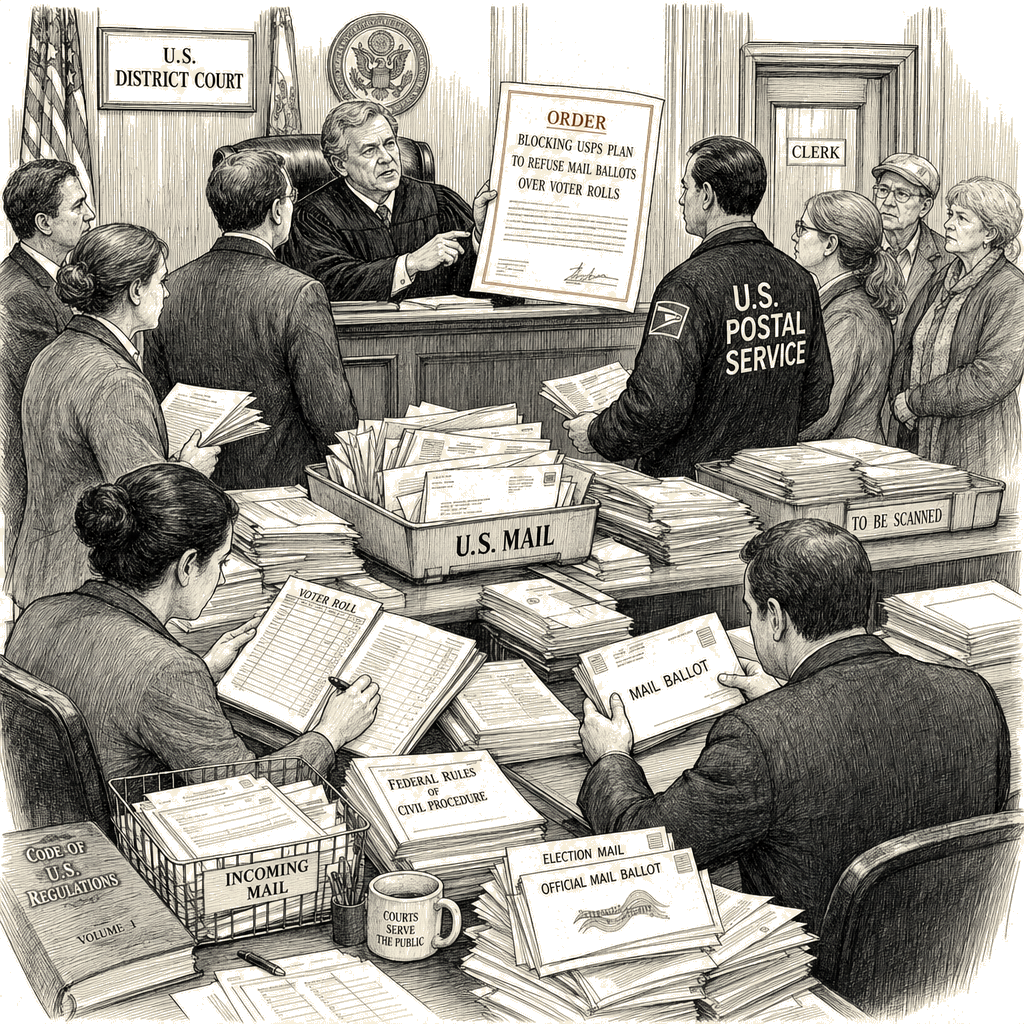
U.S. District Judge Emmet Sullivan on Wednesday blocked a U.S. Postal Service proposal that would have denied mail ballot delivery to voters in states that refuse to share their voter rolls with the federal government, the latest court decision to curb President Donald Trump’s efforts to tighten election procedures.
Sullivan’s ruling bars the Postal Service from enforcing a proposed rule issued June 2 that would have required states to give the Department of Homeland Security and other agencies access to voter lists and to adopt new balloting procedures as a condition of getting their ballots delivered. The decision is based on a 2021 legal settlement between the NAACP and USPS, in which the Postal Service agreed to take “extraordinary measures” to ensure timely delivery of election mail.
The ruling extends an earlier injunction issued last week by U.S. District Judge Indira Talwani in Boston, which blocked parts of Trump’s March 31 executive order across 23 states and the District of Columbia. Sullivan’s order applies nationwide because it enforces the 2021 settlement agreement, which binds the USPS through 2028.
Anthony Ashton, senior associate general counsel at the NAACP, said in a statement that the ruling is “a critical step in protecting the rights of voters who rely on the timely delivery of mail-in ballots to participate in our democracy.”
“The proposed USPS changes would have created unnecessary and unlawful barriers, in direct violation of the USPS’s mandate to prioritize election mail,” Ashton said. “Those barriers could have disproportionately harmed Black voters, who are more likely to rely on mail voting due to longstanding inequities in access.”
Allison Zieve, director of the Public Citizen Litigation Group, said the court correctly recognized that the USPS’s plan “was unwise, unlawful, and a threat to the millions of voters who rely on mailed ballots to participate in our democracy.”
The USPS was approached for comment. The ruling is the latest court setback in recent weeks for Trump’s push to restrict mail-in voting.