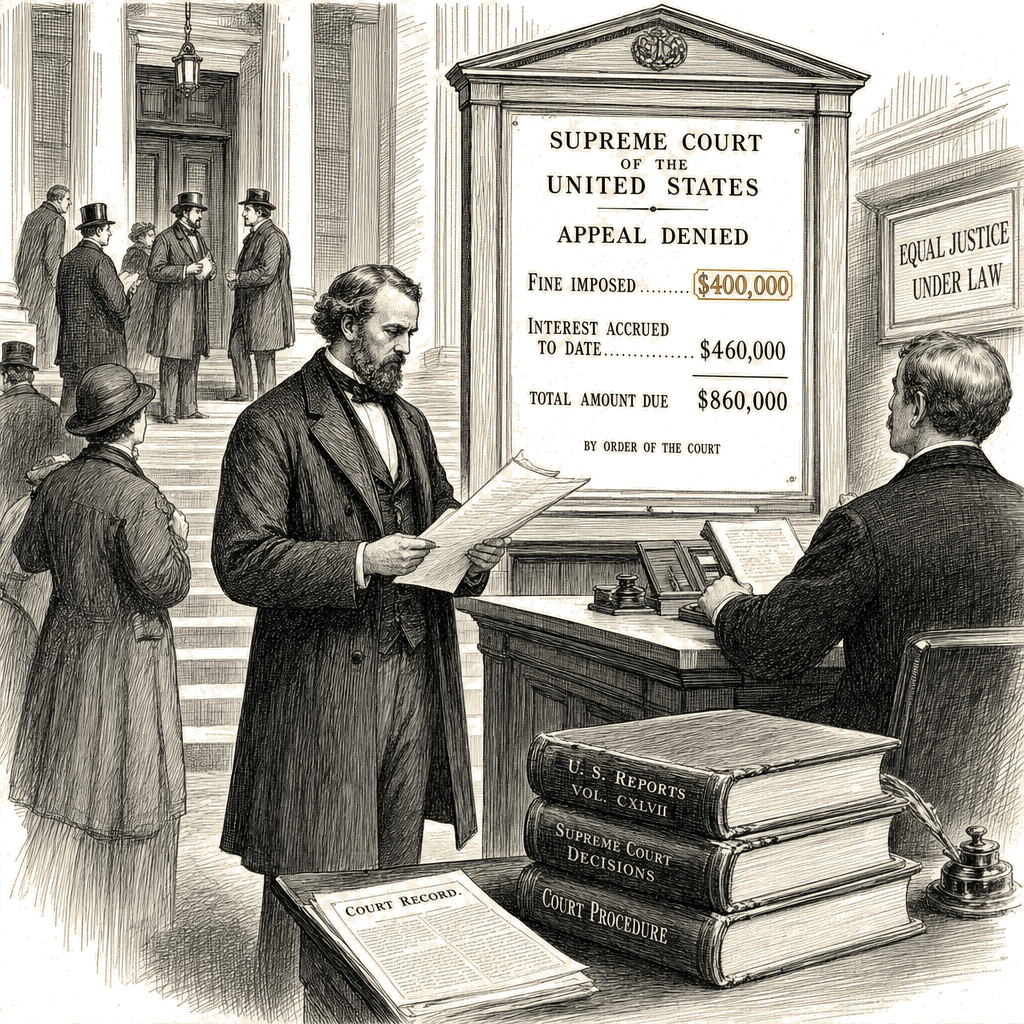
The Supreme Court on Monday rejected without comment a petition from Richard Trahant, a New Orleans attorney whose clients include dozens of victims of the clergy sexual abuse scandal that drove the city’s Catholic archdiocese into federal bankruptcy court in 2020. The denial ends Trahant’s effort to overturn a $400,000 sanction imposed by U.S. Bankruptcy Judge Meredith Grabill, which had swollen to approximately $460,000 through accrued interest.
The fine stemmed from Trahant’s actions in late 2021 after he learned through his bankruptcy work that the Rev. Paul Hart, then serving as chaplain at Brother Martin High School, had admitted to his religious superiors that he had sexual contact with a 17-year-old girl in the early 1990s. Hart had been reported to the church in 2012 and confessed during a confidential internal investigation, according to hundreds of legal documents reviewed by the Guardian.
Trahant notified Brother Martin’s principal, Ryan Gallagher — who is Trahant’s cousin — that Hart had “a credible allegation from [the] past that involved a minor.” Gallagher later said in a deposition that Trahant would not elaborate, citing a protective order in the bankruptcy case. Trahant also emailed a journalist asking the reporter to keep Hart on his “radar,” without providing details, according to legal documents.
Then-Archbishop Gregory Aymond subsequently provided Brother Martin with the specifics about Hart’s misconduct with the 17-year-old girl. Hart retired as the school’s chaplain in January 2022 after Brother Martin requested his removal, publicly citing brain cancer. Hart died at age 70 about nine months later.
The federal judge ordered an investigation into what she characterized as a violation of the bankruptcy court’s protective order. Court investigators ultimately conceded there was evidence supporting Trahant’s denial that he had provided any confidential information to the journalist, according to a report obtained by the Guardian. Nonetheless, Grabill ruled that Trahant’s actions were enough to constitute a violation, fined him $400,000, and expelled four of his clients from a committee of abuse survivors negotiating a settlement in the bankruptcy case.
Trahant appealed to the U.S. District Court for the Eastern District of Louisiana and then to the 5th U.S. Circuit Court of Appeals, both of which left the sanction in place. He petitioned the Supreme Court at the beginning of May, arguing that his due process rights had been violated. The archdiocese waived its right to respond, and the justices denied the petition on Monday.
In a statement Tuesday, Trahant challenged the archdiocese to direct the fine he owes toward clergy abuse survivors. “This entire saga hurt my clients, my wife, my kids and my co-counsel,” he said. “I maintain I did what I did to protect children.”
Two of Trahant’s clients who were expelled from the survivors committee criticized the ruling. James Adams said the Supreme Court’s decision “affirmed the protection of sexual predators over the safety of children.” Jackie Berthelot said, “It seems that if you speak up against predators who roam our schools, … you would be punished severely.”
Aymond retired from the New Orleans archdiocese in February, about two months after the organization and its insurers agreed to pay approximately $305 million to hundreds of clergy abuse survivors to resolve the bankruptcy. Survivors were initially told they could begin receiving payments in April, but a subsequent bankruptcy filing pushed that timeline back potentially to the fall.