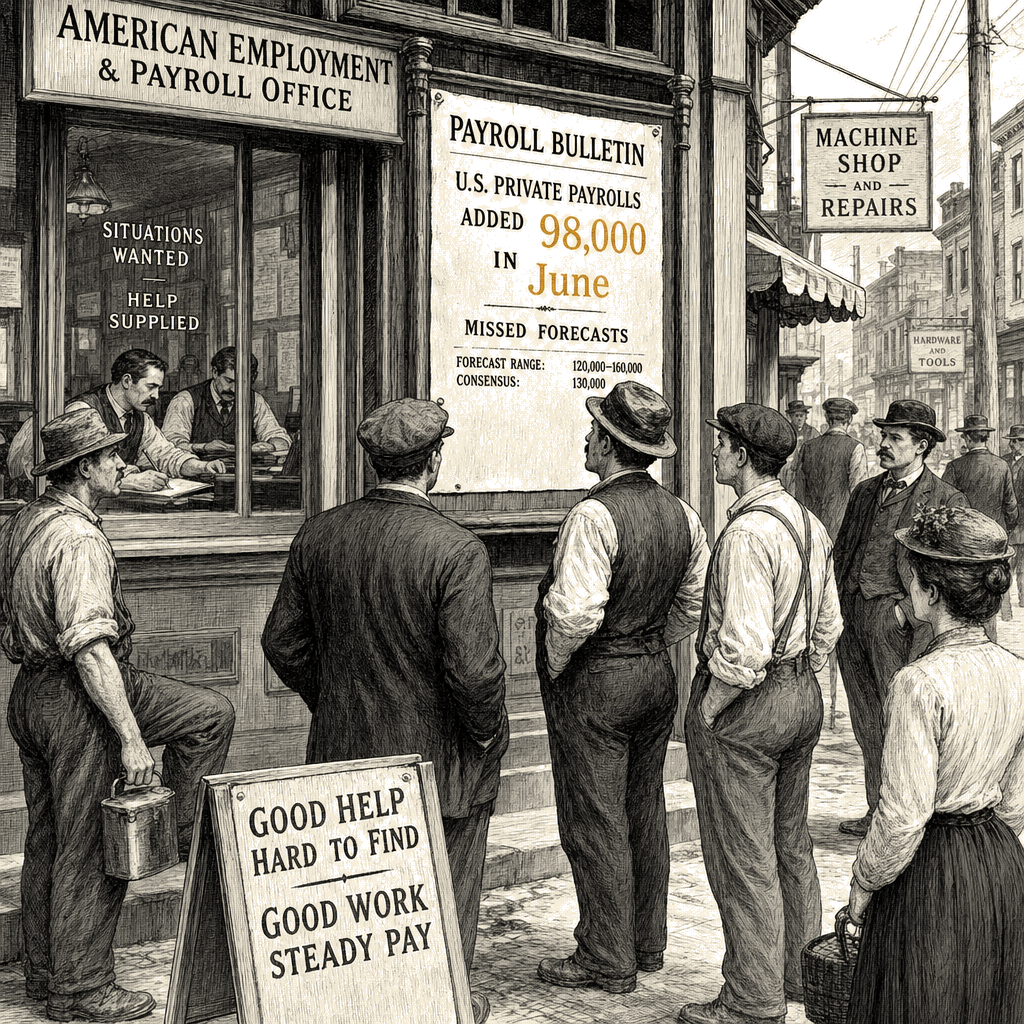
U.S. private employers added 98,000 workers in June, ADP reported Wednesday, falling short of the 110,000 Dow Jones consensus forecast and marking a deceleration from May’s unrevised gain of 122,000. The reading provides a preliminary snapshot of the labor market ahead of the Bureau of Labor Statistics’ more comprehensive nonfarm payrolls report, which is scheduled for release Thursday.
The education and health services sector was again the dominant driver of hiring, accounting for 48,000 of the month’s new positions. That category has been a consistent leader in payroll growth across recent ADP reports.
Small businesses with fewer than 20 employees added 38,000 workers in June. Large employers with more than 500 employees added 25,000. Medium-sized firms saw more modest increases. The only sector to shed jobs was natural resources and mining, which lost 5,000 positions after a 3,000 decline in May.
The information sector added 7,000 jobs, reversing a loss of 9,000 the prior month. Other sectors that posted gains included trade, transportation and utilities, which added 15,000; financial activities, up 14,000; other services, up 8,000; and leisure and hospitality, which added 2,000.
On pay, the ADP data showed median year-over-year wage growth for workers who stayed in their jobs was little changed at 4.4%. Job-changers saw a sharper increase, with median pay rising 6.6% from a year earlier.
“The pace of hiring is telling a story of both supply and demand,” Nela Richardson, chief economist at ADP, said in a statement. “We know it’s taking people longer to find work, but there also are signs of labor supply constraints in certain industries. For now, the overall effect is a slowdown in job creation.”
The ADP National Employment Report, produced by ADP Research in collaboration with the Stanford Digital Economy Lab, draws on aggregated and anonymized payroll data from more than 26 million U.S. employees. It has tended in recent months to show lower job creation than the BLS figures.