Archivist: Bill of Rights refines Declaration’s consent-of-the-people principle
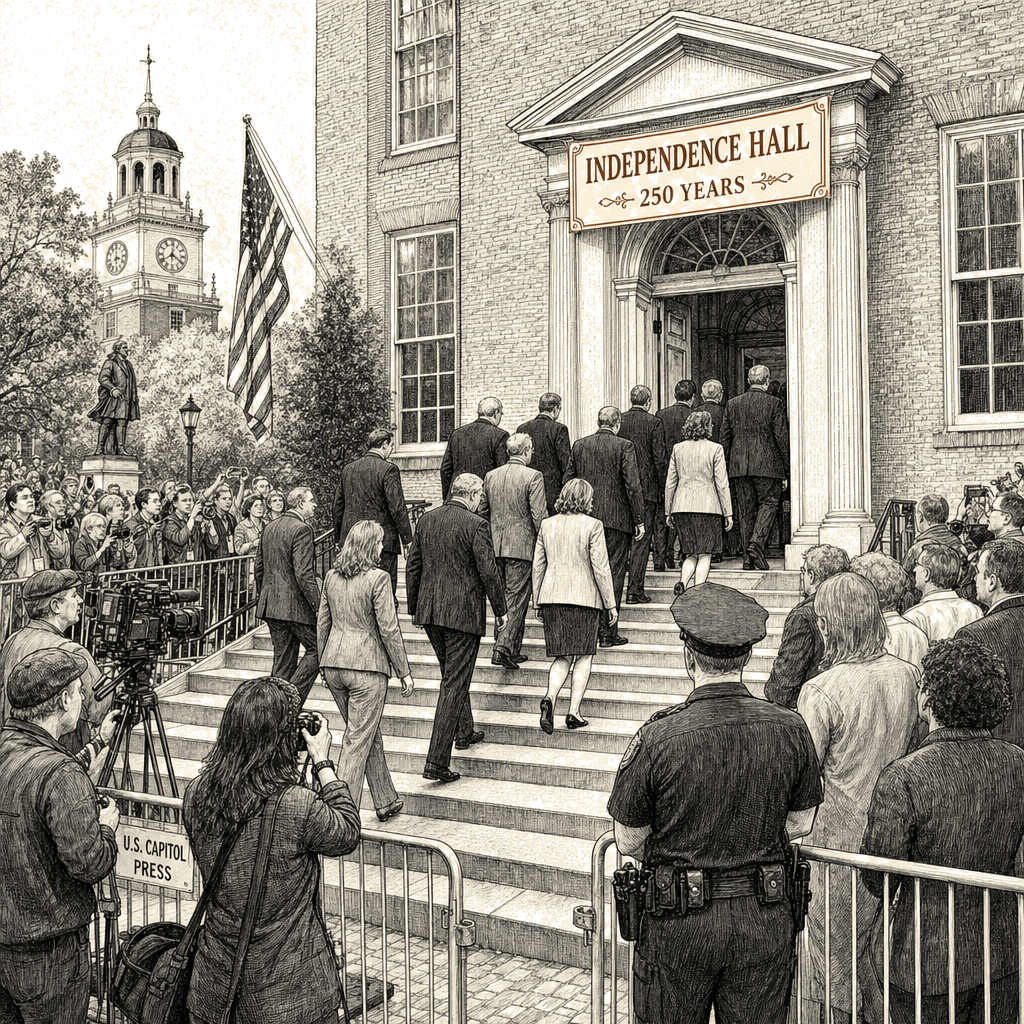
Rep. Brendan Boyle (D-Pa.) led a bipartisan group of lawmakers to Independence Hall on the 250th anniversary of the Declaration of Independence, an effort to reconnect the modern Congress with the institution that launched the nation. The visit, organized by Boyle, came as Congress faces questions about whether it has lived up to the aspirations of the founding era, according to an NPR report by congressional reporter Sam Gringlas.
At the National Archives, archivist Jane Fitzgerald showed NPR the rough journals of the Second Continental Congress, which kept meticulous records in neat cursive. The entry for June 11, 1776, recorded the appointment of a committee to draft the Declaration: “Mr. Thomas Jefferson, Mr. John Adams, Mr. Benjamin Franklin,” Fitzgerald read. The journal for July 2, 1776 — when the Congress voted for independence — notes: “That these united colonies are and of right, ought to be free and independent states.”
Archivist Jay Wyatt displayed original handwritten amendments to the Bill of Rights, the product of the first session of the U.S. Congress. Wyatt told NPR the Bill of Rights shows the through line between the Continental Congress and its modern descendant. “The end product has the consent of the people, and that is, I think, an idea that is put forward in the Declaration, and it is worked and refined until you get to the Bill of Rights,” Wyatt said.
Yale University historian Joanne Freeman said the trajectory from the Continental Congress to today’s Congress was not inevitable. The early body was more like a temporary union of allies responding to crisis, she told NPR, with regional differences: “Southerners seem to dress very loudly. The Northerners all seem like sticks in the mud, and they’re all dressed in brown.” Despite not being popularly elected, the Continental Congress encouraged town halls for regular people to debate independence. “Now, would Congress have acted without them? Probably,” Freeman told NPR. “But one of the things that was very different is that the public came first and foremost.”
Freeman said the clashing and negotiating that occurred in the Continental Congress previewed the legislative branch’s role. “It’s in that clashing and negotiating that you get something bigger than any one person or any one state,” she told NPR.
Boyle, whose district includes Independence Hall, said he thinks the founders would be dismayed by today’s divided politics. Boyle said that was one reason he organized the bipartisan visit — to bring lawmakers “from the most conservative Republican to the most progressive Democrat, to return to the room where it all began and remind ourselves that we are the inheritors of this great tradition,” he told NPR.
Boyle has said Congress has ceded too much authority to the presidency. “Our Founders would be surprised and alarmed that this current Congress has not jealously guarded its prerogatives,” Boyle said.
Standing in the Capitol rotunda beneath John Trumbull’s painting of the Second Continental Congress receiving the draft Declaration, Boyle described a mixture of awe and a sense of burden. “I feel awe and I feel pride. And I also feel a certain burden to live up to what those Founders intended 250 years ago,” Boyle said.
Boyle noted that the modern Congress is facing many questions about the country’s needs but that previous generations have wrestled with similar questions and kept pushing closer to the ideals of the Revolution.