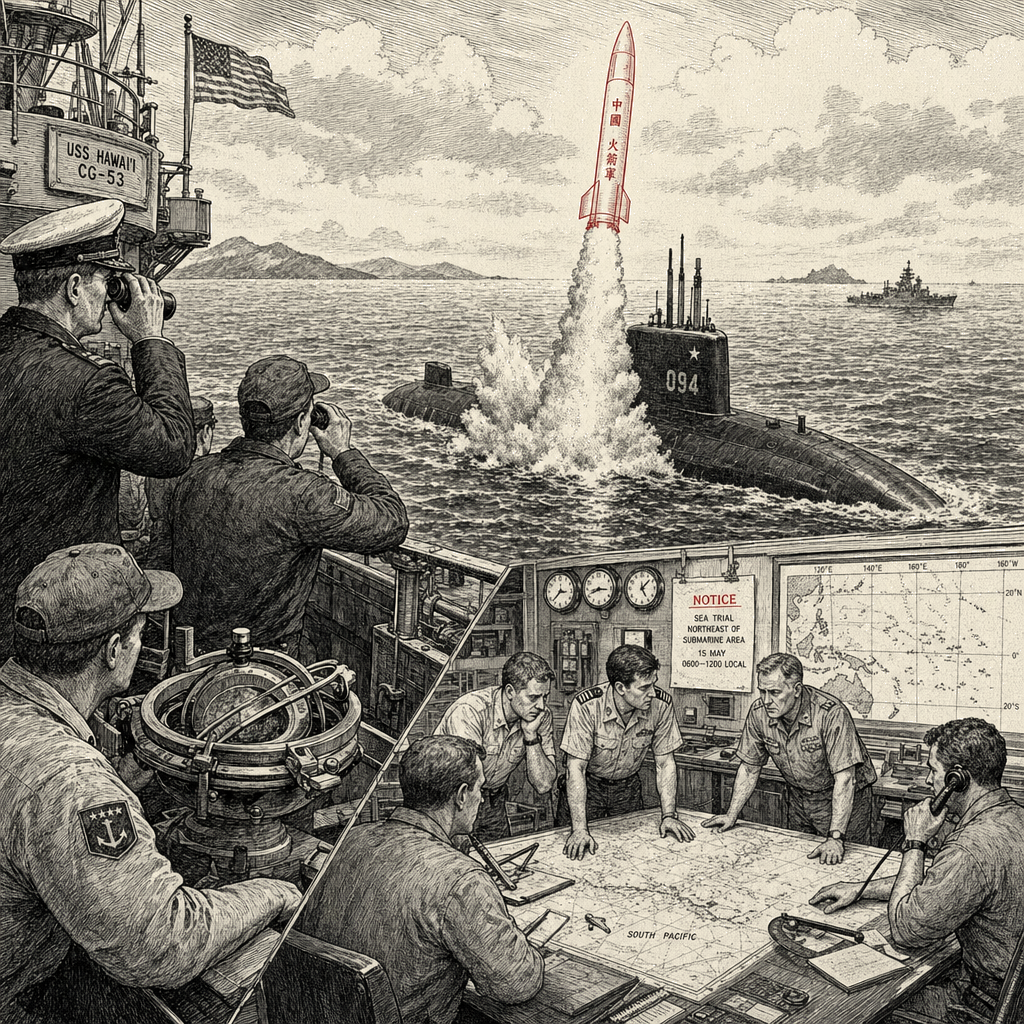
Missile fired from Bohai Bay to South Pacific, analysts say
China’s military said Monday it test-launched a long-range ballistic missile from a nuclear-powered submarine, a rare display of nuclear-capable capabilities that drew condemnation from U.S. allies across Asia and the Pacific.
Senior Captain Wang Xuemeng, a spokesman for the navy, told state media that the missile was fired at 12:01 p.m. carrying a simulated warhead to a designated area in the Pacific Ocean. Wang described the test as “a routine part of China’s annual military training program,” conducted in accordance with international law and “not directed against any specific country or target.”
It was not immediately clear where the test missile landed. Notices posted by Chinese aeronautical and maritime organizations indicate the missile was likely launched from Bohai Bay in northeastern China and flew to the South Pacific, said Tianran Xu, an analyst for the Open Nuclear Network, a Vienna-based research organization. Before Monday’s test, China had placed at least three long-range tracking ships in the Western Pacific in waters between New Guinea and Guam, according to maritime monitoring databases, which would have given a good vantage of the flight path, Xu said.
Xu assessed the test was likely of a JL-2 or newer JL-3 missile that traveled a distance of more than 7,000 kilometers, or about 4,350 miles. The JL-2 has a range of 4,350 miles or more, while the JL-3 has an estimated range of more than 6,000 miles. Both are capable of carrying nuclear warheads. Xu noted that Monday’s submarine launch marked “a huge contrast” from China’s long-running practice of launching missiles in the desert within its own borders. “This in itself is I think a show of strength or signaling,” he said.
Regional reactions
Australia and Japan quickly condemned the launch. Australia’s foreign minister, Penny Wong, who was traveling in Fiji, said China had informed Australia of the test. “Australia has been clear with China that we regard this as destabilizing to the region,” Wong said. She also expressed concern about the context of the test, describing a “rapid military buildup by China, which is lacking in the transparency and reassurance as to intent that the region expects.”
Japan, which said it was alerted on Sunday that some space debris could fall into waters in its exclusive economic zone, also condemned the launch. Tokyo raised “serious concern over the intensification of China’s military activities and strongly urged China to reconsider its actions,” according to a joint cabinet statement.
Broader military context
Monday’s test comes amid a broader push by Chinese leader Xi Jinping to modernize the military’s nuclear capabilities. In recent years, China has built roughly 350 new missile silos and bases for road-mobile launchers, according to the Federation of American Scientists. It has also upgraded long-range bombers to carry ballistic missiles capable of delivering nuclear warheads, according to Pentagon reports.
The launch was a rare submarine-launched ballistic missile test in open ocean by China. In September 2024, China carried out its first intercontinental ballistic missile test in decades, launching a dummy warhead from Hainan island into waters near French Polynesia, a test that attracted criticism from Australia and New Zealand. Analysts said that 2024 launch was seen in part as an effort to re-establish credibility of the rocket force after a widespread purge of its military leadership, including the dismissal of several missile-force commanders.