Former general’s personal loss resonates with voters
Elections are expected by the end of October, the first since the Hamas-led attack on Oct. 7, 2023, and the ensuing wars in Gaza, Lebanon and Iran. Netanyahu, who has been prime minister on and off for a total of around 19 years, faces domestic criticism over the war with Iran, which many Israelis view as a failure.
Eisenkot, the former chief of staff of the Israeli military, joined Netanyahu’s coalition after the 2023 attack that killed around 1,200 people. He resigned eight months later, accusing the prime minister of prolonging the fighting and endangering the hostages taken in the attack, the Journal reported.
His youngest son, Gal, 25, was killed in Gaza in the early months of the war, while Eisenkot was still in government. Two of his nephews also died. Eisenkot broke down in tears as he eulogized his son at the funeral, and his personal loss has resonated with voters who have children completing mandatory military service or serving themselves.
“The state of Israel stands at a crossroads, ahead of the most fateful elections in its history,” Eisenkot said at a campaign event in central Israel, according to the Journal. “Elections for the security, unity and soul of Israel.”
Eisenkot is a son of Jewish Moroccan immigrants who grew up in the working-class city of Eilat, while Netanyahu was born to an elite academic family, spent part of his youth in the U.S., and was educated at MIT. Netanyahu’s sons have not served in the reserves during the war, the Journal noted.
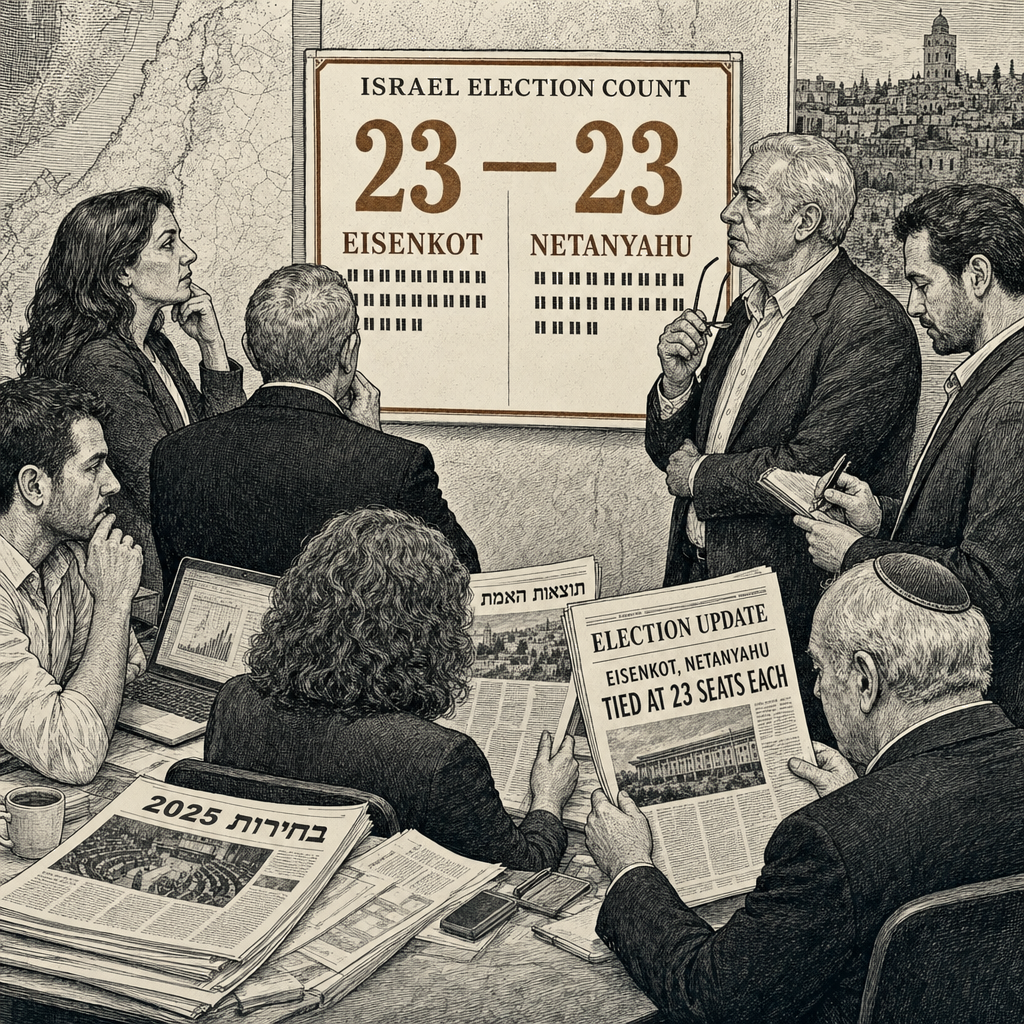
A poll by Israel’s public broadcaster projected each major party winning 23 seats in the 120-seat Knesset. Opposition leader Naftali Bennett followed with 16 seats. On the question of who is more suitable to be prime minister, Eisenkot received 41% and Netanyahu 40%.
Eisenkot has not staked out clear positions on several national security issues, including the future of Gaza, but is considered the architect of the Dahiya Doctrine, an Israeli strategy of striking urban areas with overwhelming military force used during the 2006 Lebanon war.
Netanyahu has been running attack ads that question the legitimacy of Arab-Israeli parties that Eisenkot and other opposition leaders might need to form a majority. “Eisenkot has no government without the Arab parties,” one ad said.
Analysts say Netanyahu’s strategy may be to prevent the opposition from securing a majority rather than winning a majority himself. Gayil Talshir, a professor of political science at the Hebrew University of Jerusalem, told the Journal: “Netanyahu’s strategy is not to win the election but to make sure that the other side doesn’t have a majority. If this is the case, there will be a caretaker government. Netanyahu will stay in power and there will be new elections in the coming year.”
According to the Journal, the Trump-Netanyahu relationship has splintered. Trump recently told ABC News, “I wonder if Bibi even wants to continue,” forcing the Israeli leader to clarify that he was still running. In a separate interview with Israel’s public broadcaster, Trump said it was “very likely that I will support Netanyahu in the coming elections, but I need to see who is running.”
A Gallup poll cited in the Journal found that more Americans now sympathize with Palestinians than with Israelis for the first time, a shift that has fueled concerns among some Israeli voters about long-term support from the U.S.
Despite the challenges, Netanyahu is an experienced campaigner with a history of comebacks. Israel held five elections between 2019 and 2022 because neither the pro- nor anti-Netanyahu bloc could secure enough seats to form a coalition.