CNEA researcher calls ACR-300 project a displacement of CAREM program
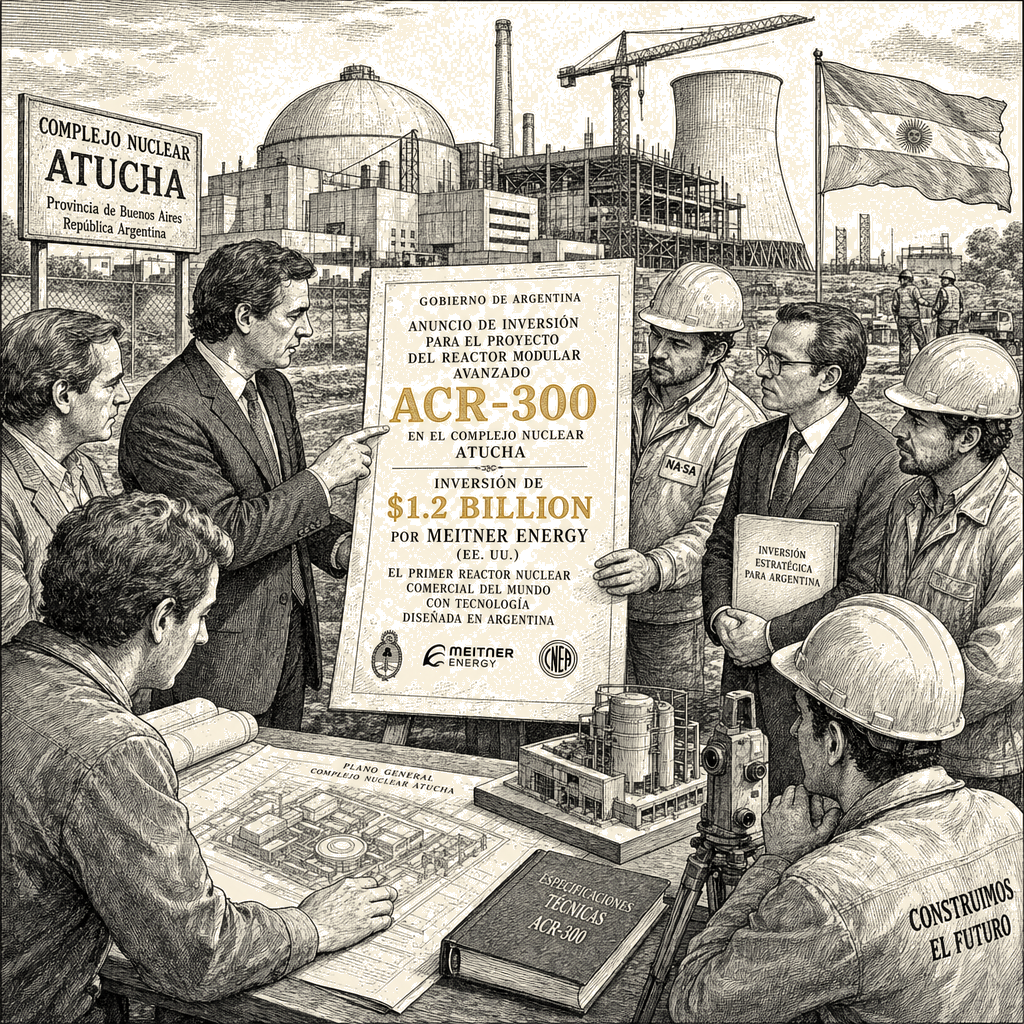
BUENOS AIRES — Argentina’s government announced plans for a $1.2 billion investment by U.S.-based Meitner Energy to build what backers describe as the world’s first commercial nuclear reactor using Argentine-designed technology at the Atucha nuclear complex, about 60 miles northwest of Buenos Aires.
The project calls for construction of the ACR-300, a Generation III+ small modular reactor, or SMR, using pressurized water reactor technology with a generating capacity of about 300 megawatts of electricity. Economy Minister Luis Caputo said the investment will come from private U.S. capital and that the reactor will use technology patented in Argentina. He added that the project is expected to create about 2,000 direct jobs.
The proposal could qualify for benefits under the proposed Super RIGI program, legislation backed by the government that would expand incentives for large-scale investments. The bill is currently under consideration in Congress.
“Argentina has more than 70 years of nuclear experience, world-class institutions and internationally recognized talent. The fact that a private company has chosen our country to build its first reactor confirms that this technical expertise, under the right conditions, can be transformed into investment, jobs and reliable clean energy,” Secretary of Nuclear Affairs Federico Ramos Napoli wrote on X.
Argentine engineers designed the ACR-300, according to La Nación. Meitner Energy is a U.S.-based company. The project is backed financially by the Ansari Group, led by Iranian American businessman Hamid Ansari, whose investment portfolio focuses on technology companies. One of the group’s firms participated in early financing of Elon Musk’s aerospace company SpaceX, now publicly traded.
Construction is expected to take five years after the Economy Ministry approves the proposal and Argentina’s Nuclear Regulatory Authority grants the required licenses.
Rolando Granada, professor emeritus at the Balseiro Institute and a researcher at the CNEA, told UPI the announcement has created uncertainty across Argentina’s nuclear sector. “We are confused and concerned. This announcement is the latest in a series of decisions by the current administration that, in our view, are leading to the destruction of Argentina’s nuclear system,” Granada said.
He added that part of Meitner Energy’s technical team is made up of professionals who previously worked at the CNEA.
Argentina’s state atomic energy agency, the National Atomic Energy Commission, faces an uncertain future. More than 60 employees have been laid off, and labor unions say the agency is being systematically dismantled, according to Infobae. For decades, the CNEA has developed the CAREM small modular reactor, a project conceived in the 1980s that made Argentina one of the pioneering countries in SMR technology. The project stalled during Argentina’s economic crisis in the early 2000s. Former President Néstor Kirchner’s administration revived it in 2006, and construction of a prototype began at the Atucha complex in 2014 before work was halted again.
Granada said the CAREM project has effectively been displaced by the new private initiative.
Granada said small modular reactors generate up to 300 megawatts of electricity per unit and represent a new generation of nuclear technology designed for applications different from those of conventional nuclear power plants. “They require less space, involve lower investment costs and can be manufactured in a nearly standardized process. That reduces costs,” he said.
SMRs can be integrated into smaller power grids to supply electricity to homes, industrial facilities, mining operations and desalination plants, Granada said. They also require less frequent refueling and less intensive maintenance than large conventional reactors, he said.
Granada said the goal is to build the first commercial unit before manufacturing additional reactors for other markets. He added that international competition to develop SMR technology is intensifying because it could expand access to nuclear energy and address emerging energy needs. “They do not emit greenhouse gases while generating electricity and should be part of the mix of technologies needed to gradually replace fossil fuels. Small modular reactors can increase the role of nuclear power in the energy mix of many countries,” Granada said.