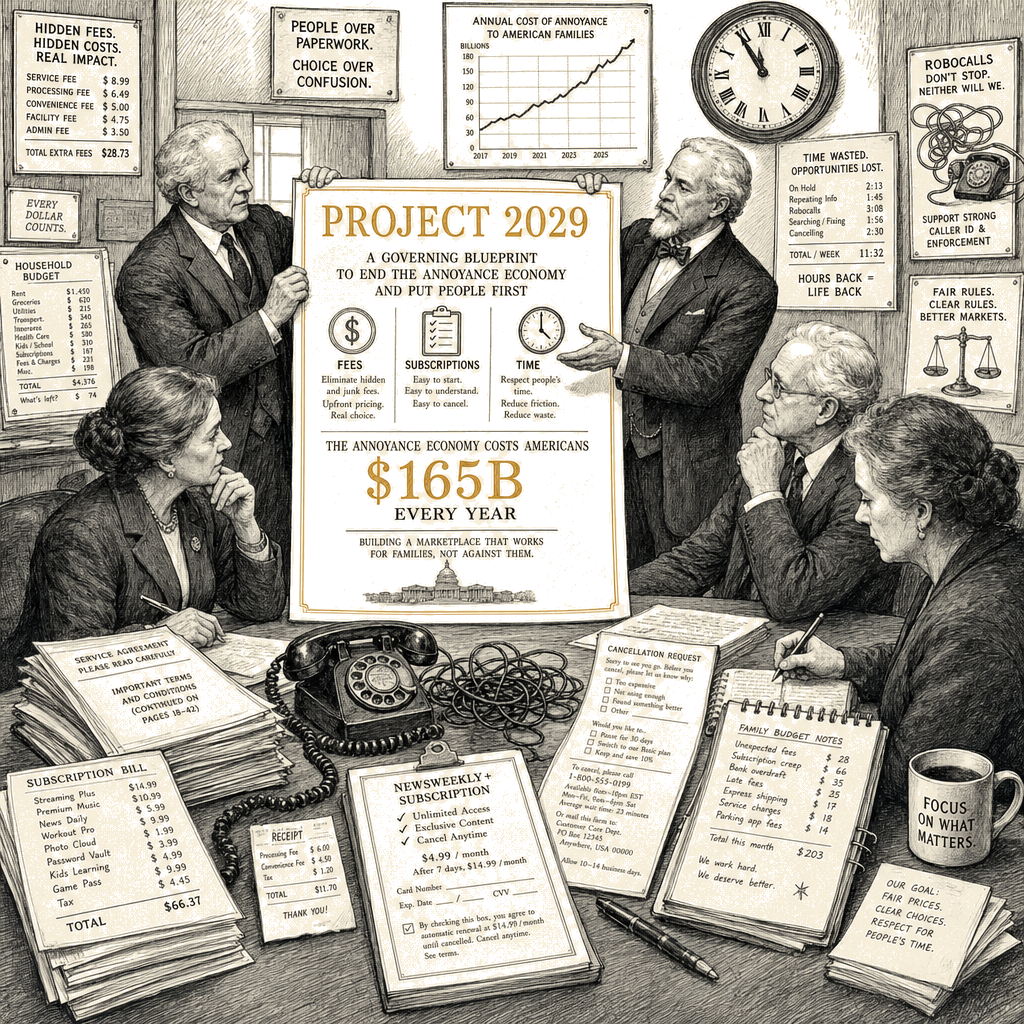
Project 2029 estimates $165 billion in annual costs from annoying business practices
A group of Democratic policy veterans is assembling a governing agenda for a future Democratic president called Project 2029, with a central proposal that takes on the daily frustrations Americans face dealing with companies.
Chad Maisel, the executive director of Project 2029 and a former special assistant to President Biden on the White House Domestic Policy Council, said the effort was inspired by the experience of Project 2025, the conservative blueprint from the Heritage Foundation that the Trump administration used as a ready-to-go policy agenda after taking office.
“I think the lesson from Project 2025 is just the importance of preparation,” Maisel said in an interview with NPR’s Planet Money. He wants a future Democratic president to “have a bookshelf full of really bold, transformational ideas” ready for deployment on their first day.
The annoyance economy concept, developed by Maisel and Neale Mahoney, a Stanford economist who directs the Stanford Institute for Economic Policy Research, covers a range of business practices that waste consumers’ time and money: hidden fees that appear only at checkout, convoluted subscription cancellation processes, robocalls and spam texts, insurance paperwork that requires hours on hold, and AI phone agents that replace human customer service.
The two estimate that these practices cost American families at least $165 billion annually. “American companies derive big profits from these painful interactions — and fight to protect them,” Maisel and Mahoney wrote in a new policy brief.
Their proposal calls for a standardized claims system to make it easier to file insurance claims online, an end to widespread use of “prior authorization” by insurers — “it should be replaced with independent clinical bodies that have no financial stake in denial decisions and would review only a narrow list of high-abuse services,” they wrote — and proposes that the government crack down on scam, marketing and robocalls. It also seeks to close a loophole that has allowed an onslaught of political fundraising texts, implement “click-to-cancel” rules to make subscription cancellation as easy as signing up, restore the ability to press zero to reach a customer agent, and expand rules against junk fees.
The idea of taking on the annoyance economy began inside the Biden White House. Maisel, then at the Domestic Policy Council, and Mahoney, at the National Economic Council, worked together on a federal rule targeting junk fees, which led to the Federal Trade Commission implementing a ban on junk fees for hotels, vacation rentals and live events in 2024. President Biden devoted a substantial portion of his 2024 State of the Union address to the campaign against junk fees.
“And so we started kind of poking around on other issues that we thought would similarly strike a chord with Americans and really take on problems that people are suffering through quietly in their daily lives, but that never seem to be acknowledged by people in power,” Maisel said.
That work produced Biden’s “Time is Money” initiative, a set of proposed federal rules to end time-wasting business practices. But most of those proposals never took effect, which Maisel attributed to the short timeframe between their unveiling and Biden’s departure, combined with fierce industry opposition. The airline industry spent millions opposing a rule that would have entitled passengers to cash refunds for significant delays, which the Trump administration scrapped in November 2025, according to Maisel and Mahoney. Telecom industry groups sued to block the FTC’s proposed “click-to-cancel” rule.
Maisel and Mahoney argue that traditional free-market economics fails to address the annoyance economy for three reasons. First, many industries are highly concentrated, giving consumers few alternatives. Second, consumers often lack information about the full experience of dealing with a company when making purchasing decisions — it’s hard to know whether an insurer will make filing a claim easy. Third, behavioral economics shows that consumers tend to focus on upfront sticker prices rather than the total cost and hassle of dealing with a company, creating what Maisel called a “race to the bottom.”
Project 2029 plans to release additional proposals over the next year covering child care, health care, housing, energy, online safety for children, artificial intelligence, and border policy. According to reporting by Semafor, the group chose to start with online safety for kids because it is among the least politically polarizing topics.
Whether a reader agrees with the specific solutions or not, Maisel and Mahoney are making an economic argument that the daily frustrations of dealing with companies are not just annoyances but a real economic cost.