Right-wing, anti-immigration AfD leads polls, calls for end to ‘perpetuation of a guilt complex’
The erosion of Holocaust memory in Germany comes as the living generation of survivors — the country’s most powerful witnesses to Nazi crimes — almost vanishes. Margot Friedländer, one of Germany’s most prominent Holocaust survivors, died last year at age 103. The Jewish Claims Conference, which distributes German compensation payments to survivors, projects that by 2040 the survivor population will drop to about 21,300, a 90% decline from current levels.
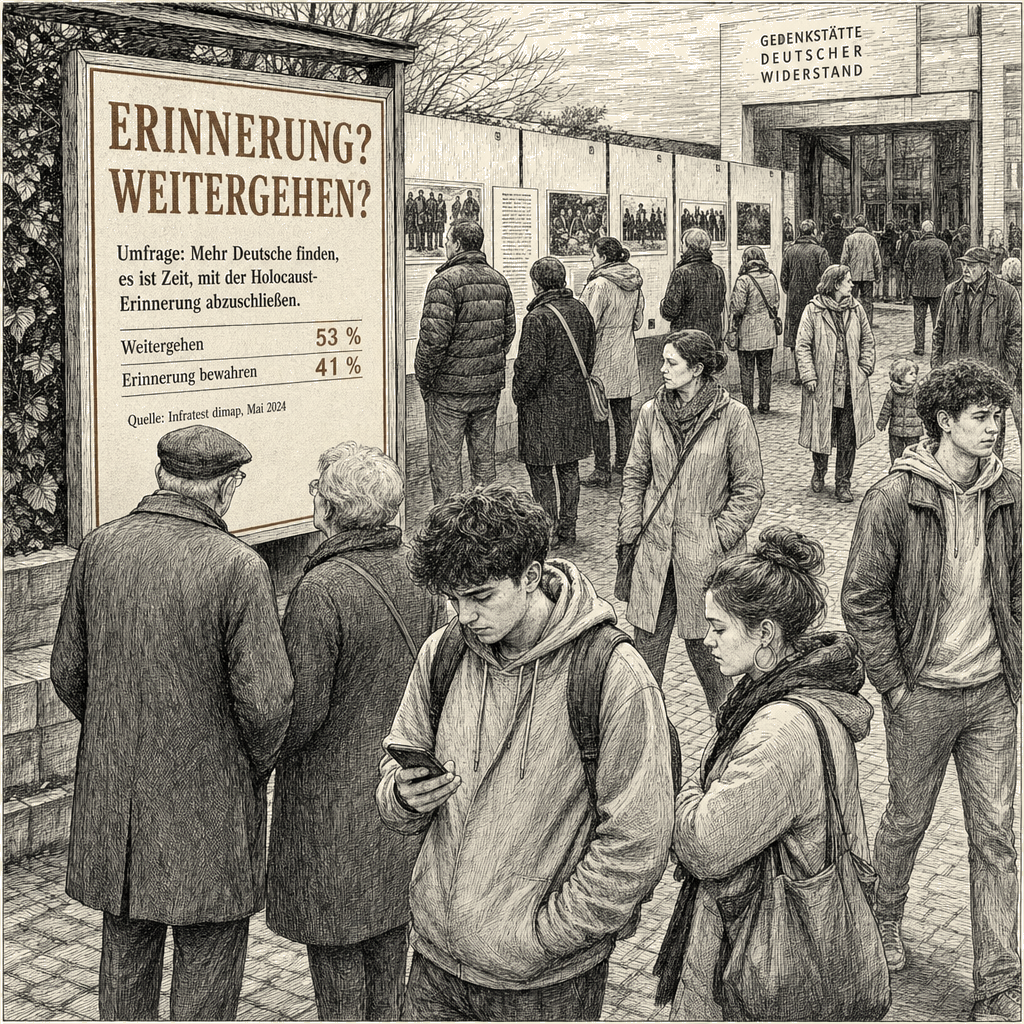
This demographic shift coincides with a political realignment. The right-wing, anti-immigration Alternative for Germany, or AfD, which has called for changing how the country remembers the Holocaust, now polls first in national opinion surveys for the first time since its founding in 2013, according to recent polls cited by the Wall Street Journal. In parts of former East Germany, where Holocaust remembrance was more muted until reunification in the 1990s, the party polls above 40%.
In a manifesto published ahead of last year’s general election, the AfD wrote that “German history must be appreciated in its entirety” and that “the official culture of remembrance must not focus only on the low points of our history; it must also keep the highlights in view.” In its platform for the upcoming state election in Saxony-Anhalt, the party calls for ending the “perpetuation of a guilt complex,” refocusing the school curriculum on the creation of the second German Reich in 1871, and restoring memorials to fallen soldiers.
Rüdiger Mahlo, a German who represents the Jewish Claims Conference in the country, said the first sign that Germans were altering the meaning of the Holocaust came when opponents of Covid-19 social distancing measures began comparing them to Gestapo actions. “Did this mean that the Holocaust was being forgotten? Not exactly,” Mahlo said. “It’s more that what the Holocaust represents for people is changing.”
The fading memory troubles educators like Dervis Hizarci, a former teacher and head of KIGA, a Berlin organization against antisemitism. Hizarci, a German Muslim with Turkish parents, travels to schools across the country to talk to teenagers of diverse backgrounds about Holocaust history. “You can take kids by the hand and get them all the way to caring deeply about the Holocaust,” he said. “You just need to make the connection to them. Only then will they open the door.”
Matthias Thiel, head of the political education program at the Louise Schroeder vocational school in Berlin, said recent global horrors — from the Syrian civil war to the civilian toll in Ukraine and the bombardment of Gaza — have made it harder for young people to focus on Nazi crimes. “The accumulation of crises has made it harder for young people to focus on the past,” Thiel said. “There is just too much noise.”
The findings from Bielefeld University showed 38.1% of respondents agreed it was time to “close the book on the era of National Socialism,” the first time since the university began asking the question in 2018 that the group seeking closure outnumbered those with the opposing view. The same 2025 Claims Conference study found that 13% of younger respondents said the number of Jews killed during the Holocaust was greatly exaggerated, against 10% of people overall.
Antisemitic incidents in Germany almost doubled between 2023 and 2024, reaching their highest-ever level last year, according to RIAS. In February last year, days before a general election, a Syrian suspect was arrested after stabbing a tourist at Berlin’s Holocaust memorial in an attack police said was intended “to kill Jews.” In the state of Hesse, a group of men shoved a rabbi and stole his phone, accusing him of complicity in the actions of the Israeli government. In November 2024, Berlin police chief Barbara Slowik urged Jewish residents to be cautious when visiting Arab-majority neighborhoods of the city because of hostility against Israel there.
More than two-thirds of Germans think antisemitism is rising, compared with less than half of people in the rest of Europe, according to a 2025 European Commission survey.
Liana Fix, senior fellow for Europe at the Council on Foreign Relations, said Germany’s postwar identity was built on three core principles: “Never again war, never again Auschwitz and never again alone.” Fix wrote an influential paper about how the rise of the AfD — which takes an anti-European Union posture — could be destabilizing for Germany at a moment of remilitarization. New figures released at the NATO summit in Ankara this week showed Germany is spending more on its military in absolute terms than any other member save the U.S.
“Even if you think that only half of the 26% to 28% of the people who support them don’t feel they need to honor the Holocaust,” Fix said in an interview, “that is still a big number.”
Dani Dayan, chairman of Yad Vashem, the World Holocaust Remembrance Center, announced in May that the memorial would open education centers in Munich and Leipzig — its only outposts outside Israel so far. Dayan said Musk’s livestreamed address to an AfD rally early last year, in which the billionaire told the crowd “there’s, frankly, too much of a focus on past guilt, and we need to move beyond that,” troubled him.
“It’s of course an affront to the victims of the Holocaust to call Germany to abandon its culture of memory,” Dayan said, “but it’s also an imminent danger to German democracy.”