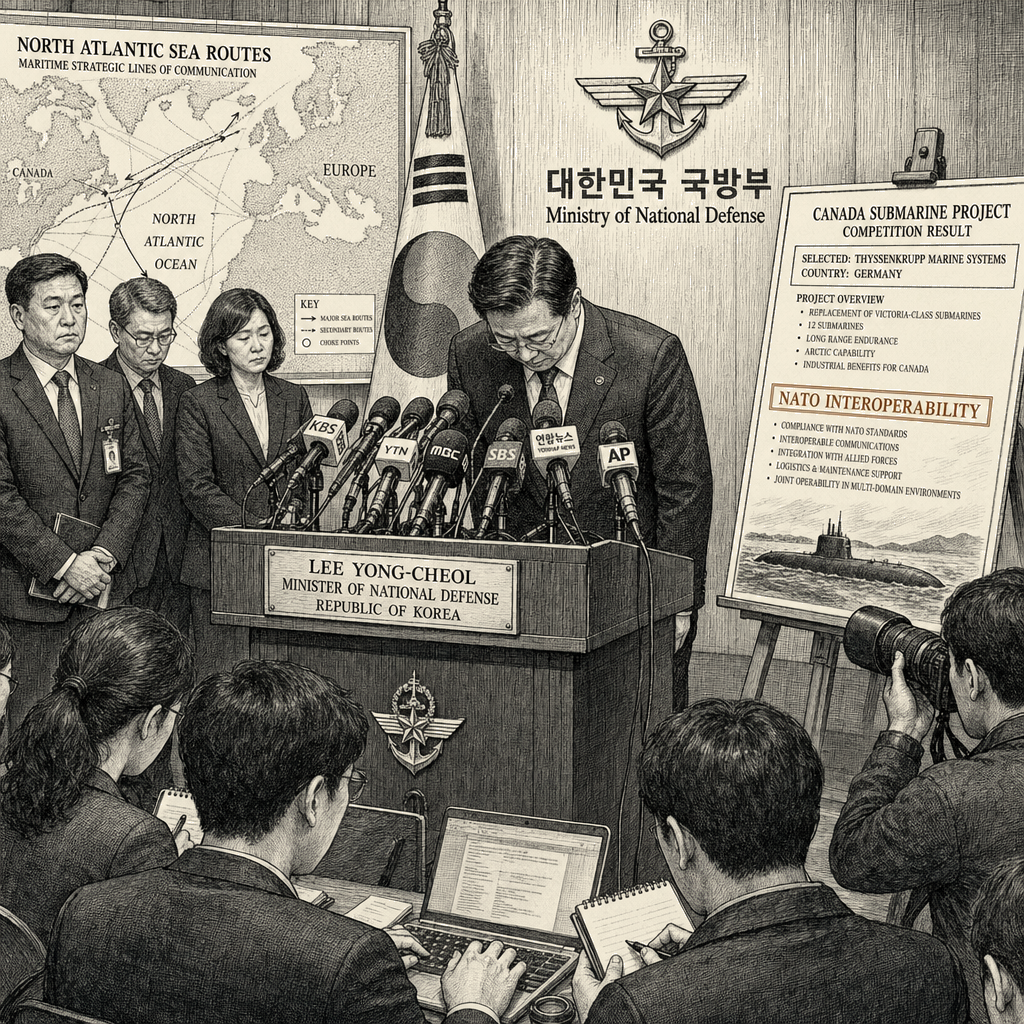
NATO interoperability tipped Canadian submarine decision, Seoul says
Lee Yong-cheol, head of South Korea’s Defense Acquisition Program Administration, told reporters at the Defense Ministry press room that he was sorry for failing to achieve the expected result despite strong public interest and support from multiple ministries and the Navy.
“I am sorry that we were unable to achieve the expected result despite strong public interest and all-out support from the Industry Ministry, Defense Ministry, Foreign Ministry, Navy and other government agencies,” Lee said. “The failure to secure the result was due to my lack of ability.”
Canada selected Germany’s Thyssenkrupp Marine Systems as the preferred bidder for its Canadian Patrol Submarine Project, which aims to replace the Royal Canadian Navy’s aging submarine fleet. Lee said Canada appeared to weigh several factors including fuel cell-based air-independent propulsion technology, battery performance, Germany’s record of supplying submarines to more than one-third of NATO members, alliance interoperability, crew sharing, joint training, maintenance, parts supply and industrial benefits tied to jobs and maintenance facilities.
“In terms of submarine performance, early delivery and regional benefits such as maintenance, repair and overhaul, I do not believe there was a meaningful gap with our proposal,” Lee said. “In delivery schedule, even considering Norway’s production slot, we were faster.”
“The decisive difference appears to have been NATO interoperability and cooperation that allows crew sharing,” he said.
A South Korean defense acquisition official said Seoul’s submarines should not be seen as inferior in operational capability.
“Submarines, for which stealth is most important, do not operate by constantly exchanging wireless communications,” the official said. “We do not believe our submarine had weaker operational capability. Canada appears to have judged that sharing future operating systems and parts would be relatively easier with Germany.”
The official said Canada’s geography and Arctic security concerns likely shaped the decision, noting that Canada must cover both the Atlantic and Pacific oceans.
“Personally, I think the difference in Arctic security priorities also played a major role,” the official said. “For South Korea, the Arctic is more of a conceptual issue, but for Canada it is a real security concern.”
The official added that Canada’s Indo-Pacific defense cooperation with South Korea is still developing, while its Atlantic alliance structure has operated for more than 70 years.
“Training among those allies is routine, to the point where they can discuss sharing submarine crew members,” the official said. “South Korea has only recently begun joint exercises with Canada. Canada chose to strengthen an existing alliance framework, and I think that strategic choice should be respected.”
Lee drew a parallel to South Korea’s earlier loss in Norway’s K2 tank procurement, saying the tank passed performance testing in harsh winter conditions but narrowly failed to win the contract.
“Poland took close note of that performance and moved aggressively to sign a contract,” Lee said. “This challenge may also lead to another reversal.”