Court raises bar for proving racial bias in immigration policy decisions
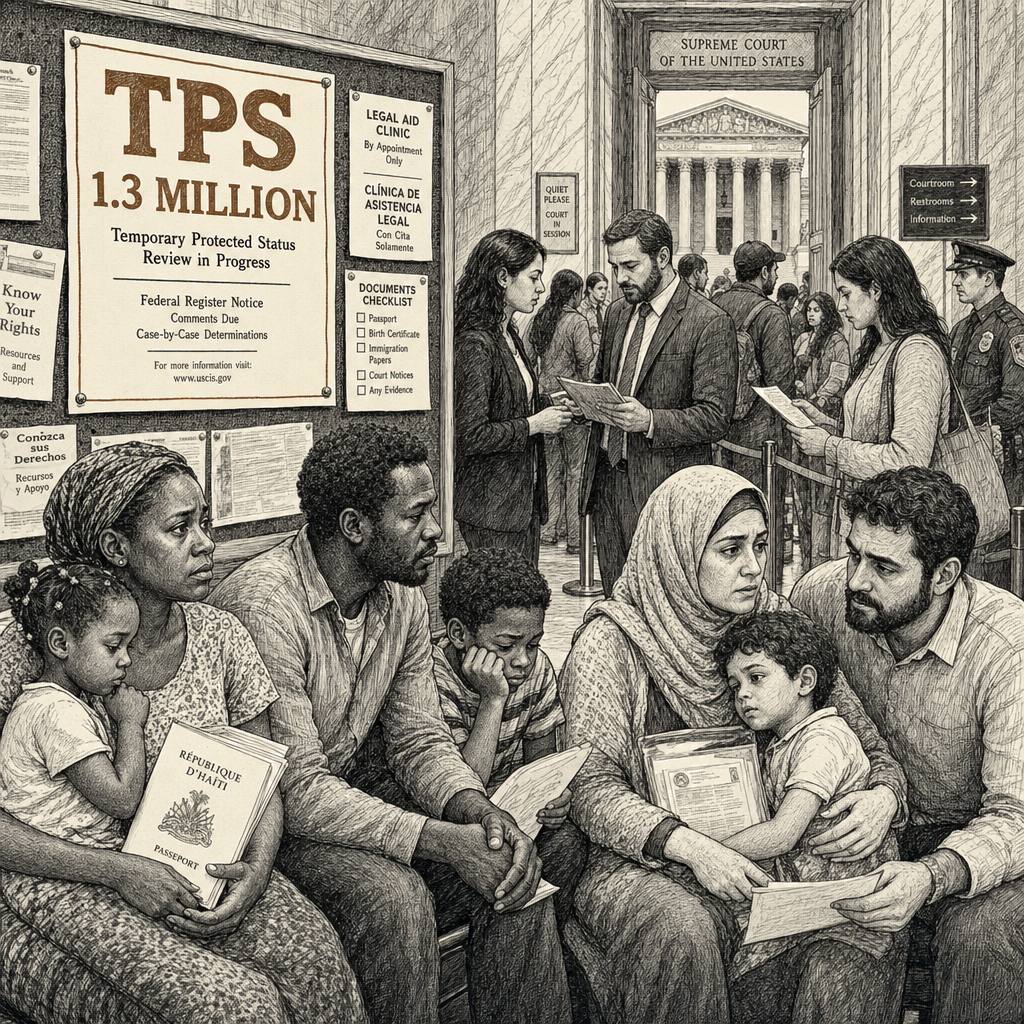
The Supreme Court’s June 25 ruling in Mullin v. Doe held that a provision of the TPS statute limits judicial review of decisions by the Department of Homeland Security secretary to designate, terminate, or extend TPS for a foreign country, barring courts from hearing lawsuits that challenge the lawfulness of the termination on non-constitutional grounds. The decision, written by Justice Samuel Alito, overturned lower court injunctions that had blocked the administration from ending TPS for Haitians and Syrians.
Megan Hauptman, a litigation staff attorney with the International Refugee Assistance Project who represented the plaintiffs, said the court’s ruling was broader than expected. “The Supreme Court reached a much broader ruling that courts in general have no power to review non-constitutional challenges or non-constitutional litigation challenging a TPS termination as unlawful,” Hauptman told UPI. “Really what the court ended up saying was even if the administration acts clearly unlawfully, doesn’t follow the TPS statute in terminating TPS for a given country, the federal courts really have no role to play in reviewing the lawfulness of that decision.”
The decision does not order immediate deportation of TPS holders, but it immediately places their legal status in jeopardy. Rodney Pepe-Souvenir, president of the Haitian American Lawyers Association of New York, said the ruling left many wondering what comes next. “It just made me feel as if we were back in the days of slavery, where families were just moved and taken from one place and face the possibility of being torn apart,” Pepe-Souvenir told UPI. She said people are seeking other legal options such as asylum, employment-based visas, and protections for their children, and are also raising questions about what happens to property, retirement savings, and taxes.
Sandra Dieudonné, supervising attorney with Catholic Charities of the Archdiocese of New York-Haitian Response Initiative, cautioned TPS recipients to consult an immigration attorney before taking new steps. “That may put you in a more detrimental position because you may not have been in removal proceedings and then you file for asylum and now you’re at the risk of being deported,” Dieudonné said.
In its argument for ending TPS, the administration maintained that conditions in Haiti and Syria had improved enough to make return safe. Stephen Miller, a senior adviser to President Donald Trump, said “Haitians live in Haiti” when asked whether Haiti is safe. However, the U.S. Department of State maintains a level four “do not travel” advisory for both countries. For Haiti, the advisory cites “kidnapping, crime, terrorist activity, civil unrest, and limited health care.” For Syria, it cites “terrorism, unrest, kidnapping, hostage taking, crime and armed conflict.” Hauptman said both countries are under advisories that effectively tell travelers “you should leave a will and DNA samples with your family in case you die.”
The court also rejected a constitutional claim that the TPS termination was motivated by racial animus. Aaron Reichlin-Melnick, senior fellow at the American Immigration Council, said the evidence of racially driven motivation was substantial, citing President Trump’s past comments about Haiti as an “[expletive] country” and his stated preference for immigrants from majority-white countries. However, the court’s ruling raised the standard for proving discrimination, Reichlin-Melnick said. “Normally you just had to show that animus racial discrimination was one factor that went into the decision, not that it was the only factor but that it was at least part of the decision-making process,” he said. “In the TPS decision, the court seemed to suggest that unless the plaintiffs could prove it was the overarching reason, the primary reason, then they would fail. That is really in contrast to a lot of previous precedent around racial discrimination.”
Reichlin-Melnick said the constitutional claim may yet be revived in lower court challenges. For now, legal experts and advocacy groups are calling on Congress to intervene, as there is little recourse available through the judiciary.