Senator Blumenthal calls medical school talks a ‘legacy-defining moment’
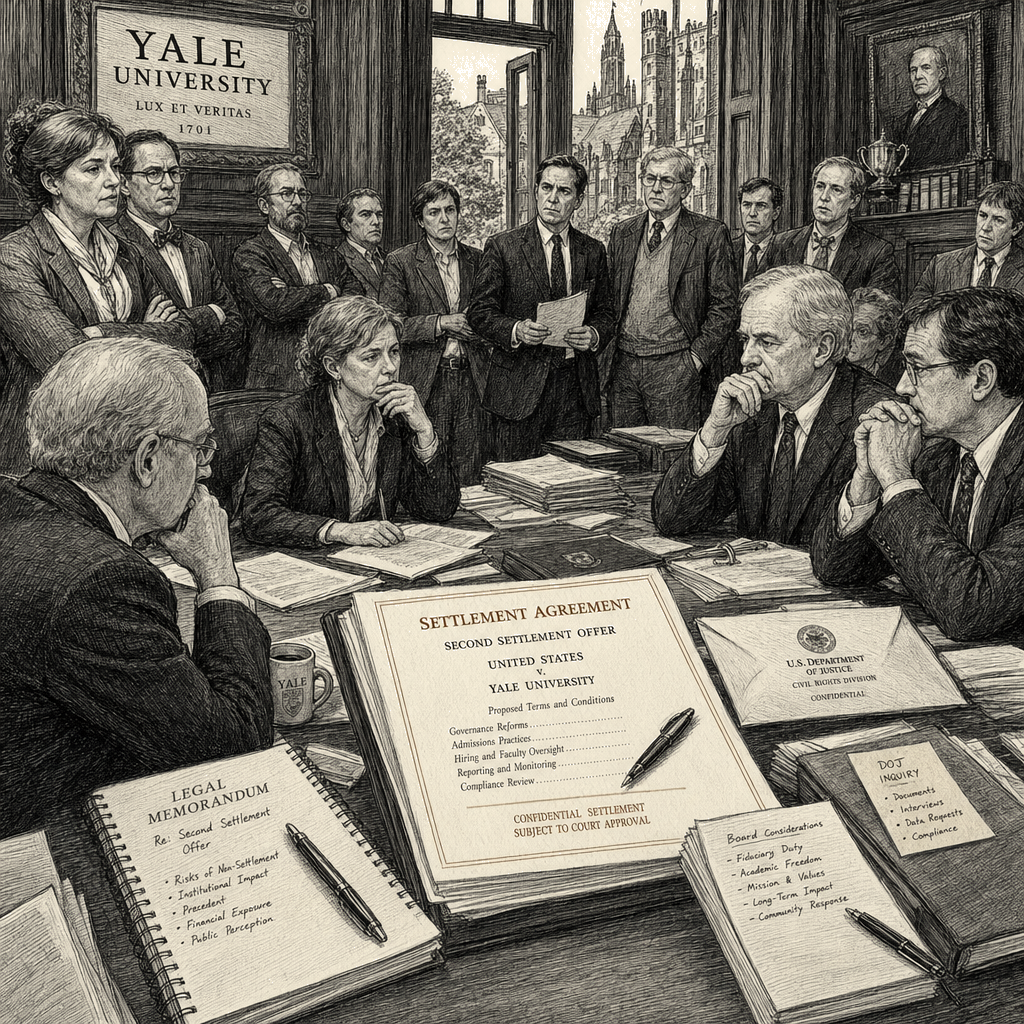
Blumenthal’s remarks came during a Friday afternoon meeting with students and faculty at Yale. He said he had been “told very reliably” that Yale made a second settlement offer to the administration after the first was rejected. He reported that he has spoken to Yale President Maurie McInnis twice.
“We’re at a legacy-defining moment,” Blumenthal said, according to a report from the Wall Street Journal. “Yale will be regarded either as a beacon and a fighter for academic freedom or as the weakling who succumbed and obeyed.”
Blumenthal encouraged faculty and students to continue mounting pressure against making concessions. “We need to be absolutely full-throated, undivided, undiluted in what we are doing,” he said.
A Yale spokeswoman said the school stands “firm in the university’s commitment to students’ free expression, academic freedom, and Yale’s ability to determine who is admitted in accordance with the law.”
The Justice Department’s findings, released two months ago, were part of a broader Trump administration probe into alleged racial bias at medical schools. The department found that at Yale’s medical school, the median MCAT score for Black admitted applicants was in the 94th or 95th percentile, while Hispanic students scored in the 95th or 96th percentile. White and Asian students scored in the 99th or 100th percentile.
A law firm hired by the Yale chapter of the American Association of University Professors has challenged the investigation’s findings.
The pressure campaign has put McInnis in a difficult position. Last year she was praised across campus for successfully navigating Washington politics while many Ivy League schools faced federal investigations and litigation from the Trump administration. Now she faces an array of faculty, unions, and deans urging her not to settle.
The Yale AAUP chapter joined with two other teacher unions in a letter Monday pleading with McInnis and the board of trustees not to back down. “The choice before Yale is not simply whether to settle one investigation,” the letter says. “It is whether to participate in a broader campaign to turn civil rights enforcement into a mechanism of political control over higher education.”
An alumni group petition addressed to the president, provost, and board of trustees, signed by more than 4,000 people, urged Yale to resist. “This is an effort to chill lawful efforts to build a diverse academic community, to undermine Yale’s academic independence, and to intimidate every institution watching this spectacle,” the petition said.
Other elite schools have reached settlements with the Trump administration over different allegations. Columbia University, the University of Pennsylvania, and Brown University reached multimillion-dollar settlements primarily over claims they did not do enough to stop the harassment of Jewish students on campus. Those settlements also included reorganization of school governance and tightened rules for student protests. Harvard University faced similar scrutiny but fought back in court and remains in active litigation.
Yale has a $44 billion endowment and extensive legal resources. The dean of the law school lobbied McInnis to exclude the law school from negotiations, according to a person familiar with the matter.
MSI has previously reported on the Justice Department’s broader investigation into medical school admissions practices, including findings at UCLA and probes at 15 medical schools.