US officials demand Iran guarantee Strait of Hormuz access as talks continue
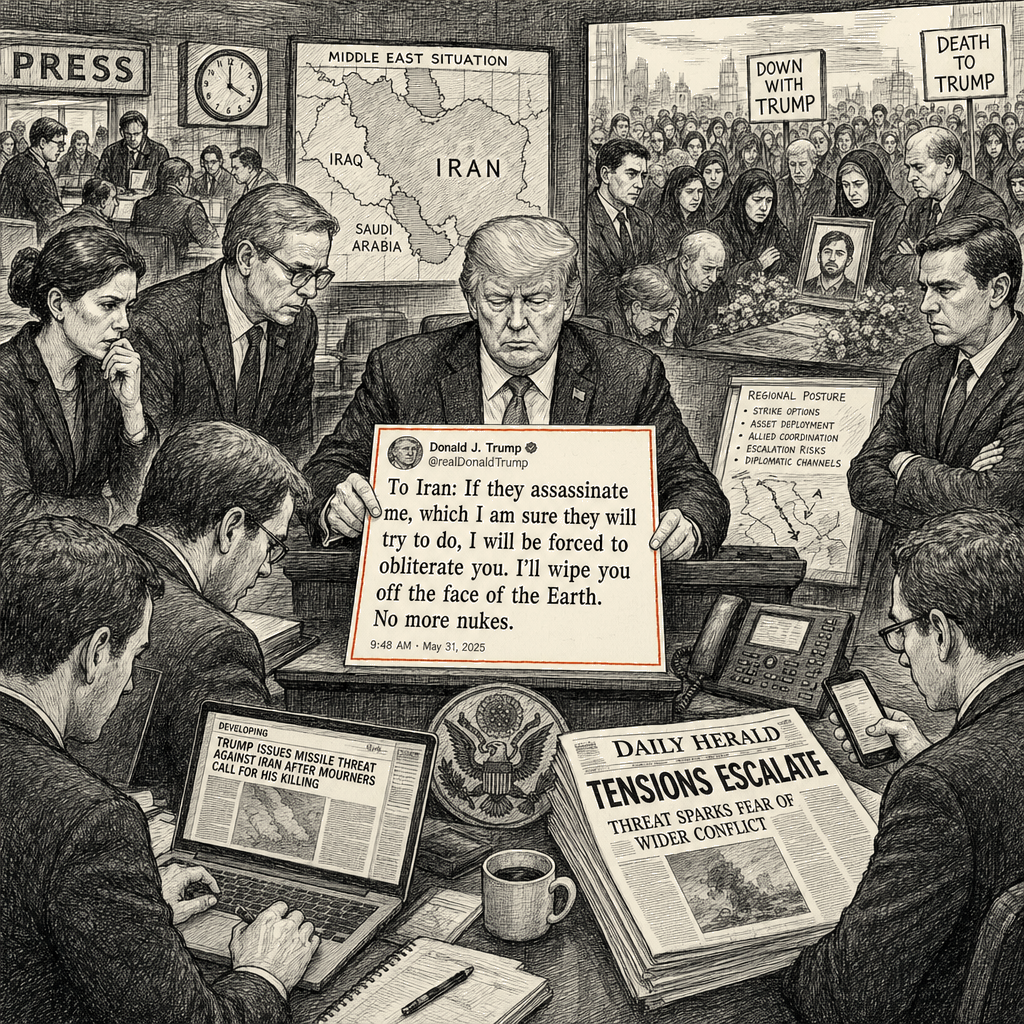
President Donald Trump threatened Iran on Saturday, writing on Truth Social that the US military had “a thousand missiles locked and loaded and aimed at the Islamic Republic of Iran, with thousands of more to immediately follow” should the Iranian government act on threats to assassinate him. The threat came after mourners at the funeral of the late Supreme Leader Ayatollah Ali Khamenei displayed posters calling for Trump and Netanyahu to be killed.
The threat accompanied renewed demands from senior US officials that Iran make a public statement that the Strait of Hormuz is open and that ships crossing the vital corridor will not be attacked. According to US officials who spoke on condition of anonymity, Tehran has so far refused, instead insisting the route remain under its control and that it be allowed to charge vessels moving through it. The demand upends decades of precedent under which the strait was considered an international waterway.
Iran attacked three ships in the strait earlier this week, drawing US airstrikes against Iranian targets. Iran retaliated by targeting Bahrain, Jordan, Kuwait and Qatar, the officials said. US officials said the resumption of strikes this week came after what they described as a rogue faction of Iranian hard-liners trying to sabotage the interim ceasefire.
The conflict began with a US airstrike on Feb. 28 that killed Khamenei, 86. His body was buried this week after a dayslong funeral that included ceremonies in cities across Iran and Iraq. Iran said the country’s theocracy is unified under the new supreme leader, Ayatollah Mojtaba Khamenei.
The Strait of Hormuz, through which about a fifth of the world’s traded oil and natural gas passed before the war, remains a central flashpoint. Iran’s grip on the strait during the conflict caused a global energy crisis, though oil prices have since dropped from wartime highs of $120 a barrel. The US has urged mariners to travel on a southern route through Oman’s territorial waters to avoid Iranian waters and the paramilitary Revolutionary Guard, a move that angered Tehran.
Iranian Foreign Minister Abbas Araghchi plans to discuss the strait with his Omani counterpart at a meeting Saturday, according to Iran’s state-run IRNA news agency. Turkish Foreign Minister Hakan Fidan said he believed “a solution can be reached” this weekend. Qatari mediators also traveled to Iran to meet with officials on Friday, Iranian Foreign Ministry spokesperson Esmail Baghaei said.
Araghchi on Saturday accused the US of violating the interim deal by ending waivers that allowed Iran to sell crude oil on the open market in US dollars, writing on X: “Reality check: There can only be mutual compliance.”
The nuclear dimension of the standoff remains unresolved. US officials told journalists that any deal on Iran’s nuclear program would require Tehran to turn over its stockpile of highly enriched uranium — something Iran has repeatedly refused. The uranium, enriched to near weapons-grade levels, is believed to be at nuclear sites the US bombed in 2025. The International Atomic Energy Agency has said Iran is the only country in the world to enrich uranium to such levels without a weapons program. The officials said that if no nuclear deal is reached, the US has military options to ensure the material “remains buried underground forever,” though they did not detail those options. They also insisted that a nuclear deal would never be reached unless Iran first stops attacks on ships in the Strait of Hormuz.
After the US wrapped up its latest strikes on Thursday, additional attacks reportedly hit Iran, leaving questions about who else may be targeting the Islamic Republic. Israel did not claim responsibility, leading US officials to suggest Gulf Arab states may have launched the strikes, likely as a deterrent against further Iranian attacks on their territory.