D.C. City Council urges Michigan’s Whitmer to end troop deployment
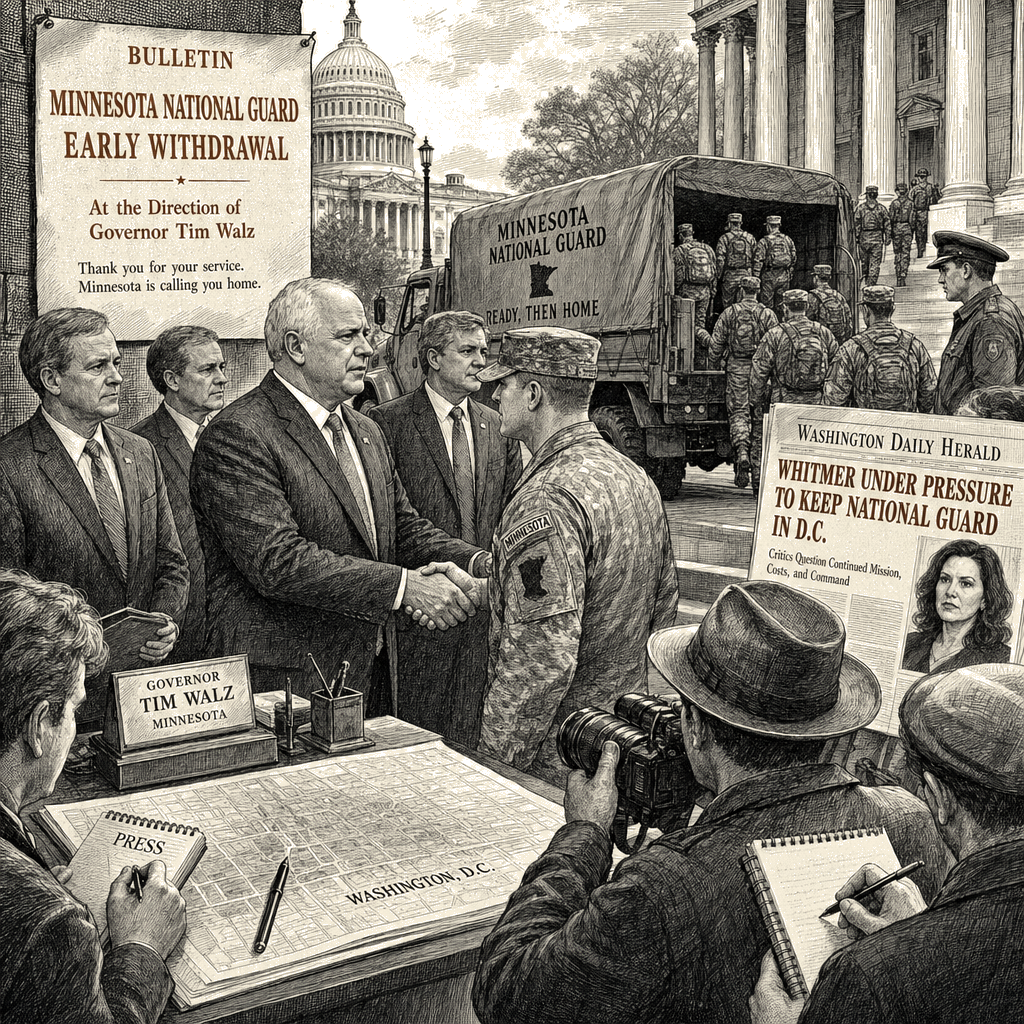
Walz’s decision to pull Minnesota’s troops came days after activists from the group Free D.C. posted videos — authenticated by NPR — showing armed Minnesota and Michigan guard members in residential neighborhoods far from the National Mall, unable to say how far they were from the America 250 celebration events they were assigned to support. The Minnesota troops had originally been scheduled to remain in Washington through July 23.
Walz’s office confirmed to NPR that when it became clear that Minnesota guard members were being used on presence patrols in other neighborhoods, the decision was made to pull them out. The governor had sent the troops with specific orders that they would be used only to help with America 250 events near the national monuments. Democratic governors from Kentucky, North Carolina, Michigan, Maryland, and Hawaii also sent troops to the city in recent weeks with similar orders.
A single Kentucky National Guard member was brought home before the main events began after being diverted to the federal task force “without the knowledge or consent” of the state’s governor or its Guard command, said Scottie Ellis, communications director for Democratic Gov. Andy Beshear. Maryland Gov. Wes Moore’s office confirmed to NPR that his state’s guard members, who were in Washington only for a brief window around the celebrations, would return at the end of the week.
All six Democratic-led states have been clear about their opposition to the Trump administration’s ongoing deployment of the National Guard in the city, which began in August 2025 as part of a federal task force to fight crime. The number of troops has doubled to more than 5,100 over the past month under what federal officials called a “summer surge,” according to NPR. The Congressional Budget Office estimated the deployment costs upwards of $3 million per day.
“They were fundamentally trusting the Trump administration to respect those lines, and I think that was a mistake,” Elizabeth Goitein, senior director of Liberty and National Security at the Brennan Center for Justice, told NPR. “No matter what limits they try to draw, as a practical matter, the governors are not there on the ground and are not giving the orders.”
Former National Guard officials said it is impractical for states to play a role in day-to-day activities in a complex national mission like the one in Washington.
Pressure has been intensifying on Michigan Gov. Whitmer to follow Walz’s lead. In a letter last week, Whitmer threatened to pull Michigan’s 162 guard members out if there are more reports of them being used in ongoing law enforcement operations. The deployment is currently scheduled through Aug. 31.
This week, all 13 members of the D.C. City Council signed a letter to Whitmer calling on her to bring her troops home early. “The continued deployment of out-of-state Guard personnel after these events, in addition to the Joint Task Force’s use of Guard personnel to conduct patrols in District neighborhoods, outside the scope of event-specific security, raises serious concerns about mission creep, militarization of civilian spaces, and the erosion of local democratic control,” the council wrote.
A coalition of more than two dozen think tanks, civic, labor, and civil rights groups also sent a letter urging Whitmer to end the deployment. Whitmer’s office did not immediately provide a response to NPR about either letter.
Hawaii’s National Guard members only arrived in Washington in recent days — after the July 4 holiday — and a spokesperson said the deployment could last up to 90 days. Nineteen former senior military officials last week sent a joint letter to all governors who have not yet sent troops, including Hawaii, urging them not to, describing the situation in the city as “fundamentally different” from past celebrations.
“I think, frankly, that the American people are being desensitized to the presence of armed, uniformed people on their streets,” former Secretary of the Air Force Frank Kendall, one of the signatories, told NPR.
The D.C. Joint Task Force did not respond to questions about troops’ specific activities in the city but said that guard members sent for the America 250 mission would not have their mission changed. All state National Guard troops on the task force list have been deputized as special police by the U.S. Marshals Service and issued a firearm, according to the Joint Task Force.