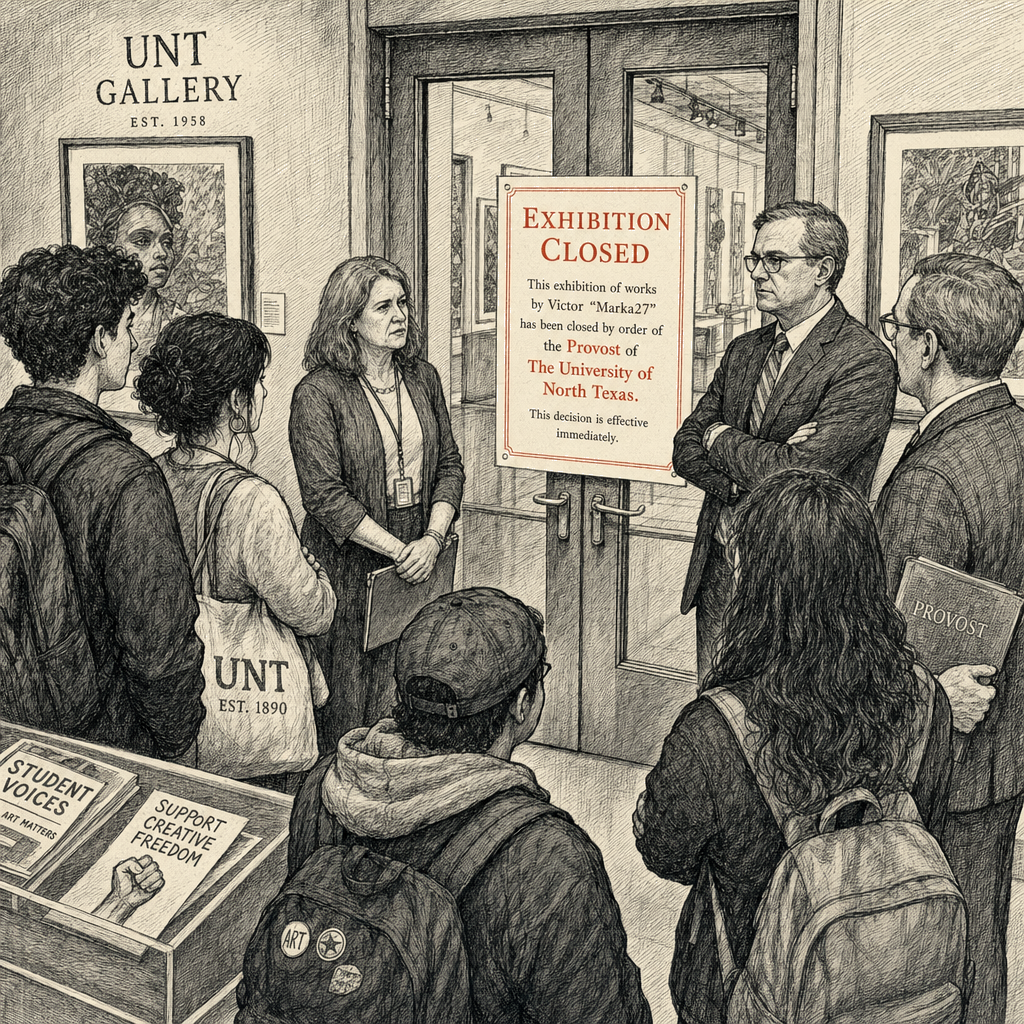
UNT provost pushed for full removal, not selective pieces
Victor “Marka27” Quiñonez, born in Ciudad Juárez, Mexico, and raised in East Dallas, Texas, said the exhibition “Ni De Aquí, Ni De Allá — Neither from Here Nor from There” had a successful run at Boston University before traveling to the University of North Texas. He was contacted by students on social media within two days of its Feb. 3 opening, alerting him that the show had been shut down.
The centerpiece of the exhibition was a series Quiñonez calls “I.C.E. Scream,” which consists of large resin sculptures in the shape of Mexican paletas. The brightly colored sculptures initially resemble playful pop art, but each one contains an item encapsulated inside — handcuffs, replica firearms or old rosaries. When asked about the popsicle sticks inside the sculptures, Quiñonez noted that normally a stamp or joke is printed on the stick, but his sticks bear a parody of the official ICE seal reading “U.S. Inhumane and Cruelty Enforcement.”
Quiñonez’s work has been presented at institutions including The Shed, a cultural center in New York City. Deja Belardo, a curator at The Shed, said the organization saw value in his work for being “responsive to what was happening around us” and “wanting to tell a story about immigrants and their labor, and all of the work that they do in the shadows.”
The University of North Texas did not respond to multiple requests from NPR for comment on why the exhibition was closed. However, independent arts journalist Adam Schrader, founder of the site Urgent Matter, filed a public records access request and obtained text messages between UNT President Harrison Keller and then-Provost Michael McPherson. McPherson stepped down from the provost role in May to become a senior advisor to Keller.
According to the records Schrader obtained and posted online, administrators initially discussed removing some pieces from the show. McPherson then texted that he wanted to take down the entire exhibition, writing: “I think it’ll be easier to manage any barking from our friends in Austin.” Austin is the home of the Texas state legislature.
Schrader said the situation at UNT reflects a broader trend of universities reversing diversity, equity and inclusion efforts they formerly championed. “It comes after a lot of discourse politically around diversity, equity and inclusion at universities and just free speech in general at universities, art displays, at campuses from Florida to Texas and across the nation,” Schrader said.
In 2023, Texas passed a state senate bill that began abolishing DEI programs at state-funded colleges and universities, including UNT. The White House has also withheld billions from federally funded universities whose diversity policies do not align with those of President Trump.
Jenny Yanez, a UNT student who graduated in May and first alerted Quiñonez to the closure, said the mood within the arts program shifted noticeably during her final months. “I feel like everyone is acting like they’re walking on eggshells and they feel very nervous as artists,” Yanez said. She noted that while UNT arts faculty wrote an open letter protesting the exhibition’s closure, they did not sign their names.
Yanez said there has been considerable anger among students, particularly over what she described as a lack of transparency by the administration. “My friends were definitely feeling like, ‘You guys want our money, but you won’t give us answers,’” Yanez said.
In response to the exhibition’s shutdown, graduating UNT seniors abandoned the traditional on-campus graduation show and instead showcased their work at independent venues across Denton and Dallas.
Quiñonez’s work is scheduled to go on exhibition at the University of California, Santa Cruz in September.