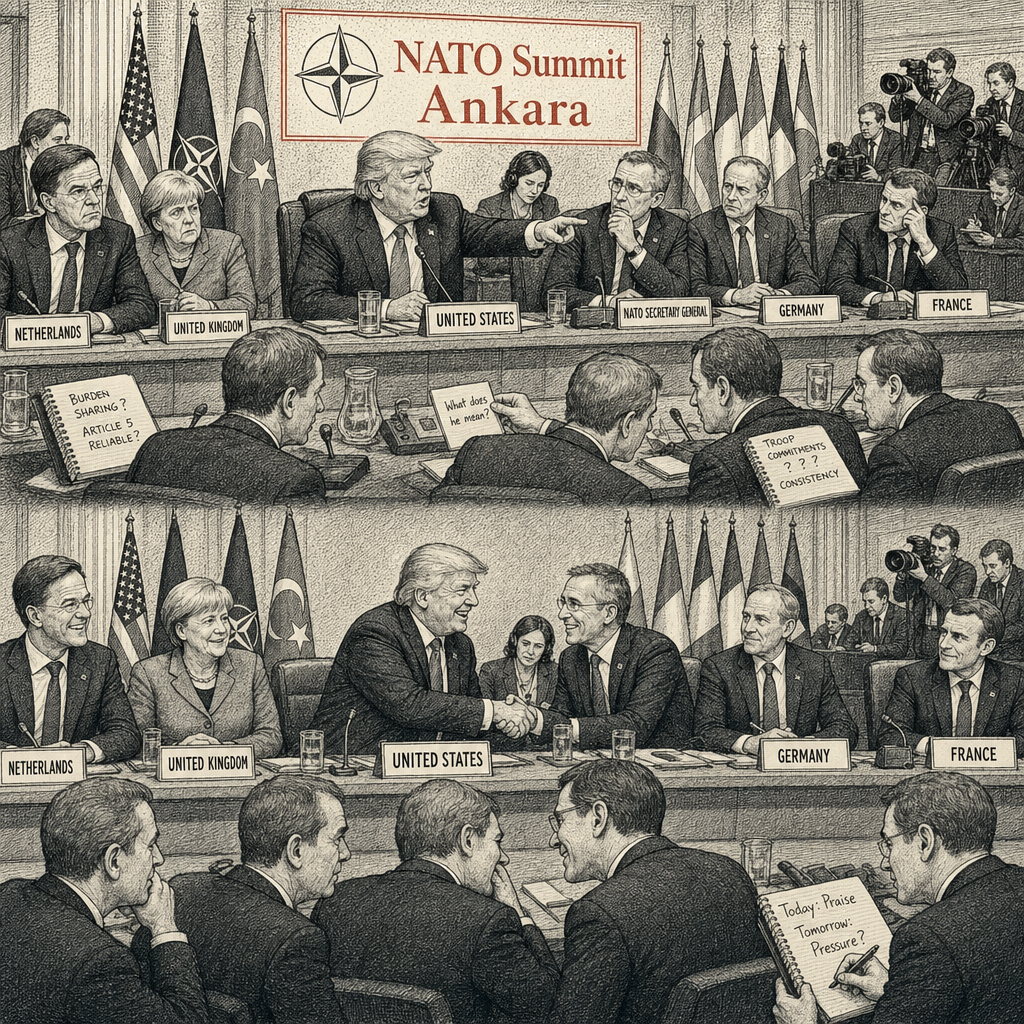
Analysts cite Trump’s rapport with Erdogan as factor in NATO summit shift
President Trump arrived in Ankara last Tuesday, in the Guardian’s description, in a “spectacular funk,” visibly angry that the temporary ceasefire he had agreed with Iran had failed to hold. He told journalists that the Islamic leadership of Iran, which he had praised as “very reasonable” two weeks earlier, were “scum” and “sick people.”
Trump also lashed out at NATO, saying he was “not happy with Nato” and complaining about the failure of alliance members, including Britain, to help him in the Iran war. He rehashed his claims on Greenland despite it being sovereign Danish territory, and demanded the U.S. sever trade ties with Spain because its socialist government, whom he denounced as “bad people,” refused to comply with new defense spending targets.
Hours later, however, Trump emerged from a meeting with the same leaders he had lambasted and spoke of unity. “There was a lot of love in that room,” Trump said. He had, apparently, never had a NATO meeting that had been so positive. He extended this sudden warmth to Ukrainian President Volodymyr Zelenskyy, whom he praised as “ingenious” for holding his country together in a war against Russia.
Analysts offered several explanations for the abrupt shift. Ian Lesser, a fellow at the German Marshall Fund who attended the summit, said the meeting had a “bipolar quality” that he attributed to Trump’s chemistry with the summit’s host, Turkish President Recep Tayyip Erdoğan. “The fact that President Trump has this apparently very close relationship with President Erdoğan probably played a role in stabilizing things,” Lesser said.
Lesser noted that Trump, more than many leaders, puts his personality into international affairs and tends to see the world through individual leaders rather than through alliances, adding that Trump holds a skeptical view of such multilateral institutions.
Another factor, according to analysts, was the flattery of NATO Secretary General Mark Rutte, who has made an art of praising Trump for “saving” NATO by getting European allies to raise defense spending. Charles Kupchan, a professor of international affairs at Georgetown University and a former senior White House adviser on Europe, said Rutte is “doing a good job of trying to say to Trump, ‘Hey, it’s working. We’re becoming more capable allies. We hear you.’”
Kupchan said Trump’s apparent change of heart toward Zelenskyy may have been fueled by disappointment in Russian President Vladimir Putin for offering no concessions to end the Ukraine war, as well as by awareness of congressional opinion as midterm elections approach.
Despite the unexpectedly emollient finale, some analysts said Trump’s regular bashing of allies could leave a permanent mark. But Kupchan argued that the rhetorical hostility had not weakened the alliance. “Stepping back from all the heated rhetoric, and Trump’s demeaning language toward Nato, in some ways, the picture that emerges is a positive one,” he said. “Nato is still Nato. There are still 80,000 US troops in Europe.”
Kupchan cautioned that the underlying problem is the collapse of the political center in the United States, which he said means the country “doesn’t really have a foreign policy any more.” He warned that European allies must “plan for the worst” because they cannot know whether they can count on the U.S. security guarantee.