Cheaper LFP batteries pose new hurdles for battery recyclers
On a sweltering morning in early July at Everett Auto Parts in Brockton, Massachusetts, co-owner Thomas Andrade supervised workers as they strapped two Chevy Volt hybrid batteries to a pallet for shipping to a recycler. Despite the batteries being full of valuable minerals — nickel, cobalt, manganese, and lithium — Andrade said he would make nothing from the deal. “The good thing with these is, they’ll at least take them at no expense,” he said, according to NPR. He said he was happy to break even.
Across the state at Westover Salvage Yard, CEO Brian Bachand faced a different calculation. A fully functional Tesla battery the size of a mattress sat on a shelf. Bachand said he had priced it at $1,200, hoping to sell it as a replacement part worth up to $2,000, but no one had bought it. He said the only recycling quote he received was negative $1,800 — meaning he would have to pay that amount to have it accepted. “This is a liability,” Bachand said. “No one’s paying me for it. I have to pay to get rid of it.”
The economics of EV battery recycling vary sharply depending on battery chemistry and scale. J.B. Straubel, founder and CEO of Redwood Materials, a major U.S. battery recycler, described the picture as improving. “Every year that goes by, every month that goes by, it’s getting more economical, it’s getting more competitive,” he said at a General Motors event in San Francisco. Andy Oury, a battery engineer at GM, said that while recycling used to be an expense for the company, it is now “a source of revenue,” with recyclers paying for scrap from GM’s own manufacturing lines.
General Motors benefits from large volumes that make logistics efficient. Smaller salvage yards lack that advantage. Emil Nusbaum, vice president of strategy and government affairs for the Automotive Recyclers Association, said salvage yards already struggle to profit from disassembling EVs because they have fewer parts than gas-powered cars. “The two most valuable components are engines and transmissions for reuse and vehicle repairs,” Nusbaum said. “We don’t have those components in electric vehicles.”
The battery itself is a wild card for salvage yards, Nusbaum said — potentially valuable if it can be resold, but a costly liability if it can only be recycled. The problem is compounded by the industry’s shift toward cheaper lithium-iron-phosphate (LFP) batteries, which last longer but contain less valuable minerals. “There’s really no value in recycling iron phosphate, unfortunately,” said David Klanecky, CEO of Cirba Solutions, a major battery recycler. “If I have to pay anybody to get an LFP battery, we don’t make any money.”
Frederick Bloomfield, an analyst at Benchmark Mineral Intelligence who tracks battery recycling supply chain prices, said recyclers charge what he called a “gate fee” — the price to accept scrap — of around $1.50 to $2 per kilogram for LFP batteries in North America. Since an EV battery can weigh a ton or more, that amounts to hundreds of dollars a salvage yard must pay before shipping the hazardous material. By contrast, recyclers will pay $2 per kilogram or more for batteries packed with pricier minerals.
Bloomfield said battery-recycling facilities built in recent years anticipated more batteries with expensive chemistries and are now “kind of looking a little bit ill-prepared” for the LFP batteries that are dominating the market. Joe Hearn, co-founder of the SHiFT vehicle retirement initiative, said the risk of holding a battery that will be expensive to dispose of is making supply chain players cautious. “The scrappers and shredders are very conservative about what they’re willing to receive at this point,” he said. “Our auto recycling partners have had loads refused and returned to them because there is an EV or hybrid in that load.”
Jessica Dunn, a scientist with the Union of Concerned Scientists who focuses on battery recycling, said that when responsible recyclers are reluctant to accept old batteries, the risks include fires from damaged batteries and improper disposal. She said EV and hybrid batteries are already showing up in landfills. “It is illegal to put a battery in a landfill, but they end up there anyway. And then that cost falls on a public entity to try to deal with it,” she said.
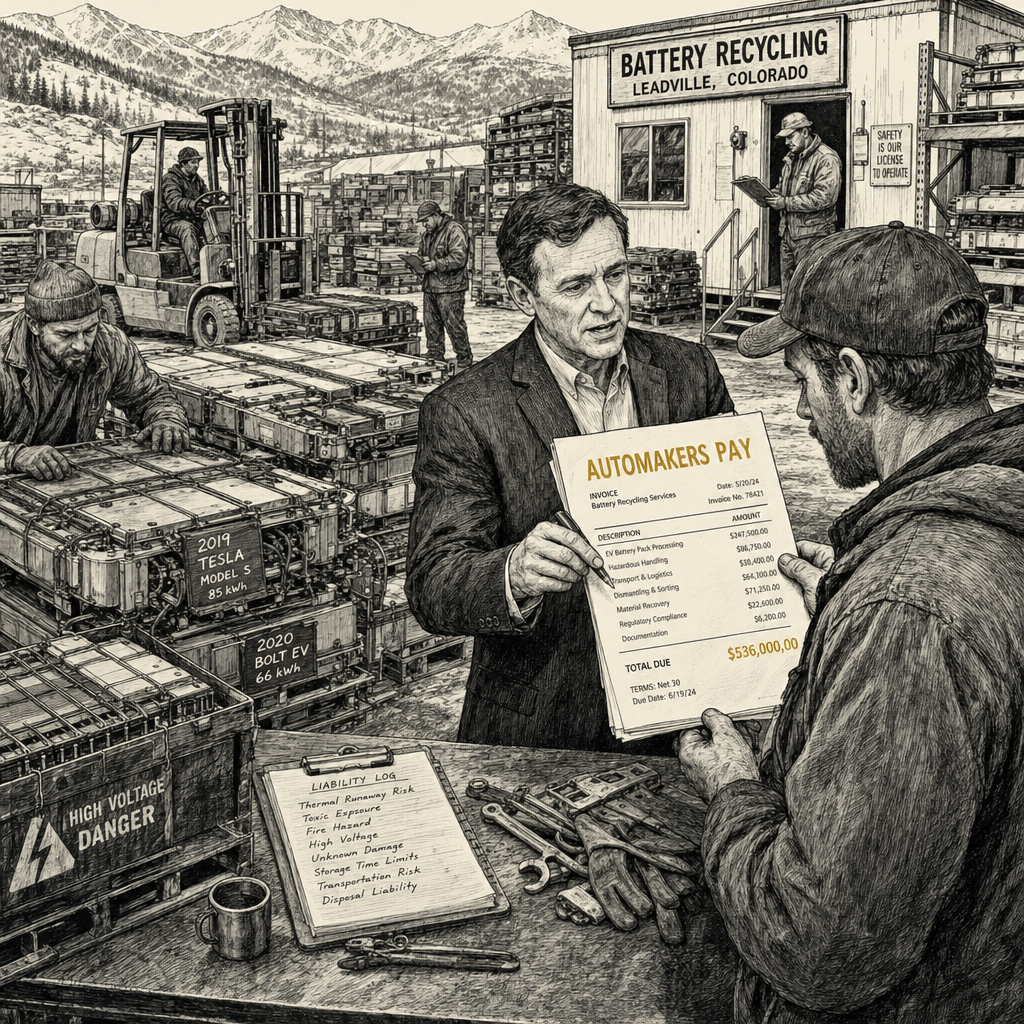
Colorado’s new law aims to prevent that outcome by establishing what state Sen. Lisa Cutter, who co-sponsored the bill, called “producer responsibility.” “Producer responsibility just means that the people making the trash — or whatever we’re considering the trash, the thing we’re disposing of — have to take responsibility for recycling it and for taking care of end-of-life,” Cutter said. “There’s not a magic trash fairy. We have to plan for these things.”
Under the law, if an EV battery is dumped at a landfill or stranded at a salvage yard, the manufacturer who originally sold the vehicle — Tesla or GM, for instance — will be responsible for picking it up and ensuring it is recycled, at the carmaker’s expense. The law also requires that a certain percentage of the battery’s minerals be recovered, a provision Dunn said ensures “that it be recycled well.”
The bill drew support from an unusually broad coalition. Environmental groups including the Union of Concerned Scientists and Western Resource Advocates backed it, as did the Automotive Recyclers Association. Battery recyclers Redwood Materials and Cirba Solutions both praised the law. The Alliance for Automotive Innovation, the trade group representing most major automakers, called the law “balanced” and noted in a letter to Colorado Gov. Jared Polis that keeping battery minerals within domestic supply chains is “foundational to America’s automotive industrial base.”
Dunn said she expects other states to follow Colorado’s lead. “We see Colorado as the starting place,” she said. The NPR report, by Camila Domonoske, noted that the European Union has a similar but more stringent producer-responsibility law already in effect.