Iran’s attacks leave nearly dozen seafarers dead, Pentagon says
President Donald Trump has asserted that the Strait of Hormuz is open and under U.S. control, but ship-tracking data from Kpler showed traffic dropped Tuesday to 21 recorded crossings, compared with an average of 30 vessels a day last week, The Wall Street Journal reported. Of the 21 ships, none used the U.S.-backed route near Oman; 16 used Iran’s approved channel close to its coast, according to the Journal, which reviewed marine traffic data.
The U.S. military has launched heavy waves of strikes this week against Iranian missile, drone and naval sites along the southern coastline, U.S. Central Command said. Early Wednesday, strikes went on for seven hours, Central Command said, followed by a 90-minute wave of daytime attacks aimed at degrading Iran’s ability to hit commercial ships. The military also said it turned around two ships under its renewed blockade.
Iran has not backed down. It has declared the strait closed and stepped up attacks on commercial vessels using cruise missiles and drones, according to the Pentagon. The attacks have left nearly a dozen seafarers dead, wounded or missing in recent days, the Pentagon said.
The fighting has laid bare the difficult choices facing the U.S. military. Danny Citrinowicz, the former head of the Iran division of Israeli defense intelligence, told the Journal: “The dilemma is quite simple: At the end of the day, if he wants to take control over the straits, he will need to take over the straits. He is not able to reach his military or strategic objectives with the force he has now.”
One option is close naval escorts for commercial ships. Experts estimate that two warships could be needed to escort a single tanker, or a dozen per convoy, according to the Journal. Navy officers warned that Iranian drones and antiship missiles could turn the area into a “kill box” for U.S. forces, the newspaper reported.
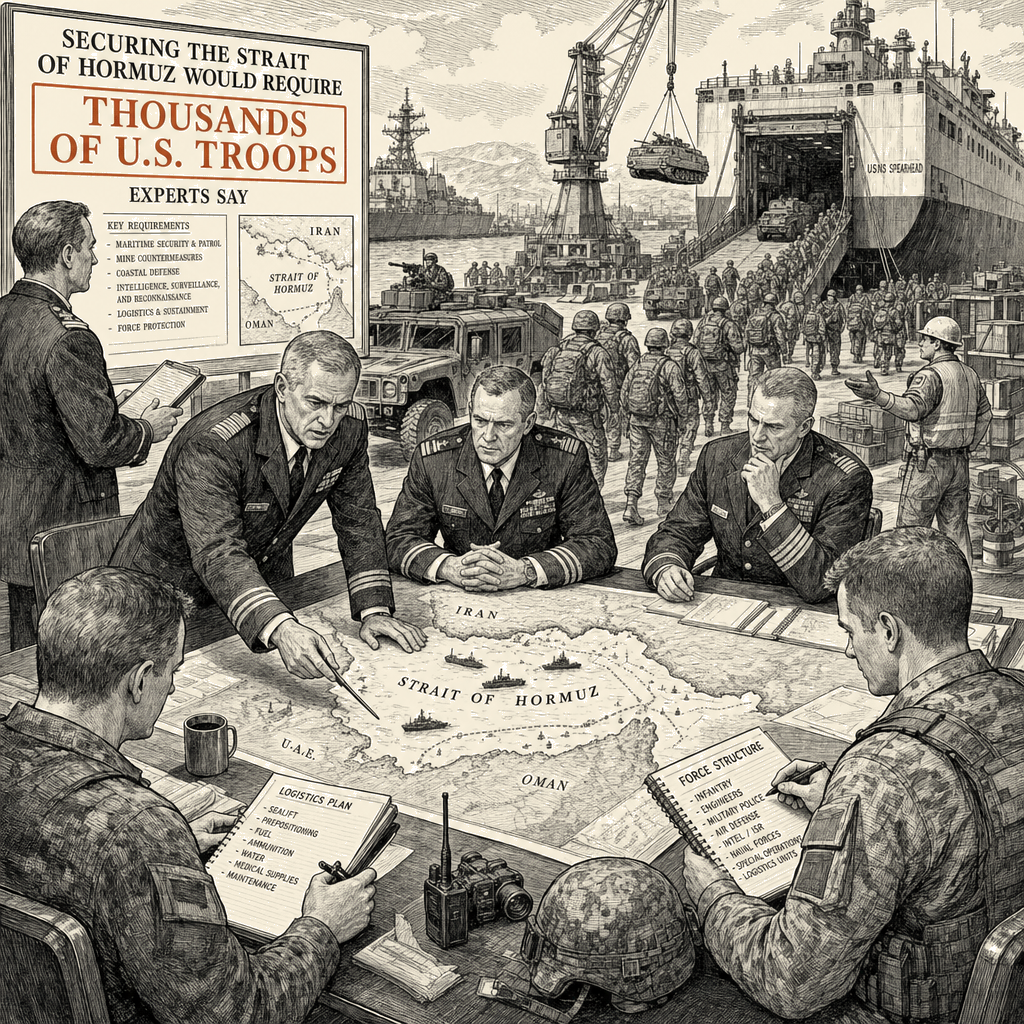
A more extreme option would be a large ground operation to seize territory around the waterway. That would require thousands of troops and likely take months, analysts said. Iran’s paramilitary Islamic Revolutionary Guard Corps has 190,000 troops, along with the country’s regular army, and specializes in fighting against better-armed foes, the Journal reported.
David Des Roches, a former Persian Gulf-focused U.S. defense official, told the Journal that a ground operation on Iran’s coastline would leave U.S. troops “extremely vulnerable to attacks from the country’s rear.”
Tuesday morning, U.S. forces broadcast over marine radio that the “southern route of the strait remains open,” according to a recording reviewed by the Journal. One sailor responded via his ship’s radio: “F— off.”
The U.S. had limited success sneaking ships through the strait in May and June by leading them along the coast of Oman with aerial protection, but Iran responded by targeting that route, sparking renewed fighting and dimming the shipping industry’s hopes for a military solution, according to the Journal.
More than 20,000 airstrikes and billions of dollars in sanctions relief offered in Trump’s initial peace deal have not persuaded Iran to relinquish control of the strait, the newspaper reported.
“Iran is not going to back down from asserting its control over the strait, and I think Trump is growing increasingly frustrated,” Dina Esfandiary, a Middle East expert at Bloomberg Economics, told the Journal. “I don’t see a way out of this.”
Sanam Vakil, director of the Middle East program at the London think tank Chatham House, told the Journal that both sides are escalating “in a dangerous way in order to increase leverage and weaken the other, and eventually return to the negotiating table, preferably with a stronger hand.” But she warned the showdown could backfire and spark a bigger conflict if they do not find an off ramp.