Stablecoin growth without FDIC insurance raises systemic risk, academics say
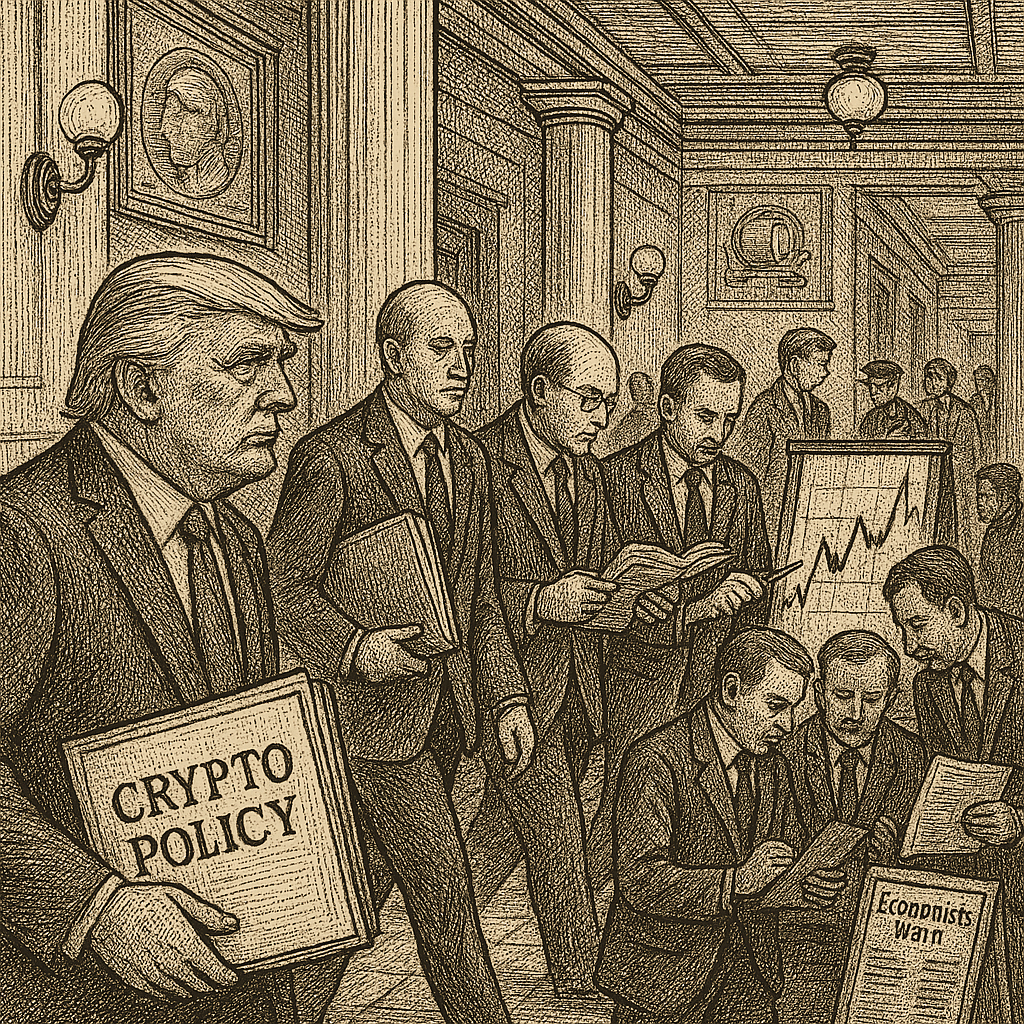
President Donald Trump made $1.2 billion from cryptocurrency ventures in his first year in office, according to a report from The Guardian, as his administration rolled back federal oversight of the industry and pushed legislation that integrates digital assets into the U.S. banking system. The president’s total personal fortune for the year reached $2.2 billion, with crypto accounting for the majority of the income, the report said.
The Guardian reported that Trump launched the crypto company World Liberty Financial and sold 49% of it to an investment firm tied to the United Arab Emirates for $500 million. He also issued a memecoin called $Trump, which netted the president more than $600 million, the report said. The coin cost investors nearly $4 billion, according to The Guardian. Trump once called cryptocurrency a “scam,” the outlet noted.
The administration took a series of steps to loosen oversight of the crypto industry, The Guardian reported. Trump’s Securities and Exchange Commission (SEC) scrapped its crypto enforcement program, aborting related lawsuits and investigations, and The Guardian reported that the unit responsible for overseeing the industry was gutted. The Department of Justice announced it would pull back investigations and prosecutions of money laundering and other offenses involving crypto-related platforms, according to The Guardian.
Congress passed the Genius Act, which Trump promoted, with 206 Republicans and 102 Democrats voting in favor, The Guardian reported. The legislation entangled crypto in the regular banking system, allowing banks and non-banks — including retailers like Walmart — to issue “stablecoins,” a type of cryptocurrency pegged to the dollar at a fixed value of $1. Unlike bank deposits, stablecoin holdings are not insured by the Federal Deposit Insurance Corp., the outlet noted.
As of early June, 233 stablecoins were available on the crypto market, according to The Guardian. Major financial institutions including Mastercard and JPMorgan Chase are building crypto infrastructure or launching their own stablecoins. Trump is also pushing for the Clarity Act, which would provide regulation-light legal cover for broader speculative crypto assets like bitcoin, the report said.
Academics have warned that the rapid integration of uninsured stablecoins into the financial system carries substantial risk. Gary Gorton of Yale and Jeffery Zhang of the University of Michigan wrote in a paper cited by The Guardian that “some policymakers may view stablecoins as an up-and-coming financial innovation that does not currently pose any systemic risk and therefore believe that the best strategy is to wait to see how things play out.” They called that approach “a terrible mistake.”
Michael Bordo of Rutgers University told The Guardian that “there are always new entities that are going to figure out a way to be outside the regulatory net,” warning that the stablecoin system could invite the equivalent of bank runs. Barry Eichengreen of the University of California, Berkeley, said in the report that if panicked customers force stablecoin issuers to sell holdings, “treasury prices could collapse, sharply increasing interest rates and destabilizing other financial markets and our entire economy.”
The Guardian’s Eduardo Porter, who wrote the report, noted that the federal government could instead ask the Federal Reserve to issue a digital dollar fully backed by the U.S. government, capturing the benefits of the technology without the risk of a systemic run. Porter wrote that such a model “would not provide the same opportunity for Trump and his family to rake in another few billion.”