Quarter of pastors use AI to write sermons, Barna finds
OKLAHOMA CITY—On a Saturday afternoon about 20 hours before he was due to preach, Darrell Stetler II sat behind a two-monitor workstation in the sound booth of his church, with ChatGPT open on one screen and a slide deck on the other. A sermon titled “Forged,” part of a summer series through the Book of Proverbs, was taking shape between his own notes and several AI chatbots. When he opened Claude, it greeted him by name: “Back at it, Disciple-maker.”
Stetler has spent more than two decades building Oklahoma City’s Bible Methodist Church, where he is lead pastor, and is part of ChatGPT’s top 1% of users. He runs a Facebook group of 500 pastors experimenting with the technology and has built a tool that can generate dozens of sermon illustrations in seconds. Yet he sounds among the most cautious. “This AI does not enjoy what it finds,” he told the Wall Street Journal. “It cannot love it.”
The wariness coexists with financial pressure. Stetler, a married father of seven, earns $600 a week plus a $1,500 monthly housing stipend that is less than his housing costs. His church keeps about two months of reserves. He takes construction jobs on the side. A sermon previously took him 10 to 15 hours to prepare; a chatbot doing first-pass research and phrasing saves several hours.
The time he saves goes toward congregants, he said. Earlier that day, he had sat at a hospital bedside of a church member. During sermon prep, his phone rang with another hospital visit request. Those hours, he said, are what the AI is buying back.
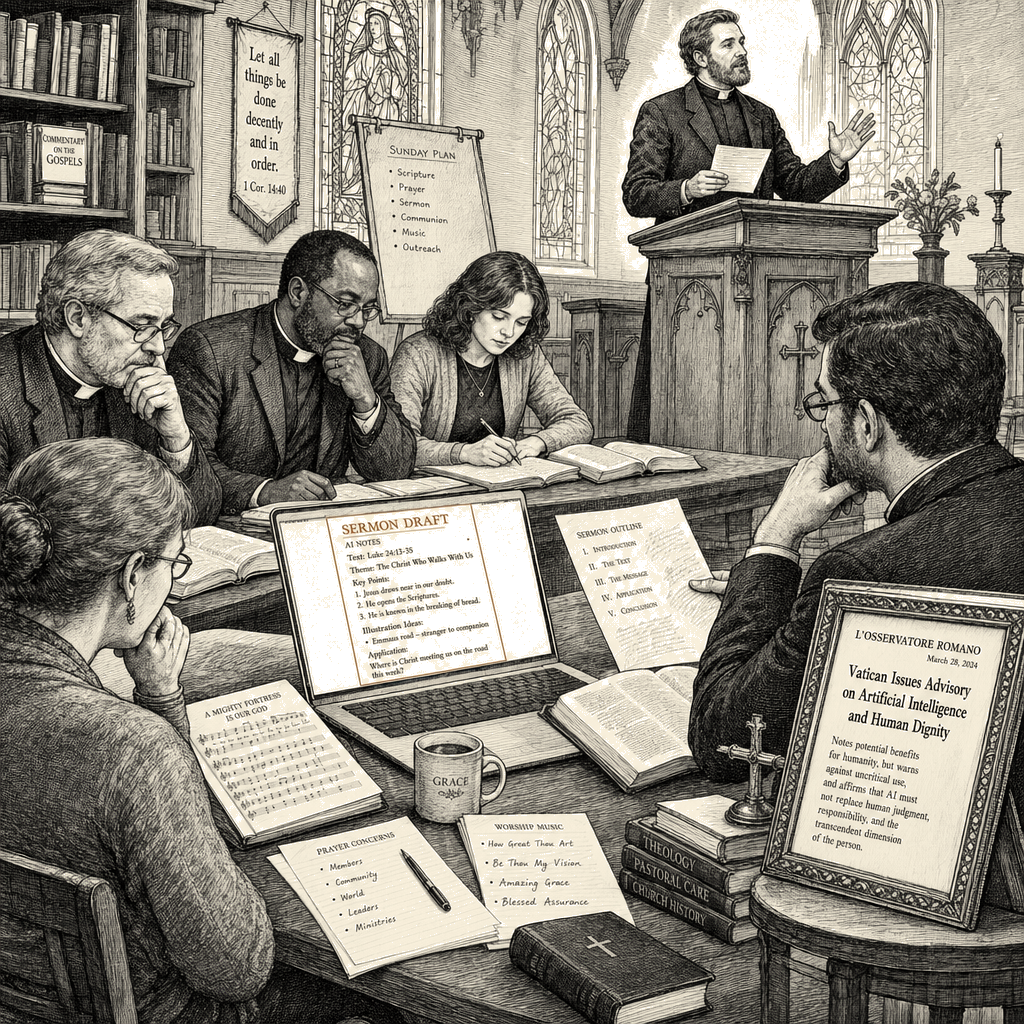
Half of all pastors say they use AI for brainstorming or idea generation, according to Barna Group. Roughly a quarter use AI to help write sermons, up from 12% in 2024, Barna found. The trend has drawn theological pushback. Earlier this year, Pope Leo XIV warned clergy that to give a true homily is to share faith, and said artificial intelligence cannot do that.
Stetler, 45, quoted a passage from Isaiah 29:13 condemning hypocrisy as a warning label for his own habits. Once, mid-prep, ChatGPT signed off a reply: “Praying for you as you preach,” the chatbot wrote. Stetler laughed. “No you’re not,” he recalled thinking.
In California, the Rev. Justin Lester, 37, a self-described tech-forward pastor, has taken the experiment further. After an Nvidia developer conference, he came home with Theo, a robot dog trained on his sermons that trots the church aisles on Sundays. Theo is the visible edge of a larger system he built called PastorGPT: a free, small-language model trained entirely on a given pastor’s sermons. It refreshes itself weekly by downloading and transcribing new sermon uploads from YouTube. More than 30 churches now run versions of it.
Built into the system, Lester said, is a pastoral early-warning function. Anonymized data flags recurring themes in what congregants confide to the bot. Last year, he said, it surfaced a surge in teenagers talking about bullying, and he built a lesson around it.
The Rev. Dwight Lee Wolter, of the Congregational Church of Patchogue on Long Island, New York, turned to ChatGPT at an emotional moment: the 2024 assassination attempt on Donald Trump at a Pennsylvania campaign rally. He asked the chatbot what he should tell his congregation the next morning. It produced, he said, a nearly perfect prayer. He also used AI to write hymns with AI-generated music.
Wolter, 75, noted that he didn’t disappear into the experiment. “Dwight is here,” he said. “He didn’t abdicate.” But he described his view of where things are heading. “I cannot imagine that a time is not coming that AI will present us with a God that’s more attractive and more flexible and 24/7,” he said, a prospect that unsettles fellow clergy more than it does him.
Using AI in the pulpit alarms critics. Meghan Sullivan, a University of Notre Dame philosophy professor leading a research project on AI and religion, said that using AI to draft anything spoken in worship reflects a basic misunderstanding of what Christians believe is happening when a preacher delivers a homily. Churches, in her view, might be among the last institutions where people are asked to sit still, in silence, and encounter another human being without mediation. “Martin Luther is rolling over in his grave,” she said, at the idea of handing scripture off to what she called a theological software middleman.
Stetler has made mistakes with AI. Two years ago, rushing to finish a slide for a sermon on a South Pacific missionary, he dropped in an AI-generated image without checking it closely. After the service, a congregant approached him. “Did you know there’s a topless woman in the background?” Stetler apologized on the spot. He tells that story as a cautionary tale. “I don’t need to rush this,” he said.
During a recent Sunday sermon, Stetler was working through an AI-generated handout when it fell out of sync with his slides. “AI has failed me,” he told worshipers. “It’s really messed me up.”
Reactions from congregants were mixed. Chad Christiansen, 48, said he uses AI for his youth nonprofit and is taking an agentic-AI course with Stetler. But Elizabeth Hughes, a 67-year-old children’s-ministry volunteer, was blunt. “I hate AI,” she said. “I like creativity.” She said she felt “lazy” when Stetler gave her AI-generated curriculum material a year ago, but added that her husband uses the tools constantly and said “they’ve won me over.”
Stetler said he worries about a future generation of AI-reliant pastors. “I’m really torn,” he said. “I would recommend guys use it lightly.” What concerns him, he said, is not the tool itself but what it could let a lazier version of himself get away with. “Preaching is truth through personality.”
MSI previously reported that faith-based AI apps bringing chatbots imitating Jesus and Buddha to market have raised questions among some clergy about authority and spiritual practice. The Vatican has created an AI study group, and Pope Leo XIV in May issued an encyclical warning that artificial intelligence is becoming “a new test of human dignity, work and power.”