Senators press Blanche on requests that went unanswered under two administrations
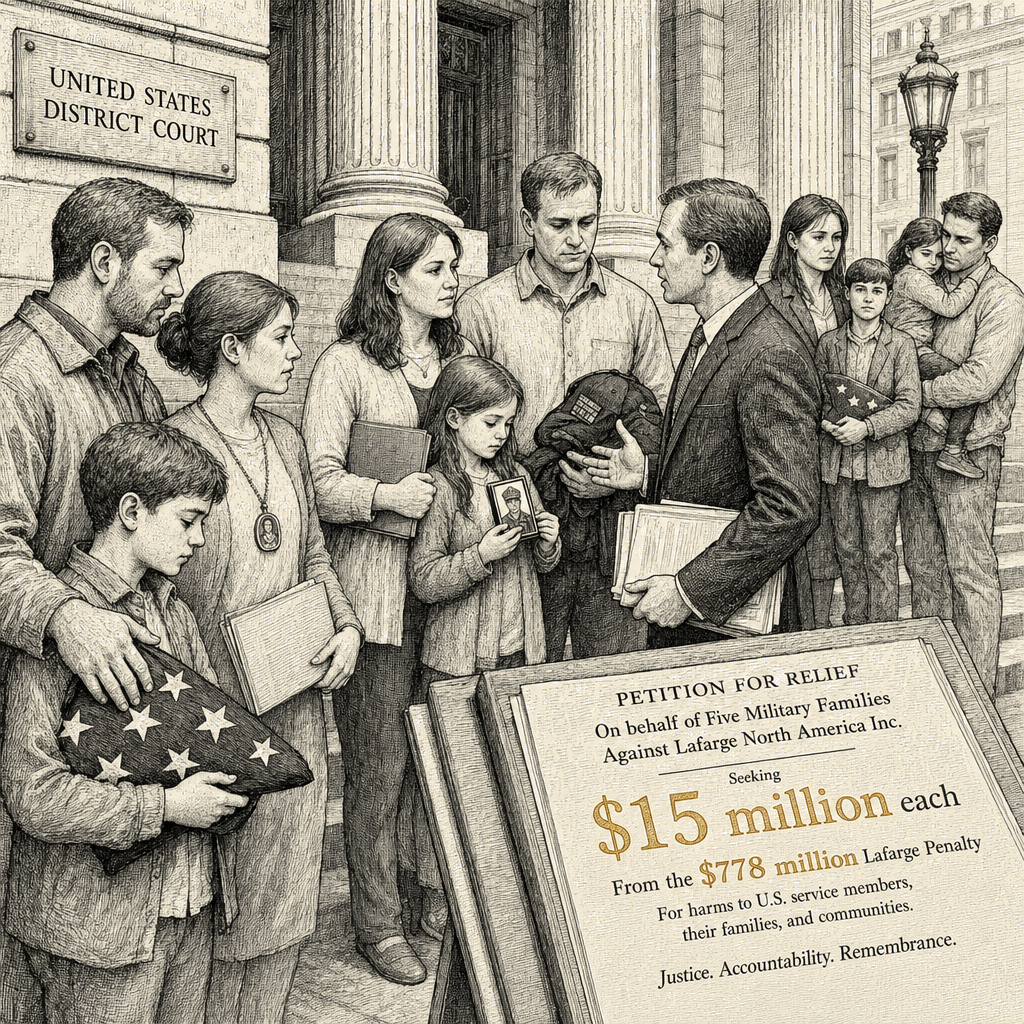
The five families each filed a formal compensation request in September 2023, seeking $15 million from the $778 million in penalties the cement company Lafarge paid to the U.S. government after pleading guilty to funding terrorist groups. The requests, addressed to the attorney general’s office then led by Merrick Garland, have gone unanswered under both the Biden and Trump administrations, according to The Wall Street Journal.
The penalty money is held in a Justice Department fund that manages proceeds of property and cash seized from convicted criminals. The fund can only compensate victims who have financial or economic losses related to the crime for which a defendant was convicted, a Justice Department official said. While the attorney general has some discretion to approve compensation in certain cases, that decision is bound by statute and regulation, the official said.
Four years ago, the French cement company Lafarge agreed to a first-of-its-kind guilty plea in which it acknowledged funding Islamic State and an al Qaeda affiliate to protect its Syrian plant, and it paid the U.S. $778 million in penalties. The plea was the first time the Justice Department prosecuted a corporation, rather than an individual or organization, for providing material support to foreign terrorist groups. Victims of attacks by those groups in Syria say they are entitled to a share of that money. Connecting Lafarge’s conduct to the terrorist-attack injuries is more complicated, raising questions about whom the Justice Department views as a victim.
The families are four Gold Star families and the family of Kenton Stacy, a retired Navy senior chief petty officer left quadriplegic and blind in one eye after an explosive blast in Syria in 2017. President Trump praised Stacy by name in his 2018 State of the Union address for his role in the fight against Islamic State. His wife, Lindsey Stacy, said the money would be a reprieve from his healthcare costs and the electrical bills, which the family said have soared with his use of a ventilator to breathe.
Lindsey Stacy said Lafarge “already paid fines to the DOJ, but our government hasn’t given us a penny of that.” “If Trump’s going to talk about Kenton, why has there been no follow-up?” she said.
Hailey Dayton, 25, told the Journal she hoped to use part of the money to start a restaurant in honor of her father, Navy Senior Chief Petty Officer Scott Dayton, who was killed in an Islamic State attack in Syria in 2016. “I had a lot of hope that someone would try and do something about this,” she said.
Two senators weighing whether to confirm acting Attorney General Todd Blanche permanently — Marsha Blackburn, Republican of Tennessee, and Dick Durbin, Democrat of Illinois — have pressed him on the issue. In a written questionnaire, Blanche said he wasn’t familiar with the specific families or their requests. He said he would review the matter and “ensure the Department takes appropriate action to comply with applicable law in order to support servicemembers and their families,” and he said he would be willing to meet with the families or their attorneys. Then-Attorney General Pam Bondi told Rep. Andy Biggs, Republican of Arizona, during a congressional hearing earlier this year that “we are aware of that and we are committed to doing everything we can to support the victims.”
The department has also made payments in other cases. The fund has returned more than $13 billion in forfeited assets to victims and their families since 2000, according to the department, which has said paying victims is a priority. It continues to pay thousands of people who lost money in international consumer scams through Western Union wire transfers after the company agreed to forfeit $586 million in 2017, and it still compensates people who were sex-trafficked through ads on the website Backpage.com, which the Federal Bureau of Investigation shut down in 2018.
Stefan Cassella, a former federal prosecutor who specialized in asset forfeiture, said sorting out who is entitled to the funds raises questions that can take years to answer. “The government’s objective is to get the money to the victims,” Cassella said. “I don’t know of a case where legitimate victims of a crime were denied money because the government wants to keep it for itself.”
The department’s payouts have recently drawn scrutiny for an additional reason. Blanche continues to draw bipartisan criticism for his role in the May creation of a $1.8 billion “anti-weaponization” fund that would have compensated people who said they were victimized by the government — people who could have included Trump supporters who stormed the Capitol on Jan. 6, 2021, as well as some groups that were the target of Internal Revenue Service scrutiny related to cases the Biden administration brought under a statute meant to provide access to abortion clinics. Blanche has said repeatedly that the department has abandoned the fund, which remains a concern at the center of his confirmation fight.