Trump is dynamiting sacred Kumeyaay and Tohono O’odham sites to build a wall nobody needs.
I run a one-man small-engine shop on forty acres my father and grandfather left me, in Friendship, Wisconsin — Adams County, which the Ho-Chunk Nation has managed since long before there was a state of Wisconsin. I am not Ho-Chunk. The work the Ho-Chunk have done on the land around my shop — the deer, the maple, the wells on the south side of the county — is work I learn from at a respectful distance, the way I read Aldo Leopold on the land he lived on, knowing he was writing after the people who managed the land first. When federal contractors blow up a sacred mountain at the border a thousand miles south of my shop, that is not a different kind of news. It is the same pattern the Ho-Chunk know from their side of the treaty table, and the rest of us ought to know it from ours.
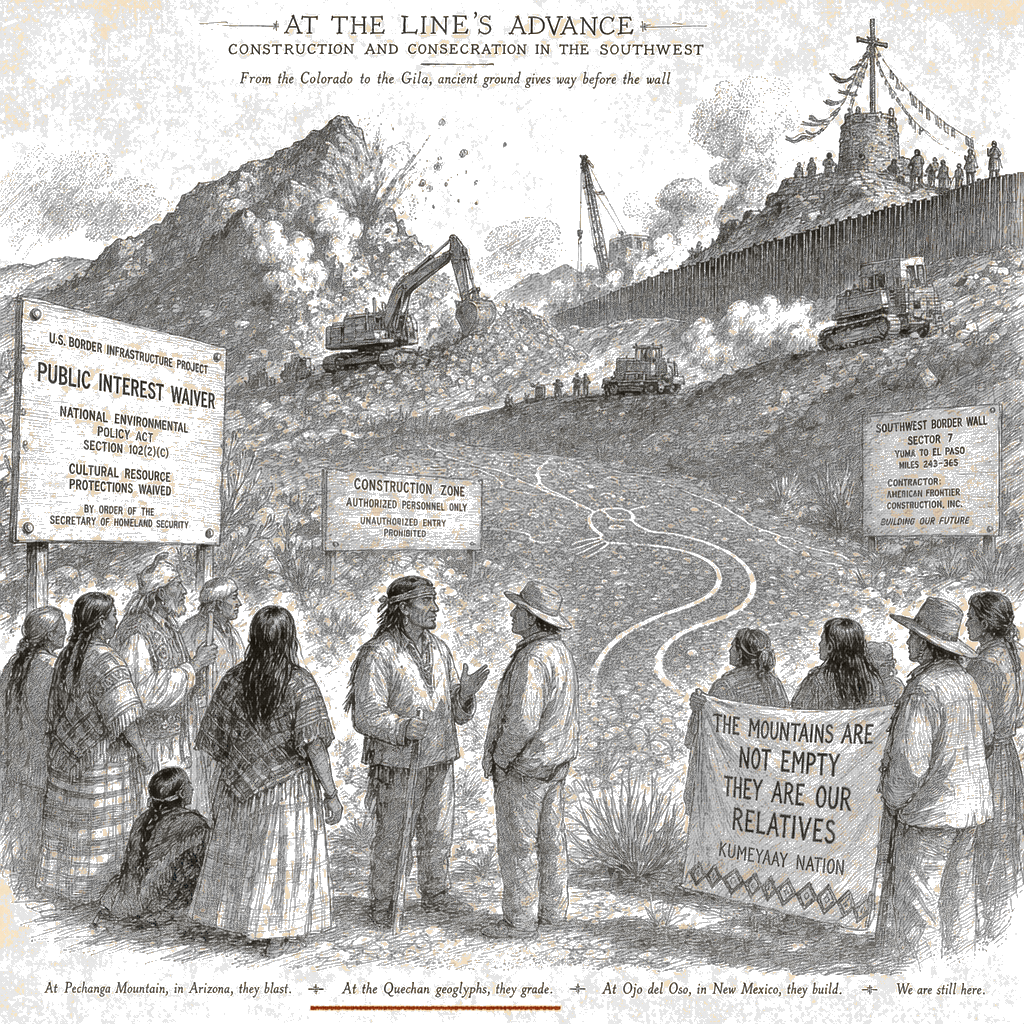
Kuuchamaa Mountain, also called Tecate Peak, sits on the U.S.-Mexico border near Tecate, California. It is sacred to the Kumeyaay Nation. The National Park Service listed it on the National Register of Historic Places in 1992 because, the agency wrote, “discarding or disturbing the mountain’s natural state would be sacrilegious.” Federal contractors are blasting it now to clear ground for a border wall. Norma Meza Calles, a Kumeyaay tribal leader, said the mountain “is our healer, our psychologist.” Emily Burgueno, a California Kumeyaay member, said in the Kumeyaay language the same word means “body” and “land.” That is not metaphor. The mountain is treated by Kumeyaay people as a living relative. The destruction of the mountain is being felt as bodily harm.
Up here in the sand counties, we have Roche-a-Cri. The petroglyphs carved into the sandstone over a thousand years ago sit on a mound that stood as an island in Glacial Lake Wisconsin. If the Department of Homeland Security waived the law to blast through Roche-a-Cri to build a pipeline or a road, we would know exactly what it meant. It would mean the agency sees the land not as a history or a relative, but as an obstacle in the way of a contract.
In April, on the Cabeza Prieta National Wildlife Refuge in Arizona, a Department of Homeland Security contractor carved a road through Las Playas Intaglio, a thousand-year-old fish-shaped geoglyph etched into a lava field. The drawing is on the ancestral land of the Tohono O’odham Nation, who said they had pointed out the site for the contractors to avoid. Tohono O’odham Chairman Verlon Jose called the destruction “devastating and entirely avoidable” and said the site was an irreplaceable piece of U.S. history. Customs and Border Protection said a contractor “inadvertently disturbed” the site. There is no inadvertent about running heavy equipment through a place tribal members had specifically flagged. The waivers do not wait for the talks to finish.
The pattern: the Department of Homeland Security has been waiving the cultural and environmental laws that would have stopped this. When the federal government waives the law, it is not streamlining. It is blindfolding itself so it can drive faster. Desecrating a sacred Native American site on federal or tribal land is a felony. The federal government is answering with dynamite anyway.
Berry’s argument in The Unsettling of America — that the exploitive mind cannot tell a place from a product — is the framework for what is happening at the border. A place has a community attached to it, a history, a stand of trees, a deer that bedded down there last Tuesday. A product is a unit of output. When the Department of Homeland Security waived the laws that protected Kuuchamaa Mountain, the Las Playas geoglyph, the Mount Cristo Rey crucifix, and the Patagonia jaguar corridor, the agency was reading all of those places as product — material to be processed through the wall contract. Leopold wrote in A Sand County Almanac that we abuse land because we see it as a commodity belonging to us. That sentence does the same work for sacred mountains and thousand-year-old geoglyphs that it does for the sand counties I work in.
The Catholic Diocese of Las Cruces is in federal court trying to keep the same kind of construction off Mount Cristo Rey, a pilgrimage site topped with a limestone crucifix in Sunland Park, New Mexico — and the diocese’s challenge to the land seizure is the strongest legal test so far. When the nationalist state decides a border is an idol, every actual faith and every actual history on the ground gets sacrificed to it.
Twenty-one Arizona tribes — the Inter-Tribal Association of Arizona — went to Washington last month to meet with Homeland Security Secretary Markwayne Mullin, a member of the Cherokee Nation, and lobby against the wall. He listened, the Tohono O’odham Nation said, and made clear his intent is to build more wall as fast as possible. In the Patagonia Mountains of Arizona, a double wall is planned or under construction through a wildlife corridor for endangered ocelots and jaguars — animals the Tohono O’odham have long considered spiritual guardians. The jaguar is now facing another wall through its last U.S. corridor.
More wall for what. Illegal crossings at the southern border are at historic lows. The administration has devoted over forty-six billion dollars to wall construction. Customs and Border Protection has awarded contracts or started work on more than six hundred miles of new wall, with a double wall planned along another three hundred and seventy miles. The agency’s own numbers say five hundred and thirty-five miles of the route will rely on detection technology only, because the terrain is too rough to build on. The agency also notes — in the same press materials — that illegal crossings have polluted and trampled sensitive habitat. The remedy, in the agency’s view, is to dynamite the habitat and pour concrete over it. There is no contradiction the agency sees here. There is no case to be made that dynamiting a thousand-year-old geoglyph to put a thirty-foot bollard wall through its remains is protecting anything.
The nationalist rhetoric of invasion is just the packaging. The product is the construction contract, the surveillance technology portfolio, the steel mill order. The border is just where they pour the concrete.
The wall is being built at the same time the federal government is telling us crossings are at historic lows. That is the part I cannot get past. If the crossings are at historic lows, the wall is not a response to a present emergency. It is a project. A project has a budget — forty-six billion dollars and counting — and it has contractors, and the contractors are paid whether or not the wall does what the agency says the wall is for. The contractors are paid when the rock is blasted. The contractors are paid when the geoglyph is carved through. The contractors are paid when the sacred mountain is broken. If the wall works, the contractor is paid. If the wall doesn’t work, the contractor is paid. Either way, the mountain is gone.
We remember what the walleye wars cost up here — the state of Wisconsin tried to shut down the Ojibwe spearfishing in the 1980s, and it took the federal courts to enforce the treaties. That was the federal government protecting tribal rights against the state. In the Southwest, the roles are reversed: Washington is the one overriding tribal voice. The Great Lakes Indian Fish and Wildlife Commission has spent decades managing the resources in the ceded territories based on the treaties the Ojibwe never gave up. That is the model of what it looks like when the people who have tended the land for generations are the ones making the decisions. The Kumeyaay and the Tohono O’odham are asking for that same basic respect: the right to leave the mountain and the desert drawing alone. Last year the tribes tried the legal route again. A 2025 lawsuit challenged the DHS waivers directly. The court declined to enjoin the construction. The Trump administration’s wall waivers are the rule, and the rule is moving the wrong way.
The rock at Roche-a-Cri has stood since the glaciers retreated. The desert lava field in Arizona held that fish drawing for a thousand years. The land keeps the record of what we do to it, long after the politicians who signed the checks are gone.
I am a small-engine mechanic in Adams County. I do not have standing to tell the Kumeyaay people how to mourn their mountain, and I would not try. The Ho-Chunk Nation manages lands up and down the county I live in. The Menominee manage forest to the north. The Ojibwe bands treaty-hunt the same land my family has hunted on. They are still here. The federal government is supposed to negotiate with them, not blast through them. When the federal government blasts through them, I am implicated — because I am a citizen of the government that is doing the blasting, and I have a column. This is the column.